
Dividing a numbered grid into rectangles by area
A grid of squares, some holding numbers. Cut the whole grid into rectangles so that each rectangle contains exactly one number and that number equals the area of the rectangle. Every square must be covered and nothing may overlap.
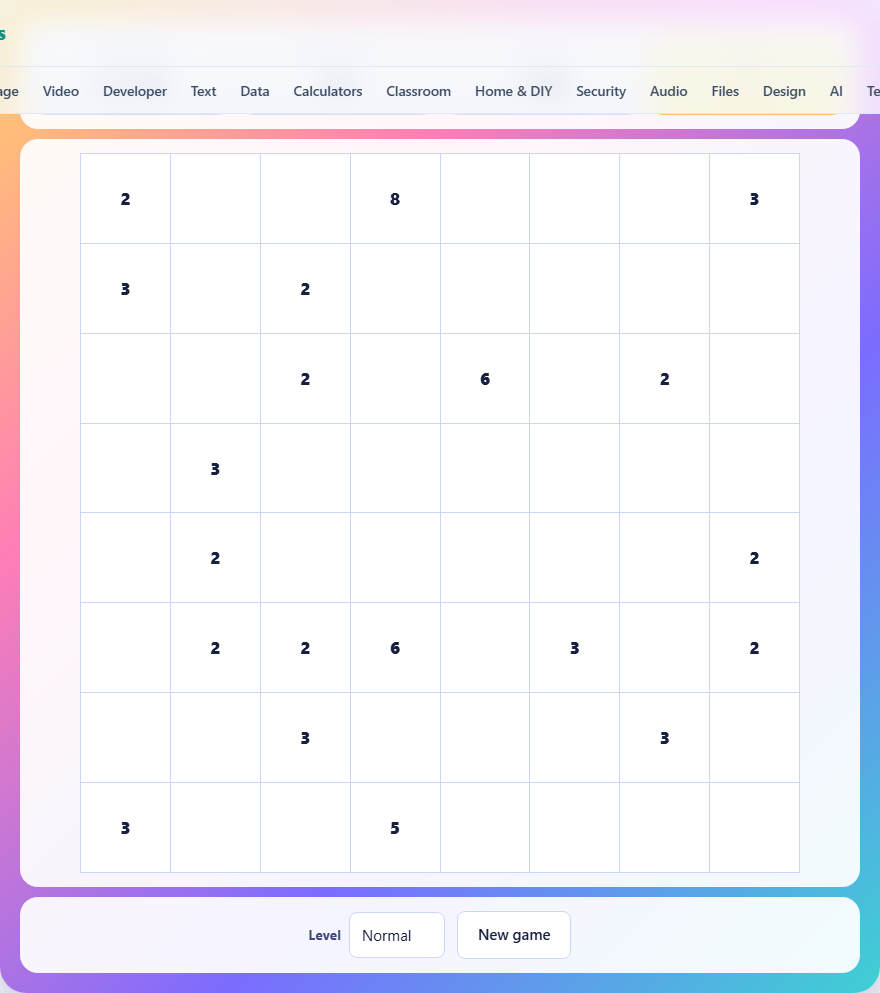
The rules in detail
You are given a grid with numbers scattered across it. Your job is to divide the entire grid into rectangles. Each rectangle must contain exactly one number, and that number must match the area of the rectangle it sits in. A square holding the number six must end up inside a rectangle that covers exactly six grid squares.
Rectangles can be any shape that is a valid rectangle. A six could be a one-by-six strip, a six-by-one strip, a two-by-three block, or a three-by-two block. The orientation does not matter as long as the total area matches the number.
No square may be left uncovered. No two rectangles may overlap. The puzzle is complete when every square on the grid belongs to exactly one rectangle and every rectangle satisfies the area rule.
Controls and how to draw
To place a rectangle, hold and drag from one corner to the opposite corner. A highlight follows your pointer to show the area you are about to claim. When you release, the rectangle is placed if it meets the rules: it holds exactly one number, and that number matches the area.
If the rectangle would overlap an existing one, or if it holds zero numbers or two or more, or if the area does not match, the drag is rejected and nothing changes.
To remove a rectangle, tap it. It disappears and the squares it covered become available again. There is no penalty for removing and replacing rectangles, so feel free to experiment.
Scoring and the timer
The stats bar shows three things: how many rectangles are placed out of the total needed, how many squares are still uncovered, and how much time is left on the clock.
Easy mode gives five minutes, normal gives seven and a half minutes, and hard gives ten minutes. Running out of time is the only way to lose. There is no move counter and no penalty for undoing placements.
The puzzle is won when every square is covered and every rectangle holds a matching number. Your completion is recorded in this browser on this device.
Starting with prime numbers
Numbers that are prime have far fewer possible rectangles than composite numbers. A five can only be a one-by-five or a five-by-one strip. A seven can only be a one-by-seven or a seven-by-one strip. There is no other way to factor them.
This means prime-numbered squares are the most constrained clues on the board. The strip must extend in one direction from the number, and the surrounding numbers and edges of the grid usually leave only one or two possible placements.
Start by finding every prime number on the board and working out where its strip can go. Placing these first often locks in large areas of the grid and reveals where the remaining rectangles must sit.
Corners and edges shrink the options
A number sitting in a corner of the grid can only grow in two directions. If it is a four, the options might be a one-by-four going right or a one-by-four going down, or a two-by-two block. The corner cuts the possibilities roughly in half compared to a number in the middle of the grid.
Edge numbers are nearly as constrained. They cannot extend past the edge, so one direction is blocked. After placing the corner and edge clues, the centre of the grid often falls into place because the remaining space is shaped in a way that fits only one arrangement.
This outside-in strategy mirrors how most experienced players solve the puzzle. Work the boundary first, then let the shrinking free space guide the rest.
Looking for orphan squares
An orphan square is one that can only be reached by a single rectangle. If every possible rectangle for every other number on the board would leave a particular square uncovered, then the one rectangle that does reach it must be the right one.
Orphan squares tend to appear in corners, at the edges of already-placed rectangles, and in narrow channels between two solved regions. Spotting them is a powerful technique because it gives you a forced placement without any guessing.
After placing a few rectangles, scan the remaining empty space for squares that only touch one possible number. These give free information and often trigger a chain of placements.
Dealing with composite numbers
Composite numbers like six, eight, and nine have many possible rectangle shapes. A six might be one by six, two by three, three by two, or six by one. An eight adds one by eight, two by four, four by two, and eight by one.
The trick is to delay placing composite numbers until their surroundings narrow the options. Once the primes and corner clues are in, the composite numbers usually have only one or two shapes that fit the remaining space.
If you find yourself guessing between two shapes for a composite number, look at what happens to the squares that each shape would leave behind. If one shape would strand an unreachable square or block another number from reaching its required area, that shape is wrong.
Common mistakes beginners make
The most common mistake is placing rectangles in the centre of the grid first. Centre numbers have the most freedom, so guessing there is likely to be wrong. Start at the edges and corners where the constraints are tightest.
Another mistake is forgetting that a rectangle cannot contain two numbers. A large six-by-one strip might look right for the number six, but if it also covers a three along its length, the placement is invalid. Always check that the rectangle holds only the one number it is built around.
A third mistake is ignoring the timer. On normal and hard modes, large grids take time to reason through. If you spend too long on one stubborn number, the clock runs out. When stuck, remove a nearby rectangle and try a different arrangement rather than staring.
- Start with prime numbers because they have the fewest possible shapes.
- Solve corners and edges before the centre.
- Check that every rectangle holds exactly one number before letting go.
- Scan for orphan squares after every placement.
- Do not guess in the centre of the grid when the boundaries are unsolved.
The three difficulty levels
Easy uses a six-by-six grid with areas up to six and a five-minute timer. The small grid means fewer numbers and shorter rectangles, so the solving process is quick. This is a good level for learning the drag and drop controls.
Normal raises the grid to eight by eight with areas up to eight and a seven-and-a-half-minute timer. The extra rows and columns open up more possible placements for each number, which makes reasoning harder.
Hard uses a ten-by-ten grid, areas up to nine, and a ten-minute timer. The board is large enough that you cannot hold the whole picture in your head. Systematic solving from the outside in becomes essential.
How the puzzles are generated
Each grid is built by starting with a full rectangle and cutting it into smaller rectangles at random until every piece is a reasonable size. A number equal to each piece's area is placed in a random square within that piece. This guarantees at least one solution exists.
A solver then counts the number of valid solutions. It works by trying the most constrained clue first, which is the same strategy a human player should use. Any grid with more than one solution is thrown away. What reaches you is always a puzzle with exactly one answer.
Everything runs on your device
The grid is generated and solved entirely inside your browser. No puzzle data is sent to a server, no account is needed, and your progress is not uploaded anywhere. Your best result is stored in local storage on this device only. Once the page finishes loading, the game works offline without a network connection.