
Setting every gear to its mark with clutches and turns
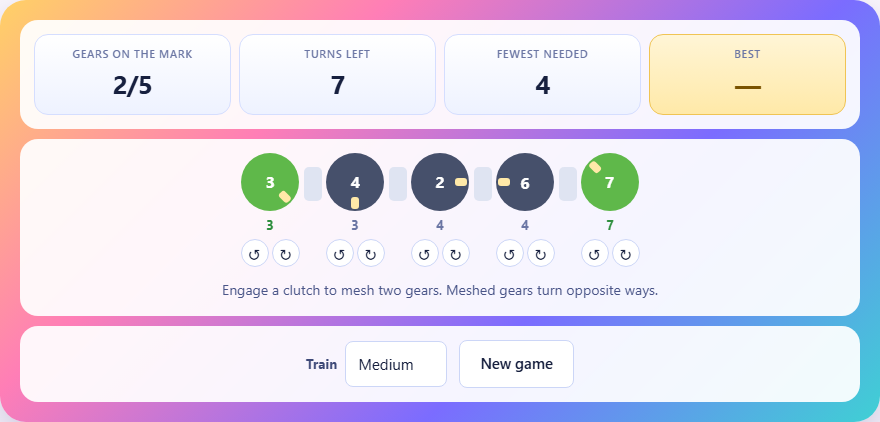
A row of gears sits on a rail, each one showing a number. Between every pair of neighbours is a clutch you can engage or free. Engage a clutch and two gears mesh, so turning one drives the other the opposite way. Set every gear to the number below it before your turns run out.
The rules explained
Each gear displays a number on a circular dial with a fixed number of teeth. Below each gear is a target number, its mark. Your goal is to set every gear so its displayed number matches the mark underneath it.
Between each pair of neighbouring gears is a clutch. Tapping a clutch toggles it between engaged and free. An engaged clutch meshes two gears together. When gears are meshed, turning one forces the other to turn the opposite way. If you turn one gear forward, a meshed neighbour goes backward.
A whole run of engaged clutches creates a train. Turn any gear in the train and every gear in that connected run turns together. The direction alternates along the chain: forward, backward, forward, backward. A gear with no engaged clutch on either side turns alone.
Controls and interactions
Below each gear are two arrow buttons. The left arrow turns the gear backward and the right arrow turns it forward. Each press counts as one turn from your budget.
Clutches appear as buttons between neighbouring gears. Engaged clutches are shown in gold. Tapping a clutch toggles it at no cost. You can engage and disengage clutches as many times as you want without spending any turns.
The dropdown labelled Train sets the puzzle size. Small gives four gears, medium gives five, and large gives six. Larger trains mean more gears to coordinate and a tighter budget relative to the difficulty.
Scoring and the turn budget
The stats bar shows three things: how many gears are currently on their mark, how many turns you have left, and the par, which is the fewest turns needed to solve the puzzle.
The budget is the par plus a small slack allowance. On a medium puzzle, the par might be four and the budget seven. You do not need to match the par to win, but you must finish before the budget runs out.
Your best score is the lowest number of turns used to complete a puzzle. Lower is better. The game saves your best on this device.
Thinking about direction and coupling
The core insight is that meshed gears turn opposite ways. If two neighbouring gears both need to move forward by the same amount, you cannot mesh them and fix both in one turn. You must turn them separately.
But if two neighbours need opposite adjustments, meshing them is powerful. One turn forward on the left gear sends the right gear backward. A single movement fixes both at once.
Before spending a turn, set up the clutches so the train moves the gears you want in the directions you need. Think of the coupling step as free planning time and the turn step as the expensive action.
Protecting gears already on their mark
Once a gear is on its mark, any further turning knocks it off again. The solution is to disengage the clutches on both sides of that gear so it sits outside the active train.
This is the most common source of frustration. You carefully set two gears, then turn a third to fix it, and the train pulls one of the finished gears along for the ride. Always check which gears are in the train before pressing a turn button.
On larger puzzles, isolating a solved gear in the middle of the row means splitting the train into two shorter sections. That is usually fine. Each section can be worked on separately, and as more gears are solved, the problem shrinks.
Counting the short way round
Gears wrap around. On a gear with eight teeth, the numbers run from zero to seven and then back to zero. If a gear shows five and the mark is two, you could turn it backward three steps or forward five steps. The short way around is three, so turn backward.
Always count in both directions before deciding which way to turn. The budget is tight enough that taking the long way around can cost the puzzle. A mistake of one or two extra turns might be the difference between winning and running out.
Working from the outside in
A gear at the end of the row has only one neighbour. Fixing it first is often safe because once it is set, you can free the clutch beside it and never disturb it again. End gears are the lowest-risk starting point on any board.
Start by fixing one end, then work inward. Each time you finish a gear, isolate it by freeing its clutch. The active problem gets shorter with every gear you solve. On a six-gear board, solving the first two ends leaves a four-gear problem in the middle.
The middle gears are the hardest because they sit between two neighbours. Both clutches matter. If the gear to the left needs turning one way and the gear to the right needs the other, the middle gear cannot be in a train with both at the same time. Plan the coupling carefully before spending a turn.
Common mistakes and how to avoid them
The biggest mistake is leaving all the clutches engaged and turning a gear without thinking. The whole row moves, and gears you already fixed get knocked off their marks. Before any turn, ask yourself which gears should be in the train and which should be isolated.
Another mistake is forgetting that the direction alternates along the train. If you engage three gears in a row and turn the left one forward, the middle one goes backward and the right one goes forward again. Players who expect all three to move the same way are surprised when the middle gear goes the wrong direction. Count the hops from the gear you are turning to make sure the alternation works in your favour.
A third mistake is spending turns before adjusting the clutches. Since coupling is free, there is never a reason to rush into a turn. Take the time to set up the train so each expensive turn moves as many gears as possible in the right directions.
- Free the clutches on both sides of any gear already on its mark.
- Count the short way around the dial before choosing a direction.
- Set up the coupling before every turn, not after.
- Work from the ends of the row toward the middle.
- Use a single turn to fix two neighbours when they need opposite adjustments.
The three difficulty levels
Small gives four gears with six teeth each and a par of three. The train is short and the wrapping range is narrow, so each gear needs at most a few turns. This is a good introduction to the coupling mechanic.
Medium raises the count to five gears with eight teeth and a par of four. The extra gear adds a layer of decision-making, and the larger number of teeth means wrapping matters more often.
Large gives six gears, eight teeth, and a par of five. With five clutches to manage and six gears that all interact, this level rewards careful planning. The slack in the budget is slightly more generous to compensate, but the puzzle is still tight enough that wasted turns are punished.
How each puzzle is built
Every puzzle starts from a solved state where all gears are on their marks. The generator then makes a known number of turns, re-coupling the clutches randomly before each one. Because every turn can be undone by turning the same gear in the other direction, the marks can always be reached again.
After scrambling, all clutches are freed so the coupling used during the scramble does not act as a free hint. The number of scramble turns becomes the par displayed on the board.
Everything stays on your device
The puzzle runs entirely inside your browser. No data is sent anywhere, there is no account to create, and your best score lives in local storage on this device only. Once the page has finished loading, it works without a network connection.