
Planning a walking week where every pair meets exactly once
Fifteen walkers go out in groups of three, five groups a day, seven days in the week. Every pair must walk together exactly once. The arithmetic is locked tight, and careless choices fail almost every time.
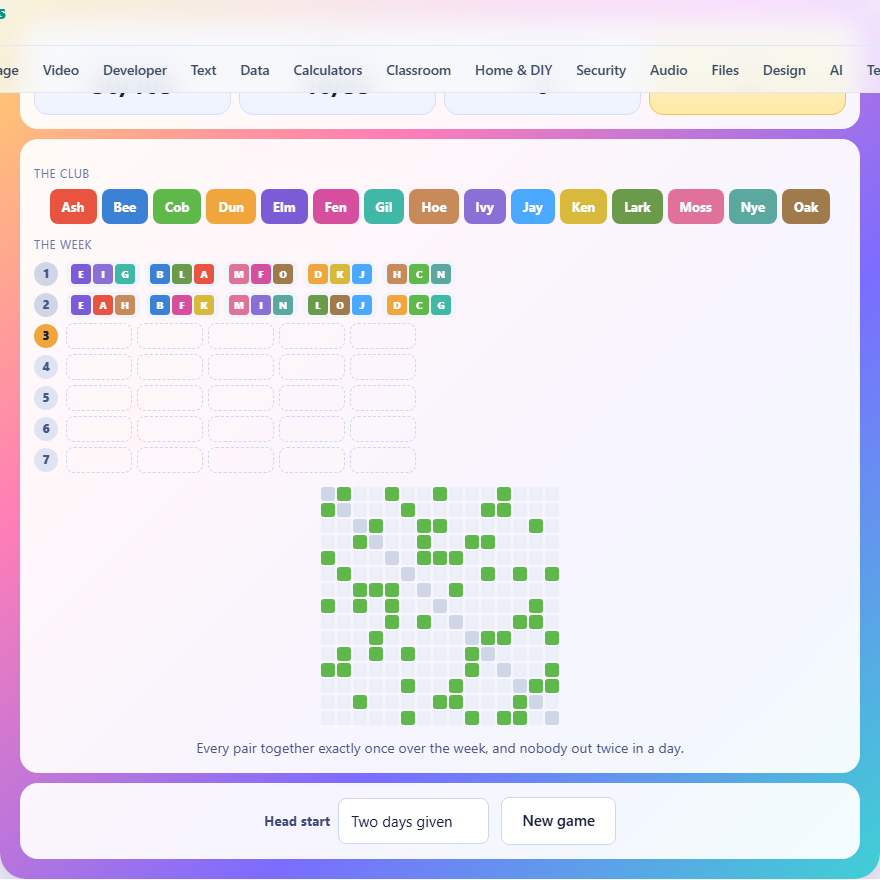
The rules in full
You have fifteen named walkers. Each day, all fifteen go out in five groups of three. The week lasts seven days, which means thirty-five groups in total. No pair of walkers may walk together more than once across the whole week, and every pair must walk together at least once.
Fifteen walkers produce one hundred and five distinct pairs. Each group of three covers exactly three pairs. Thirty-five groups times three pairs gives one hundred and five, so there is no room to spare. Every pair must be used and none may be repeated. The numbers leave nothing optional.
Tap three walkers to form a group on the day that is highlighted in orange. Once all fifteen walkers are placed into five groups, that day is complete and the next one opens. If you make a mistake, tap a group to break it apart and free its pairs for reuse.
Controls and how to interact
The walkers appear as coloured buttons at the top of the board. Tap any three who are not already assigned on the current day. When you pick the third, the group is placed if all three pairs are still unused. If a pair has already walked together, the board rejects the group and tells you which two have met before.
Below the week display sits a grid that tracks which pairs have walked. Green squares mark pairs already used. The diagonal is always filled because nobody walks with themselves. As the week fills up, the grid shows at a glance which walkers still have open companions.
A dropdown labelled Head start controls how many pre-filled days you receive. Four days given is the easiest setting, two days given is the default, and nothing given is hard mode where every day is yours to plan from scratch.
Scoring and what counts
The stats bar tracks three numbers. Pairs walked shows how many of the one hundred and five pairs have been covered. Groups set shows how many of the thirty-five total groups are in place. Groups made counts only the groups you created yourself, not the ones given to you at the start.
Your score is the number of groups you made. Lower is better, because fewer groups made means fewer mistakes and less rework. The game saves your best score on this device.
Why random play almost always fails
The page says it up front: played at random, the week could not be completed once in two thousand attempts. That is not an exaggeration. The problem is what happens at the end of each day.
As you fill a day, the walkers left over have fewer and fewer unused partners. If the last three on a day have all already walked together in previous days, there is no legal group to make. The day is stuck and you must undo work.
This failure rate means brute force does not work here. You need to think ahead, watch the constraint grid, and plan which walkers are grouped early in a day so the ones left at the end still have fresh pairs between them.
Watching the grid to plan ahead
The pair grid at the bottom is the most important tool on the board. Before picking your next group, scan it for walkers whose rows are almost full. A walker with twelve of fourteen squares already green has only two possible partners left. If those two have already walked together, that walker is impossible to place and something earlier must change.
Look for clusters of walkers who still share open pairs with each other. Three walkers who all have unused pairs between them form a natural group. Spotting these clusters early prevents dead ends on the final group of a day.
The grid also helps across days. A group made on day four narrows what is possible on days five, six, and seven. Watching the grid before placing a group tells you whether you are closing off future options.
Filling the first day freely
On the first day, every pair is fresh. Any five groups of three that cover all fifteen walkers will work. There is no wrong choice on day one by itself.
But the first day shapes everything that follows. Some arrangements of day one leave the remaining pairs spread evenly, while others create tight clusters that cause problems later. If you reach a dead end on day five or six, it may trace back to a first-day split that consumed pairs unevenly.
The easiest approach for day one is to spread the pairs as broadly as possible. Avoid grouping walkers who appear near each other in the list, because later days tend to need adjacent walkers to pair up and those opportunities should be kept open.
Dealing with stuck days
The board detects when a day can no longer be completed and warns you. When that happens, you must break up a group. Tap any existing group on the current day or on a previous day to dissolve it. The pairs it covered become available again.
Breaking a group from the current day is cheapest because it only affects today. Breaking one from an earlier day reopens more pairs but also means that day is no longer complete, and you will need to refill it.
When you hit a dead end, look for a group that shares a pair with the walkers who are stuck. Breaking that specific group often frees exactly the pair needed to make the current day work. Random undoing wastes time and raises your group count.
Common mistakes new players make
The first mistake is ignoring the grid. Players tap walkers whose names they remember and hope for the best. Without checking the grid, they create groups that burn pairs needed later and reach dead ends by day four.
The second mistake is always fixing the current day without looking back. Sometimes the best undo is on day three, not day six. A group that looked fine three days ago might be the one that blocked everything downstream.
The third mistake is restarting too often. The puzzle has many solutions, and a dead end on one day rarely means the whole week is ruined. Usually a single group needs to be swapped out. Patience with the undo button beats starting over.
- Check the grid before every group, not after.
- Count how many open pairs each remaining walker has before placing them.
- Use the undo on earlier days when the current day cannot be fixed locally.
- On hard mode, plan the first day carefully instead of placing groups at random.
The three difficulty levels
Four days given hands you most of the week already arranged. You only need to fill the last three days, which is a gentle introduction to the constraint. Two days given is the default and a fair challenge. The first two days are done, leaving five days of work and plenty of room for things to go wrong.
Nothing given is the hardest setting. Every day from first to last is yours. The first day is still easy by itself, but the decisions you make on it ripple all the way through to the seventh day. This is where the puzzle truly earns its reputation.
The mathematics behind the puzzle
The game is based on a question posed in 1850 about how fifteen people could walk in rows of three over seven days so that no pair ever repeated. This question opened a field of study around balanced arrangements.
An arrangement where every pair appears in exactly one group of three is called a triple system. When those groups can be sorted into days so nobody appears twice on the same day, the arrangement is called a resolvable triple system. The condition for such a system to exist is that the number of participants leaves a remainder of three when divided by six.
Nine walkers also meet this condition, but with nine the puzzle is trivially easy. Every random attempt at nine succeeds. Fifteen is the smallest number where the puzzle is genuinely hard, which is why it became famous.
Everything runs in your browser
The puzzle is generated and played entirely on your device. No data is sent to any server. There is no account, no login, and no tracking of your play. Your best score is stored in this browser only and will not follow you to a different device or browser. Once the page has loaded, it works without an internet connection.