
How to win at the Quorum seeding puzzle
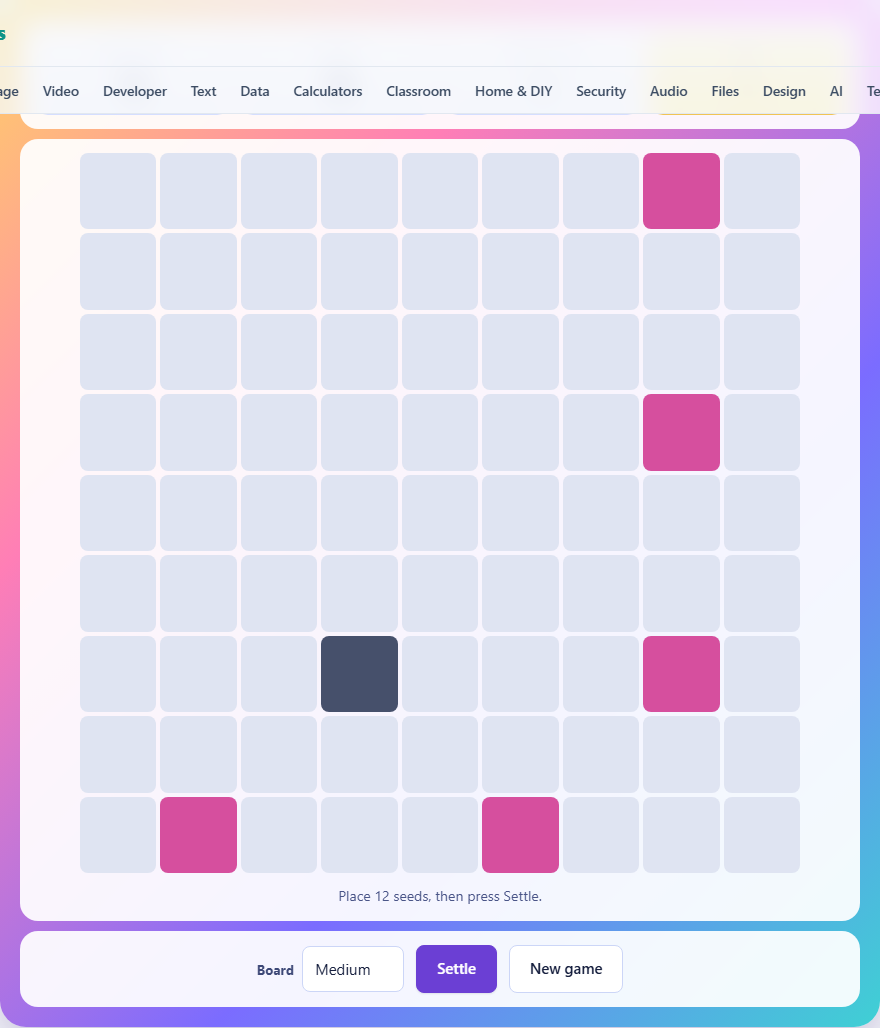
Quorum is a seeding puzzle built on majority rule. You are given a grid of cells, some of which hold rival seeds and some of which are walls. You get a limited number of seeds of your own colour to place anywhere on the empty cells. When you press Settle, every cell looks at itself and its four neighbours and adopts whichever colour holds a strict majority. All cells update at once, generation after generation, until the board stops changing. Your goal is to place your seeds so that when the board settles, at least as many cells show your colour as the target demands. This guide covers the rules, the controls, the strategy, and the common traps.
Rules in full
Each cell on the grid is one of four things: empty, your colour, the rival colour, or a wall. On every generation the board updates all cells at once. Each cell counts itself and its four orthogonal neighbours. Walls are not counted at all. If your colour holds a strict majority of that little group, the cell becomes yours. If the rival colour holds a strict majority, the cell becomes the rival's. A tie changes nothing. Because walls are excluded from the count, a cell next to a wall has a smaller group, and a smaller group is easier to tip.
All cells are decided from the previous state of the board, not from the current generation in progress. This means the order in which the cells are calculated does not matter. The board runs for up to forty generations or until no cell changes, whichever comes first. At these grid sizes it always settles well before the cap.
Controls and how to play
Tap any empty cell to place one of your seeds there. Tap a seeded cell again to pick it back up. You cannot seed a wall or a rival cell. The stats bar shows how many seeds you have left, the target you need to reach, and, after settling, how many cells ended up as yours.
When you are happy with your placement, press the Settle button. The board animates generation by generation so you can watch where your colour spreads and where it dies out. If your final count meets or exceeds the target, you win. If it falls short, a message tells you how many cells you got versus how many you needed. Press New game for a fresh board, or review where your fronts stalled and try a different placement on the same board.
The Board selector offers three sizes. Small is a seven by seven grid with eight seeds and three rival seeds. Medium is nine by nine with twelve seeds and five rivals. Large is eleven by eleven with sixteen seeds and eight rivals. Larger boards have more walls and more rival seeds, but you also get more of your own seeds to work with.
Why clumps do not spread
The most important lesson in Quorum is that placing seeds next to each other is usually wrong. Four of your seeds in a two by two block are already stable, because each one sees at least two of its own kind in its neighbourhood. But none of them is tipping an outside cell past the halfway mark, because the cells around the block have only one of your seeds as a neighbour and that is not a majority of anything.
What actually spreads is a seed placed so that a neighbouring empty cell gets pushed past half. If that empty cell has three neighbours in total and two of them are your colour, it flips. Once it flips, it becomes a neighbour to the next cell over, which may now have enough support to flip as well. This cascade is how a handful of well-placed seeds can conquer a large section of the board.
Using walls and corners
A cell at the corner of the board has only two neighbours plus itself, so a group of three. One seed on that corner makes two out of three, which is a majority. The corner cell flips to your colour without needing any help. Edge cells have three neighbours, so a group of four. Two of your colour out of four is a tie, not a majority, but if one of the neighbours is a wall, the group shrinks to three and two out of three wins.
Walls are your best friends. A cell next to a wall has a smaller pool of voters, so it takes fewer seeds to win the majority. Look for corridors between walls and seed the entrance. A single seed at the mouth of a narrow passage can flip every cell along it, generation after generation, because the walls keep the group small enough for one seed to matter.
Spacing seeds for maximum spread
Two seeds placed with one empty cell between them are stronger than two seeds placed side by side. The cell in the gap sees both seeds as neighbours, and if the total group is five, two out of five is not enough on its own. But if one of the gap cell's other neighbours is a wall or already your colour, the count tips. Once the gap cell flips, it reinforces the next cell in line.
A good rule of thumb is to space your seeds about two cells apart in areas where you want to spread, and closer together only when you need to defend against a nearby rival seed. Wide spacing maximises the number of cells each seed can influence, while tight spacing wastes influence on cells that are already safe.
Cutting off the rival
Rival seeds spread by the same rules yours do. A rival seed in open ground with no competition will take over a large area, just as yours would. The most efficient counter is not to overwhelm the rival with more seeds in the same area but to place a single seed that breaks the line between the rival and the empty space it is trying to reach.
Think of it as blocking a chain reaction. If the rival seed at position five needs the cell at position six to flip before it can reach position seven, putting one of your seeds at position six stops the whole cascade. That one defensive seed is often worth more than two offensive seeds placed far from any rival.
Where the target comes from
When a new board is generated, the game runs a search to find a good placement of your seeds. It tries many random placements, settles the board for each one, and keeps the best score it finds. It then refines that placement by moving individual seeds to better positions. The target is set a little below the best score the search managed, so you are never asked to reproduce one exact arrangement.
This means every target on offer is known to be achievable. The search has already seen someone make that score, so the puzzle is always fair. The target is a floor, not a ceiling. You can exceed it if your placement is better than what the search found.
Common mistakes beginners make
The most common mistake is clustering all seeds in one area. This creates a safe block that never grows. Instead, spread your seeds across the board, placing each one where it can tip at least one neighbour.
Another error is ignoring rival seeds entirely. A rival seed left uncontested in a rich area will grab far more cells than you can recover by placing your seeds somewhere else. Always check where the rivals are and whether they are in a position to spread. If a rival seed sits next to a corridor of empty cells, one of your seeds near the entrance of that corridor is a high-value play.
Beginners also tend to avoid the edges and corners, thinking the centre is more valuable. In fact, edges and corners are where majority rule is cheapest, because the groups are smaller. A seed on the edge of the board can flip cells that a seed in the middle never could.
Privacy and how the puzzle runs
The entire puzzle runs inside your browser. No data is sent to a server, there is no account, and your results are stored in local storage on this device only. Nothing is uploaded at any point. Once the page has loaded, the game works fully offline.