
How to win at Quarry against the computer
Quarry is a two-player strategy game about structural thinking. You and the computer take turns removing blocks from a stone face, but every block you take must leave the rest of the face still standing. A block is supported when it sits on the floor or rests on at least one of the three blocks directly beneath it. Pull the wrong one and the whole column above locks up. The player who runs out of legal moves loses. This guide covers the full rules, the controls, and the thinking that turns a lucky guess into a reliable win.
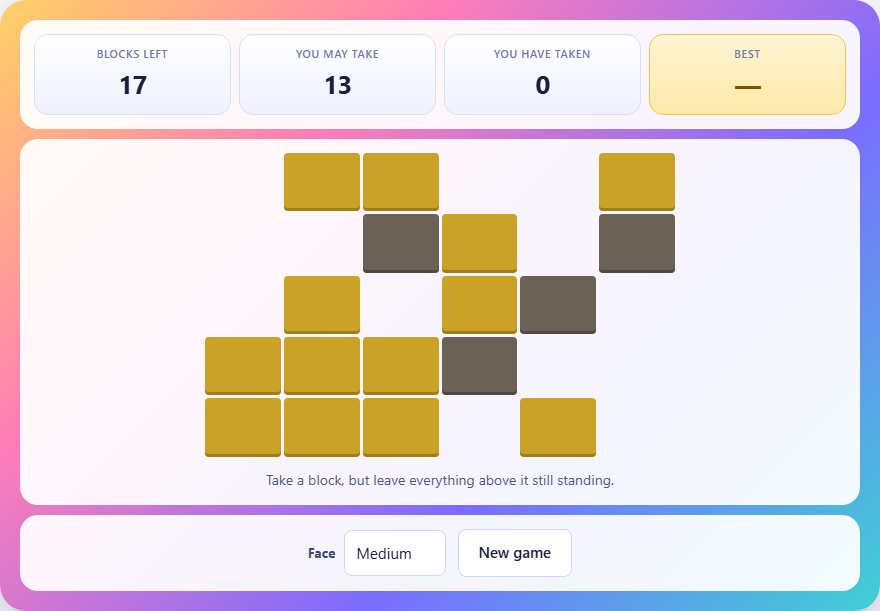
Rules in full
The game begins with a randomly built face of stone blocks arranged in a grid. The face is generated from the floor upward, so every block already has something holding it when the game starts. You and the computer alternate turns, and on each turn the active player must remove exactly one block. A block may only be removed if, after it is gone, every remaining block is still supported. A block counts as supported when it rests on the floor row or when at least one of the three cells directly beneath it still contains a block. Those three cells are the one straight below and the two diagonal neighbours below left and below right.
There is no score in the traditional sense. Nobody collects points for blocks taken. The game ends when one side has no legal moves at all, meaning every remaining block is holding something up. That player loses. Because the face only ever gets smaller, somebody must eventually run out of moves, so the game always ends and can never be drawn.
Understanding the colours
The board does the legality work for you. Blocks that can be safely removed are shown in gold, and blocks that are currently holding something up are shown in grey. After every move the entire face is recalculated, and blocks often change colour as a result. A block that was gold a moment ago can turn grey when a neighbouring block is removed, because the removal may have left something above relying on it as its only remaining support.
This recalculation is what makes the game interesting. Removing one gold block from the middle of a row can turn several other blocks grey at once, because each of those blocks was leaning partly on the one you just took. Reading the gold and grey pattern before and after a move is the core skill.
Controls and how to play
Tap any gold block to remove it. Grey blocks cannot be tapped because they would bring something down. The computer responds almost immediately after your turn. A stats bar shows the total blocks remaining, the number of legal moves available to you, and how many blocks you have taken so far.
The Face selector offers three sizes. Small gives a five wide by four tall grid with fewer blocks, which is good for learning the mechanics. Medium raises the grid to six by five and is the default. Large uses a seven by five grid where the faces are denser and the consequences of each move reach further. Press New game at any time to generate a fresh face at the selected size.
Counting moves and the odd-even principle
The single most powerful idea in Quarry is parity. Since you move first and moves alternate, you want the total number of legal moves remaining to be odd after your turn. If it is odd, the computer takes one and leaves you with an even number, and eventually the computer is the one left with zero. If you leave an even number after your turn, the arithmetic works against you.
This is easier said than done, because removing one block can change the count of legal moves by more than one. Taking a block from the middle of a structure might make three other blocks load-bearing at once, which drops the legal count by four. The skill is reading which blocks cost the fewest extra legal moves when they disappear and which ones cause a cascade of grey.
Strategic use of the top row
Nothing rests on the top row, so every block there is always free to take. These are your safe moves when you need to pass the turn without changing the structure. If the legal count is already in your favour, taking a top-row block preserves that advantage because it removes exactly one legal move and turns nothing else grey.
But do not burn through the top row too early. Every safe move you spend is one fewer you have later when the face tightens. If the computer is about to run out of options and you still have two top-row blocks in reserve, those blocks are insurance. Save them for the turns where taking anything from the middle would wreck your position.
Locking columns from the bottom
One of the strongest moves in Quarry is pulling the base out from under a tall stack. When a floor-level block supports a column of three or four blocks above it, removing the base makes every block in that column load-bearing at once, because each one is now the sole support for the next. This can remove several legal moves in a single turn.
Use this deliberately. If the legal count is even and you need to make it odd, look for a base block whose removal locks an even number of blocks above it. Removing the base plus the base itself drops the legal count by an odd total, which flips the parity in your favour. Conversely, if the count is already odd, do not remove a base that locks an even number, because the total drop would be odd and you would flip parity against yourself.
How the computer thinks
The computer uses a search technique called alpha-beta pruning with a transposition table that remembers positions it has already evaluated. When the search cannot reach the end of the game, it estimates by checking whether the number of legal moves remaining is odd or even, which is exactly the parity principle described above. Near the end of the game, when few blocks remain, the search reaches all the way to the finish and the computer plays without error.
On the Small face the computer searches deeper and is very hard to beat. On Medium and Large, the search depth is lower and the computer relies more on its estimate, which means mistakes are possible. If you want to practise the parity ideas, start on Large where the computer is weakest, and move to smaller faces as your reading improves.
Common beginner mistakes
The most common mistake is removing gold blocks at random without thinking about what turns grey. Every move changes the face, and a careless removal in the middle can lock up half the remaining blocks. Before you tap, look at what sits directly above the block and whether those blocks have any other support. If the block you are about to take is the last support for something above, that something turns grey, and so does anything resting solely on it.
Another frequent error is ignoring parity entirely and playing for material. It does not matter how many blocks you have taken. What matters is whether the count of available moves is odd or even after your turn. A player who takes twenty blocks and leaves the computer with zero moves wins just as cleanly as one who takes five.
Beginners also tend to avoid the edges and corners, treating central blocks as more valuable. In fact, corner and edge blocks often have fewer things resting on them and are excellent safe moves. A block on the far left of a row can only support things above and to its right, so removing it usually affects fewer neighbours than removing something in the centre. Do not overlook these quieter parts of the face.
Privacy and how the game runs
The entire game runs inside your browser. No moves are sent to a server, no data leaves your device, and there is no account to create. Your results are saved in your browser's local storage on this device only and will not follow you to another machine. Once the page has finished loading, the game works offline without any change.