
How to clear the pyramid in Pyramid Solitaire
Pyramid Solitaire is a card game where twenty-eight cards are dealt face up in the shape of a pyramid, seven rows deep. You clear the pyramid by removing cards in pairs that add up to thirteen. Kings are worth thirteen on their own and go straight off. It sounds like simple arithmetic, but the layout means most cards are buried under others, and taking the wrong pair can block the card you needed next. This guide covers the full rules, the controls, and the thinking that helps you clear the table more often.
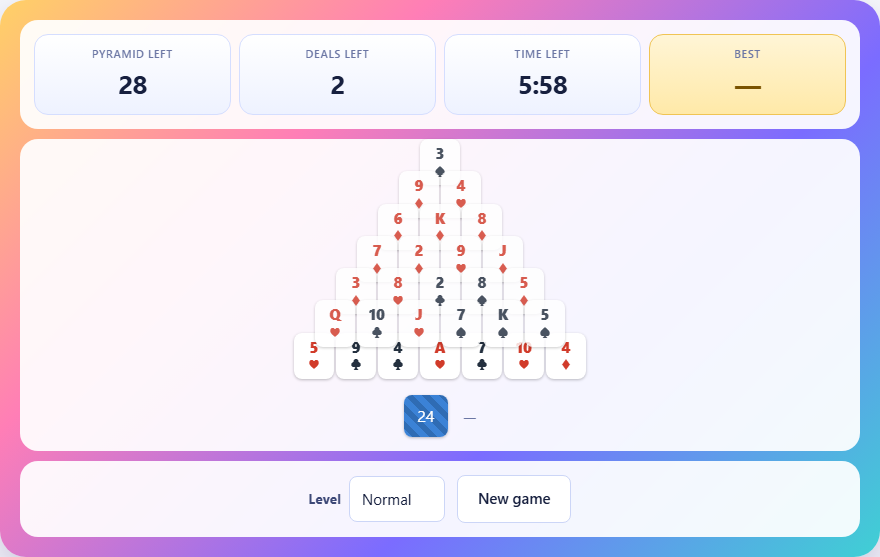
The layout and card values
The pyramid has seven rows. The top row holds one card, the second row holds two, the third holds three, and so on down to seven cards in the bottom row, making twenty-eight cards in total. Each card in the upper rows is partially covered by two cards in the row below it. A card can only be removed when nothing is resting on top of it, which means the entire bottom row is always fully exposed at the start, but the single card at the very top is buried under six layers of other cards and can only be reached after clearing a path down to it.
Card values are straightforward. Aces count as one, numbered cards carry their face value, jacks are eleven, queens are twelve, and kings are thirteen. The six pairs that add up to thirteen are ace and queen, two and jack, three and ten, four and nine, five and eight, and six and seven. Kings need no partner and are removed on their own because they already equal thirteen by themselves. Suits do not matter at all. A red queen pairs with a black ace just as easily as with a red one.
The stock pile and waste pile
The twenty-four cards not in the pyramid form the stock pile. Tap the stock to flip one card face up onto the waste pile. The card on top of the waste pile is available to pair with any exposed card in the pyramid. If you flip a king onto the waste, it is removed on its own. When the stock runs out, you can redeal by sweeping the waste pile back into the stock.
The number of redeals you get depends on the difficulty level. Easy allows three passes through the stock, Normal allows two, and Hard gives you only one. Each pass means one complete cycle through all the remaining stock cards. Once you have used all your passes and the stock is empty, no new cards will appear. At that point you are limited to whatever pairs you can find among the exposed pyramid cards and the current top of the waste pile, and if no valid pair exists the game ends.
Controls and difficulty levels
Tap any exposed card in the pyramid to select it. A highlighted outline shows it is selected. Tap a second exposed card that pairs with the first to remove both. If you tap a king, it goes off by itself with no second tap needed. Tap the stock pile to flip a new card. Tap the waste pile to select the top card and then pair it with a pyramid card.
Easy gives you three redeals and eight minutes on the clock. Normal gives two redeals and six minutes. Hard gives one redeal and five minutes, which leaves almost no room for hesitation. Changing the level and pressing New game deals a fresh pyramid. The clock starts the moment the cards are dealt, and the game ends either when you clear the pyramid, run out of time, or run out of moves with cards still remaining. The game will detect when no valid move exists and end the round for you, so you never have to wonder whether you are stuck or simply missing something.
Strategy: which pair to take first
When you have a choice between two pairs, take the one that uncovers more of the pyramid. Every card in the upper rows is covered by two cards below it, and removing a card from the bottom row uncovers one or two cards in the row above. Look at what sits underneath your candidates. If one pair frees a king, that pair is almost always better because the freed king will go off immediately, uncovering even more cards.
Think about the pyramid in terms of width, not depth. Clearing a horizontal strip across the bottom row opens the most new cards. Digging a narrow hole through one side of the pyramid frees fewer cards overall, because each upper card needs both of its covering cards gone, not just one. Spread your removals across the full width of the bottom row whenever possible.
When to use the stock and when to hold
Flipping through the stock is free, but every card you pass buries the one before it. With a limited number of redeals, a card that disappears under the next flip might not come back for a long time. Before you tap the stock, scan the exposed pyramid for any available pairs. Remove everything you can from the pyramid first, then flip the stock only when you are stuck.
Pay attention to which cards you have already seen in the waste pile. If you know a queen is sitting somewhere deep in the waste and you have an ace exposed in the pyramid, flipping through the stock is worth it to find that queen. But if you are on your last pass and the queen is near the bottom, it might not surface in time. Counting the passes you have left is just as important as counting the cards.
Common mistakes beginners make
The most costly mistake is ignoring kings. A king is a free removal. It costs no partner, it opens the cards underneath, and there is never a reason to leave it sitting on the pyramid. Take kings the instant they are exposed. Waiting gains nothing and risks running out of time with a perfectly good removal still on the table.
Another frequent error is pairing cards without looking at what they cover. Suppose you see two sevens in the bottom row and only one six. Pairing the seven that sits beside the six might be worse than pairing the other seven, because the six will need a seven later when it becomes available to pair. Think one step ahead before each removal.
Beginners also use the waste pile too eagerly. The top of the waste is always available to pair, but once you take it, the card beneath it may not be helpful at all. Sometimes it is better to leave a useful waste card sitting on top and work the pyramid instead, saving the waste card for the exact moment you need it. Patience with the waste pile is a skill that improves your win rate noticeably.
Late game tactics and reading the dead end
As the pyramid shrinks, each removal matters more. With only a few cards left, scan every exposed card and check whether its partner exists somewhere reachable. If a card's partner is buried under other pyramid cards that cannot be removed, the game might already be lost. Recognising a dead position early saves you time so you can start a fresh deal.
In the late game, the waste pile is often your lifeline. A single card on top of the waste that pairs with an exposed pyramid card can open up a chain of removals that clears several rows at once. Keep track of which cards went into the waste during earlier passes. If you know the card you need is one or two flips away in the stock, it is worth burning through to reach it rather than staring at a locked pyramid. The deal counter at the top reminds you how many redeals remain, so factor that into every decision about whether to cycle through the stock again.
Privacy and how the game runs
The entire game runs inside your browser. No card data is sent to a server, there is no account, and nothing is uploaded at any point. Your best score is stored in your browser's local storage on this device only, so it will not follow you to a different computer. Once the page has finished loading, you can go offline and the game will keep working without any change.