
How to solve every light puzzle in Prism Split
Prism Split is a puzzle about light and mirrors. A white beam leaves an emitter on the edge of the board, bounces off angled mirrors, and hits a prism that splits it into red and blue. Each colour has its own target on the rim, and both must be lit at the same time. Your only move is to flip mirrors between two diagonal orientations, and you only get a limited number of flips. This guide explains how the board works, how to trace the beam efficiently, and how to solve each level without wasting moves.
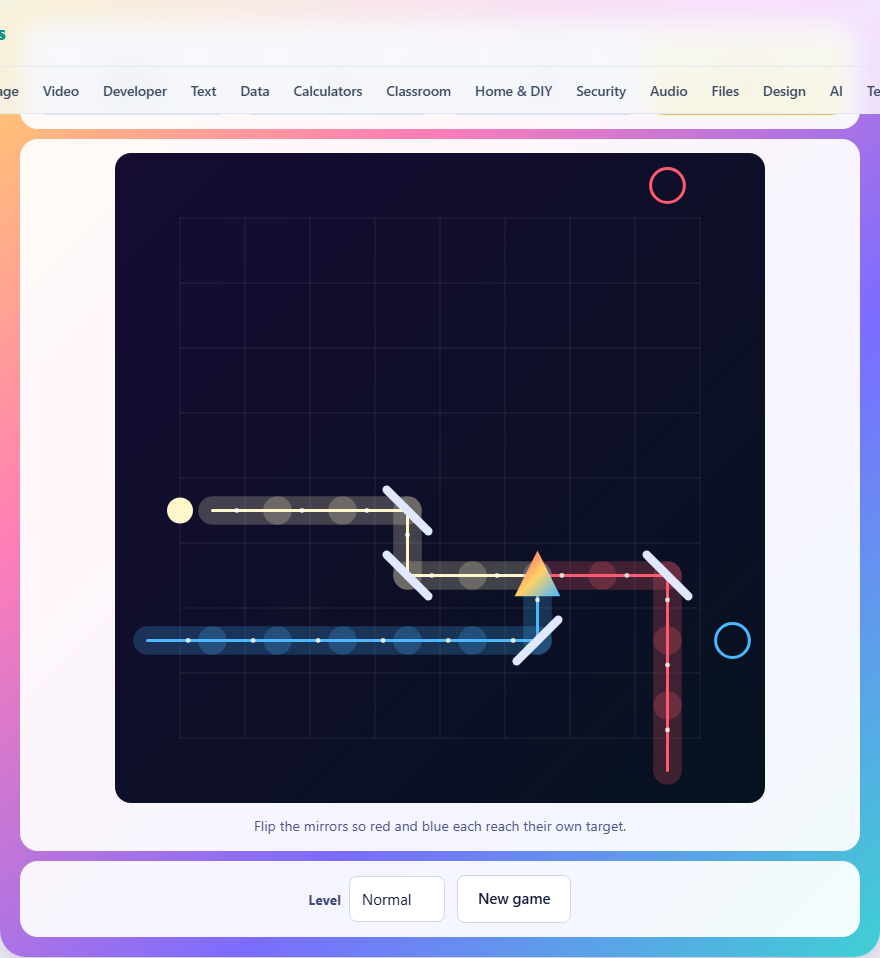
How the beam, mirrors, and prism work
The board is a grid of cells. A white beam enters from the emitter, which sits on the left edge. The beam travels in a straight line until it hits something. Mirrors are angled diagonals that redirect the beam. Each mirror sits in one of two orientations: a forward slash that sends a beam arriving from the left upward, or a backslash that sends it downward. Flipping a mirror swaps it between these two angles.
Somewhere on the board sits a prism, drawn as a small coloured triangle with a gradient from red through yellow to blue. When the white beam reaches the prism, it splits into two: red carries straight on in the same direction, and blue turns off at a right angle to the side. After the split, each coloured beam continues through the grid, bouncing off mirrors just like the white beam did. The prism only acts on white light. If a red or blue beam happens to pass through the prism cell again, it goes straight through without any further change. This distinction is important because it means a coloured beam cannot be split a second time.
Targets and the win condition
Two coloured rings sit on the edges of the board, one red and one blue. Each ring marks a target cell. To win, the red beam must reach the red target and the blue beam must reach the blue target, both at the same time. Lighting only one target is not enough. The stats panel shows how many targets are currently lit, so you can track your progress as you flip mirrors.
Every board is guaranteed to be solvable. The game builds each level by routing the beam along a valid path first, placing mirrors wherever it needs to turn, and then scrambling some of those mirrors. Because every mirror is a simple two-state toggle, undoing the scramble is always possible. You are given more flips than the scramble used, so there are always enough moves to reach the solution.
Controls and difficulty levels
On a desktop, click a mirror to flip it. On a phone or tablet, tap the mirror. That is the only interaction available to you. You cannot move mirrors, add new ones, rotate the prism, or change the position of the emitter or targets. Flipping is the single action you have, and every flip counts against your limit regardless of whether it helps the beam reach a target or sends it further off course.
Easy uses a seven by seven grid with one mirror before the prism and one after each colour, plus three spare flips beyond the minimum needed. Normal is eight by eight with two mirrors before the prism and one after each colour, and two spare flips. Hard goes to nine by nine with two mirrors before the prism and two after each colour, and just two spare flips. Changing the level and pressing New game generates a fresh board with a completely new layout.
Tracing the beam before you flip
The most important habit is to follow the beam with your eyes before you touch anything. Start at the emitter on the left side and trace the white beam through the grid, cell by cell. Watch where it hits each mirror and note the direction it takes after each reflection. Find the first mirror that sends the beam in the wrong direction. That is usually the mirror to flip first, and correcting it often fixes several downstream problems at once.
The beam is drawn on the board in real time, with small sparks running along its path to make the direction clear. White segments run from the emitter to the prism, and coloured segments run from the prism to wherever they end up. If a beam runs off the edge of the board without hitting a target, the path simply stops. Reading these paths carefully before you act saves you from wasting flips on mirrors that are already correct.
Fix the earliest mistake first
Mirrors later in the beam's path often look wrong only because the beam is arriving from the wrong side. When an early mirror is flipped incorrectly, it sends the beam off course, and every mirror downstream receives light from an unexpected direction. Correcting the first wrong mirror can cause several downstream ones to suddenly work. This cascade effect means you should always fix the earliest error before looking further along the path.
A practical approach is to start at the emitter and walk forward along the beam one mirror at a time. At each mirror, ask whether the beam is turning in a direction that makes progress toward the prism or toward a target. If it is heading away from where it needs to go, flip that mirror and watch the beam redraw. Often a single early correction clears up most of the board.
Common mistakes that waste flips
The most expensive mistake is flipping a mirror that is not on the beam's path. Some mirrors sit in cells the beam never visits. Flipping one of those does nothing except cost you a flip. Before you tap, confirm that the mirror you are about to flip actually has the beam passing through it. If no coloured line runs through that cell, leave it alone.
Another frequent error is flipping a mirror that is already correct. This happens when you work backwards from the target instead of forwards from the emitter. A mirror might look wrong from the target's perspective but be perfectly fine for the beam coming from the emitter. Always trace forward to avoid this confusion.
Players also sometimes create loops by accident. Two mirrors facing each other can trap the beam in an endless bounce between them. The game cuts the beam off after a couple of hundred steps to prevent the page from freezing, but a looping beam will never reach its target. If the beam suddenly vanishes or stops partway through the grid without reaching an edge, check for a pair of mirrors bouncing light back and forth and flip one of them to break the cycle.
Working with the two colours after the split
After the prism, you have two independent beams to guide. Red continues in the same direction the white beam was travelling, and blue turns ninety degrees. Each colour bounces off mirrors the same way white does, but neither colour is affected by the prism again. If a coloured beam passes through the prism cell, it simply continues straight through.
When fixing the post-prism path, treat each colour separately. Follow the red beam from the prism to the edge and fix any wrong mirrors along the way. Then do the same for the blue beam. Because the two paths diverge at the prism and share no mirrors after that point, fixing one colour never breaks the other. Before the prism, though, every mirror affects both colours, since the beam is still white and has not split yet. Changes to mirrors in the pre-prism section require more care, because getting the white beam to the prism correctly is a requirement for both colours to have any chance of reaching their targets.
Privacy and how the game runs
The entire game runs inside your browser. The grid, the mirror layout, and the beam tracing are all computed on your device. No puzzle data is sent to a server, there is no account, and nothing is uploaded at any point. Your best score is stored in your browser's local storage on this device only, so it will not follow you to a different computer. Once the page has finished loading, you can go offline and the game will keep working without any change.