
How to solve the Egyptian fraction puzzle in Portion
Portion is a puzzle about sharing. A target amount is shown at the top of the board, and you have to make it from pieces that are each a single share: a half, a third, a fifth, a twelfth. No two pieces can be the same size. This is not an invented restriction. It is how Egyptian scribes wrote fractions over three thousand years ago, and it turns a simple arithmetic question into a genuine puzzle. This guide explains the rules, walks through the controls, and teaches you how to find short solutions instead of getting stranded.
The rules of Egyptian fractions
Every piece you pick must be a unit fraction, meaning one over some whole number. You can take a half, a third, a seventh, or a twentieth, but never two thirds or three eighths. On top of that, each size may be used only once. You cannot take two halves, or a third and another third. The pieces must all be different sizes, and they must all be single shares. This is the Egyptian rule, named after the scribes who wrote fractions this way on papyrus over three thousand years ago.
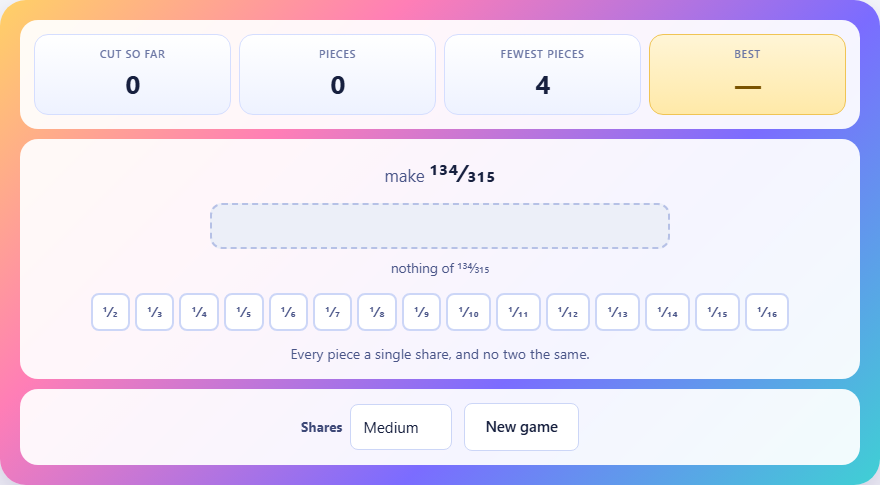
The board shows a target fraction at the top and a row of available pieces below. Each piece is shown as a chip labelled with its fraction. Tap a chip to add that piece. The bar fills up as you go, showing how close you are to the target. Your pieces must add up to the target exactly. Close is not a win, and going over is not allowed. The board will refuse any piece that would push the total past the target.
Controls and how to undo a choice
Tap a chip to select it. The chip lights up, and the fraction bar fills to show your running total. If you change your mind, tap the same chip again to remove it. Nothing is committed until you hit the exact target. You can freely add and remove pieces until you find the combination that works.
The Shares selector offers three sizes. Small boards use pieces up to one twelfth, which keeps the arithmetic simple and the solutions short. Medium boards go up to one sixteenth, and Large boards reach one twentieth. Larger ranges give you more pieces to choose from but also more ways to go wrong, because the additional small fractions create many more possible combinations to explore. The par number shown in the stats panel tells you the fewest pieces needed to solve this particular board. You do not have to match par to win, but using far more pieces than par suggests you took a wrong path.
Why the greedy method fails
There is a well-known method for building Egyptian fractions: always take the largest single share that still fits, then repeat. This greedy approach always works and always finishes, which is a fact proven centuries ago. The problem is that it does not stay small. On certain targets it produces five or six pieces where three would do, and the final piece can be vanishingly tiny.
On the boards in this game, the greedy method is nearly useless. The available pieces stop at a fixed size. When the greedy approach asks for a piece of one over several hundred, that piece simply does not exist on the board. You are stranded with a remainder that nothing on offer can fill. This is why the puzzle is a puzzle rather than a calculation: you have to choose pieces that leave a remainder the board can actually handle, not just the biggest piece that fits.
The splitting trick
The most useful technique is knowing how to split a unit fraction into two smaller ones. A half is the same as a third plus a sixth. A third is the same as a quarter plus a twelfth. A fifth is a sixth plus a thirtieth. The general rule is that one over n equals one over n plus one, plus one over n times n plus one. This identity is the source of most short solutions.
When you look at the target and recognise a unit fraction lurking inside it, try splitting that fraction into two pieces that are both on the board. For example, if the target includes a half and you need to avoid using the half chip directly, take a third and a sixth instead. Similarly, a quarter splits into a fifth and a twentieth, and a sixth splits into a seventh and a forty-second, though that last one is rarely on the board. This flexibility lets you route around pieces that are already taken or that do not fit the remaining balance. Memorising the three or four most common splits is enough to solve most boards.
Reading the denominator for clues
The denominator of the target fraction tells you a great deal about which pieces will be involved. If the target is something over twelve, then twelfths are almost certainly part of the answer. If it is something over thirty, then fifths, sixths, tenths, and fifteenths are all worth considering because they divide evenly into thirty. Pieces whose denominators share factors with the target denominator are the ones that combine cleanly.
This observation turns a guessing game into a structured search. Instead of trying chips at random, look at the bottom number of the target and ask which chips on the board divide evenly into it. Start with those, and the fractions will add neatly without producing remainders that need awkwardly small pieces to fill. On the Medium and Large boards where many chips are available, this filter alone can narrow your candidates from a dozen possibilities down to three or four worth testing.
Common mistakes and how to avoid them
The biggest mistake is grabbing the largest chip first. It feels natural to start with the half or the third, but that often leaves a remainder so small that only a chip outside the available range can fill it. Start with the second or third largest chip instead. Leaving a slightly bigger remainder gives you far more options for closing the gap.
Another mistake is ignoring the par count. If par is three and you have already used four pieces without solving the puzzle, something has gone wrong. Undo a piece and try a different path. The par number is not just a challenge target. It tells you the minimum depth of the search, which is useful information when you are deciding whether to keep adding or start over.
New players also forget that tapping a chip a second time removes it. There is no penalty for experimenting. Tap a chip, see what the new total looks like, and take it back if the remainder feels wrong. The board is designed for trial and error, so use it.
Working backwards from the target
An advanced approach is to work backwards. Suppose the target is seven twelfths. Instead of asking which pieces add up to seven twelfths, ask which single piece, when subtracted from seven twelfths, leaves a remainder that can be expressed as a sum of other pieces on the board. Subtract a third from seven twelfths and you get three twelfths, which is a quarter. So a third plus a quarter solves it in two pieces.
This subtraction method is especially powerful on harder boards where the direct approach stalls. Pick a candidate piece, subtract it from the target, and reduce the remainder to its simplest form. If the reduced fraction is itself a unit fraction that appears on the board, you are done in two pieces. If not, subtract again with a second candidate. Two layers of subtraction will solve almost every board this game generates, and checking a handful of candidates by hand is much faster than tapping chips at random and hoping the bar fills up.
Privacy and how the game runs
The entire game runs inside your browser. The target fraction, the available pieces, and the par calculation are all computed on your device. No puzzle data is sent to a server, there is no account, and nothing is uploaded at any point. Your best score is stored in your browser's local storage on this device only, so it will not follow you to a different computer. Once the page has finished loading, you can go offline and the game will keep working without any change.