
How to fly through every gate in Plume
Plume is a balloon game built on one strange truth: a hot air balloon has no rudder. You can climb and you can sink, and that is all. Where you go sideways is decided entirely by the band of wind you happen to be sitting in. The sky is striped with bands that blow left or right at different speeds, and your job is to ride them so the balloon passes through every gate on the way up. This guide explains the rules, the controls, and the thinking that turns a bumpy flight into a clean one.
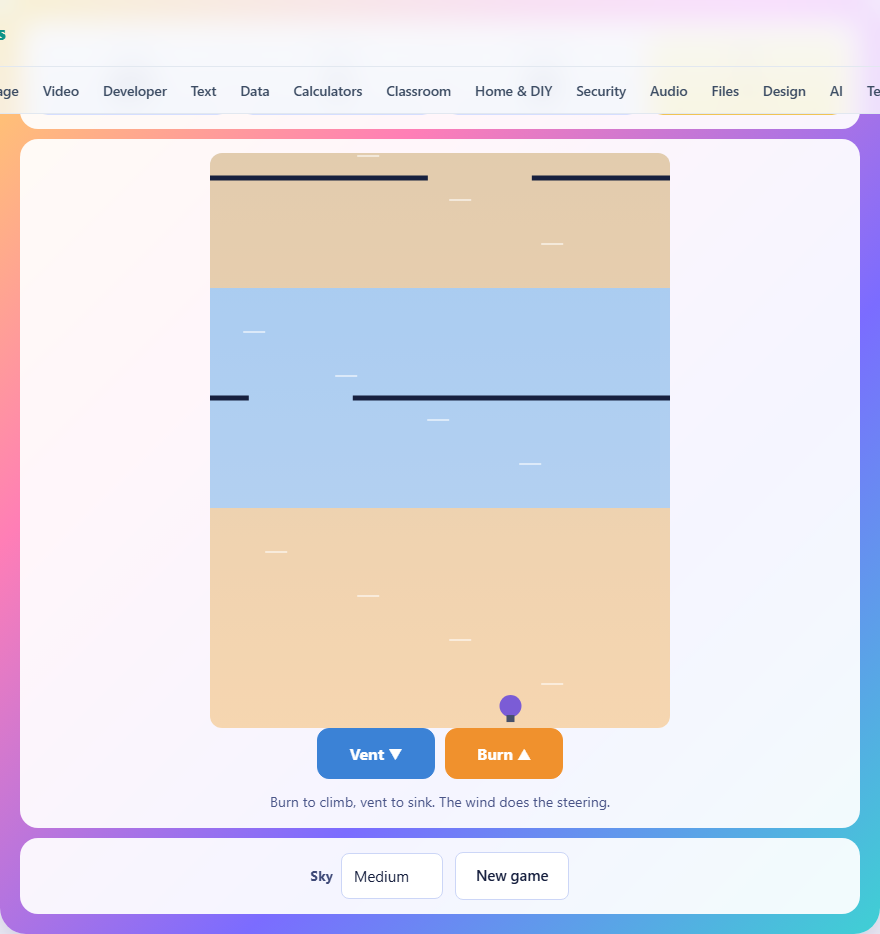
The three speeds the balloon settles into
At any moment the balloon is aiming for one of three vertical speeds. Hold Burn and it aims for 96 units of height per second going up. Hold Vent and it aims for 110 going down. Hold nothing and it aims for 14 going down, the slow sag. It does not snap to the new speed. Each frame it closes 3.4 times the frame length worth of the gap, so after a full second it is about 97 per cent of the way there. That is the small lag you feel when you press a button and when you let go.
Sideways there is no aim at all. The code divides your height by the band height to see which stripe you are in, then adds that stripe's wind number to your position for that frame. That is the only thing that moves you left or right. The number is the same everywhere inside a band, so the drift at the ceiling of a stripe matches the drift at its floor.
A sky is built before the first frame. The band count is the gate count plus 2. Each band gets a speed of the level's wind figure times a random number between 0.45 and 1.30, rounded to a whole unit. The first direction is a coin flip and every band after that flips again, which is the rule that keeps every gate reachable. The sky is 460 units wide and the balloon is held between 12 and 448, so it stops at the wall rather than leaving.
Gates sit at fixed heights. Gate number g, counting from one, is placed at g plus 0.5 band heights above the floor. On the Medium sky that gives 330, 550, 770 and so on up to 1650, and the flight ends one band higher at 1870. The gap centre is dropped anywhere that keeps the whole gap on screen with 8 units to spare. A gate is settled the moment your height crosses its line going up: if the gap centre is within half a gap width of you, it counts, and a rising tone plays at 660 hertz plus 40 more for each gate you have already made. Otherwise a 180 hertz buzz marks a miss.
Here is a flight you can check with a calculator. Medium sky. You are at height 250, inside the first band, which runs from 220 to 440 and blows right at 48 units a second. You are in the middle of the sky at 230. The first gate is at height 330 and its gap is centred at 300, so the opening runs from 248 to 352. You hold Burn from a standstill. Rising 80 units takes about 1.12 seconds, a bit more than the 0.83 seconds that 80 divided by 96 suggests, because the first moments are spent speeding up. In that time the wind carries you 48 times 1.12, which is 53.6 units right. You cross the line at 283.6, which is 16.4 from the gap centre. The test allows 52. Gate made.
Now change one thing. Same height, same 1.12 second climb, but the band blows left at 48. You cross at 230 minus 53.6, which is 176.4. That is 123.6 from the gap centre, far outside the 52 the test allows, so the miss counter goes up. Your flying was identical. Only the sign of one wind number was different, and that is the whole game in one line.
- Small sky: 5 gates, bands 260 tall, gap 130 wide, wind figure 46, so band speeds land between 21 and 60.
- Medium sky: 7 gates, bands 220 tall, gap 104 wide, wind figure 60, so band speeds land between 27 and 78.
- Large sky: 9 gates, bands 190 tall, gap 84 wide, wind figure 76, so band speeds land between 34 and 99.
- The gap is 28 per cent of the sky's width on Small, 23 per cent on Medium and 18 per cent on Large.
- Venting is quicker than burning by design: 110 down against 96 up. Dropping a whole Medium band takes about 2.3 seconds on Vent and about 16 seconds if you just let go.
What this sky leaves out
The thing being tested at a gate is a single point, the centre of the balloon. The circle you see drawn is 11 units across the radius and takes no part in the test. So you can appear to clip the end of a gate line and still be counted through it. It never works the other way round, which makes the game slightly kinder than it looks.
Once a gate is settled it is closed for good. The loop skips any gate already marked as made or missed, so sinking back below a miss and climbing through the gap a second time changes nothing. Crossings are only checked going up, which is why drifting down past a gate is free and also why it can never earn you anything.
The sideways position used at a gate is the one after that whole frame's drift has been added. Frame length is capped at 0.05 seconds, so on a stalled tab the game runs in slow motion instead of jumping, but a single slow frame can still shift you almost 5 units on the Large sky before the check runs. The times quoted above were measured at 60 frames a second. Because the smoothing uses the frame length directly, a slower device gets very slightly different numbers.
One quiet gap between the description and the flight: the code does treat the air above the top band as still, but you never get there. On Medium the band stack reaches 1980 and the run ends at 1870. On Small it is 1820 against 1690, and on Large 2090 against 1995. Every flight finishes half a band below the calm, so there is wind on the final stretch.
Nor is any band ever calm. The slowest a band can be is 0.45 times the level's wind figure, which is 21 units a second even on Small. That is why parking under a gate is impossible and why swapping between two neighbours is the only way to stand still. The pale grey colour the code keeps for a windless band is never actually used.
Shading is relative, not absolute. A band's opacity comes from its speed divided by 1.6 times that level's wind figure, so the deepest a band can ever look is about 0.52 and the palest about 0.30. Two bands that look the same on different skies do not blow the same. Matching shades on Large and Small differ by a factor of 76 over 46, near enough 1.65.
- There are no thermals, gusts, updraughts or turbulence. Wind is horizontal, constant inside a band, and never changes during a flight.
- The balloon has no fuel, no envelope temperature and no weight setting. Burning is free and unlimited, so this is not a simulator of real ballooning.
- Touching a gate line does nothing, the walls just stop you with no penalty, and the balloon cannot crash or fall out of the sky.
- There is no clock. A slow, careful flight scores exactly the same as a fast one.
- The saved best is simply the highest number of gates you have ever passed, kept under one name for the game. The sky size is not stored with it, so 6 gates on Large will outrank a flawless 5 on Small.
- The winning panel appears for more than half the gates, which means 3 of 5 on Small, 4 of 7 on Medium and 5 of 9 on Large. Only a full set is called a clean flight.
How the sky works
The playing field is a tall column of sky divided into horizontal bands. Each band blows in one direction at its own speed. Orange bands carry you to the right and blue bands carry you to the left, with small streaks inside each one showing which way the wind runs and roughly how fast. Darker, more vivid bands blow harder, while paler bands are gentler and easier to control in. Above the last band the air is completely still, which is why the finish is always calm and you can cross the final line without any lateral drift.
A key rule governs how bands are arranged: neighbouring bands always blow in opposite directions. If one pushes you right, the one above it pushes you left. This alternating pattern is what guarantees that every gate can be reached. Without it, a run of bands blowing the same way could pin you on one side of the sky with no hope of getting back. Because the directions alternate, you can always work your way to any position by climbing or sinking one band.
Gates and how they are judged
Gates are horizontal lines with a gap somewhere along them. To pass through a gate, the balloon must be inside that gap at the exact moment it crosses the line going upward. Drifting past a gate sideways below it costs nothing, but the instant you rise through the line, either you are inside the gap or you are not. There is no second chance, because gates are only judged on the way up.
Missing a gate does not end the flight. You lose that gate and the counter marks it as missed, but you can still try for the rest. The flight ends when the balloon rises above the last gate. If you made them all, the game reports a clean flight. If you missed some, it tells you how many you got out of the total. You need to pass through every single gate for a perfect run. The stats panel at the top shows your current gate count, how many you have missed, and your altitude, so you always know exactly where you stand.
Controls and difficulty levels
On a keyboard, hold the up arrow or the W key to burn and climb. Hold the down arrow or the S key to vent and sink. Release everything and the balloon drifts gently downward on its own. On a phone or tablet, two buttons labelled Burn and Vent sit below the canvas. Hold either one for as long as you need, then let go.
The Sky selector offers three settings. Small gives you five gates with wide gaps and slow winds. Medium raises it to seven gates with narrower gaps and stronger winds. Large is nine gates with tight gaps and fast-moving bands. Changing the setting and pressing New game starts a fresh flight with the chosen sky. The number of bands, the speed of each one, and the position of every gate are all generated fresh each time, so no two flights are the same.
Planning your path through the bands
The temptation is to start climbing right away, but that is usually a mistake. Before you rise into a new band, look at the gate above you and figure out which side of the sky it sits on. Then look at the band you are about to enter. If it blows the wrong way, it will carry you further from the gate, and you will have to drop back down and try again.
The best approach is to get your sideways position roughly right before you climb. Sit in a band that carries you toward the next gate, ride it until you are underneath the gap, then burn upward. If the band above the gate blows the right way, even better. If it blows the wrong way, make sure you are already lined up so you only spend a moment passing through it.
Holding still and using slow bands
No band in the sky stands still. Even the gentlest one nudges you sideways, which means there is no way to simply hover under a gate and wait. To hold your position, you have to keep bobbing between two neighbouring bands. Since they always blow in opposite directions, the drift from one is cancelled by the drift from the other. The faster you swap, the less you move overall.
Pale, slow-moving bands are your best friend when you need precision. Sitting in a slow band gives you time to watch where you are heading and decide whether to climb or drop. The fast, vivid bands are useful for covering ground quickly, but they demand fast reactions and good timing. Use the slow ones to line up, and the fast ones to travel.
Common mistakes new players make
The most frequent error is climbing without reading the sky first. A new player sees a gate above and holds the burn button, only to be swept sideways by a band blowing the wrong way. By the time they react, the gate is behind them and missed. Always check the direction of the next band before you enter it.
Another common mistake is spending too long in a fast band. The wind does not stop while you think, and a powerful band can push you from the centre of the sky to the edge in a few seconds. If you find yourself pinned against the side, that is a clear sign you stayed too long. Drop down into the neighbouring band, which blows the opposite way, and work your way back.
Beginners also underestimate how fast venting is compared to burning. Sinking drops you quicker than climbing lifts you, so going back down for a second attempt at a band is cheaper than you might expect. Do not be afraid to vent and retry if your approach is wrong. A brief descent and a better run is nearly always faster than fighting the wind. Remember that releasing both controls causes a gentle downward drift rather than a hover, so letting go is not the same as staying still.
Advanced technique: reading gates overhead
A gate that requires a long sideways drift is often easier than one almost directly above you. When the gate is far to one side, you have the entire width of a band to carry you there, and you can sit patiently until you arrive. A gate right overhead gives you no room for error, because any band you enter will start pushing you away immediately.
For a gate almost directly above, the trick is to enter the band from the far side. Let the wind carry you across and time your climb so you pass through the gap while the wind is still pushing you toward it, not away from it. If you enter from the wrong side, the wind has to push you back first, which costs time and often causes a miss. On the Large sky with nine gates, several of these overhead gates appear in sequence, and the margin for error shrinks with each one. Mastering the approach from the far side is what separates a complete flight from one with two or three missed gates.
Privacy and how the game runs
The entire game runs inside your browser. No flight data is sent to a server, no account is needed, and nothing is uploaded at any point. The wind bands, gate positions, and balloon physics are all calculated on your device in real time. Your best score is saved in your browser's local storage on this device only, so it will not follow you to a different computer. Once the page has finished loading, you can disconnect from the internet and the game will keep working exactly the same way.