
Connecting every pipe from the source outward
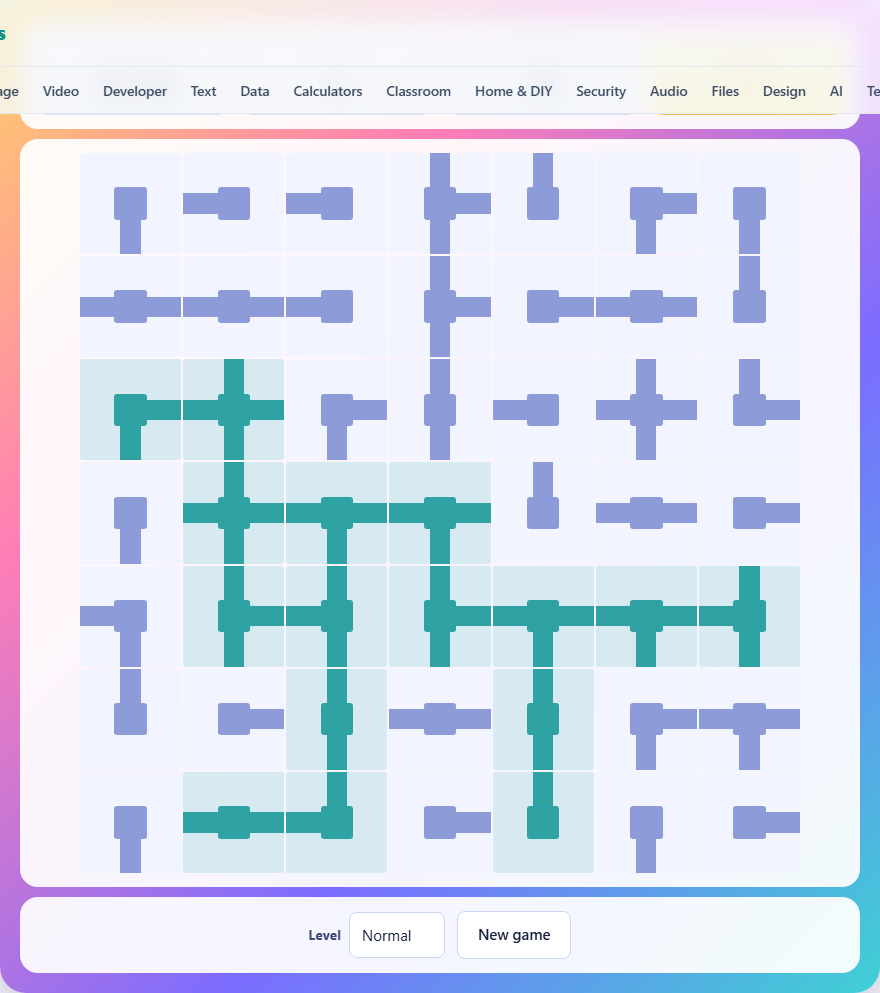
A grid of pipes sits scrambled on a board. Water flows from a marked source and travels through any pipe that connects to it. Your job is to rotate each pipe until the water reaches every square on the board. Each tap turns a pipe a quarter turn clockwise, and you have a limited number of turns to finish. Every puzzle is guaranteed to have a solution because the board is built from a connected network that is then scrambled.
How the puzzle works
Every square on the board holds a piece of pipe. Each pipe has one or more openings that point in the four cardinal directions: up, down, left, or right. A straight pipe has two openings on opposite sides. A corner pipe has two openings at a right angle. A tee pipe has three openings. A dead end has only one.
Water starts at the source square, which is outlined and usually sits near the middle of the board. From the source, water flows into any neighbouring pipe whose opening faces the source, but only if the source also has an opening facing that neighbour. Both sides of a connection must open toward each other for the water to flow.
Pipes that are carrying water are shown in a highlighted colour. Pipes that are not connected remain dim. This colour feedback is the most important tool you have, because every turn immediately shows whether the new orientation made a connection or broke one.
Controls and how rotation works
Tap or click any pipe to rotate it one quarter turn clockwise. Four taps bring it back to where it started. That is the only control. There is no way to rotate counter-clockwise, but since four clockwise turns complete a full circle, three taps forward is the same as one tap backward. The board scales to fit your screen, and on a phone the pipes are sized large enough to tap comfortably with a thumb.
Each rotation costs one turn. The stats bar shows how many pipes are connected out of the total, how many turns you have used, and how many turns you have left. If you run out of turns before all pipes are connected, the game ends. There is no undo, so each tap should be deliberate.
Strategy for working outward
Always start with the pipes touching the source. These are the only pipes that can become connected on the first move, and they give you immediate visual feedback. Once the first ring of pipes around the source is lit, move to the next ring outward.
Working inward from the edges is tempting because edge and corner pipes seem constrained, but it wastes turns. A pipe far from the source gives you no information about whether it is correct because you cannot see the water reach it until everything between it and the source is already connected. Every turn spent rotating a disconnected pipe is a turn spent guessing.
The outward approach turns every move into a test. You rotate a pipe next to a lit one and either the water flows into it or it does not. If it does not, you rotate again. You never have to wonder whether you are wasting a move because the colour change tells you immediately.
Using edges and corners to your advantage
A pipe sitting against an edge of the board cannot have an opening that points off the board. If it does, that orientation is wrong. This eliminates some possibilities before you even tap. A corner pipe, touching two edges, is even more constrained. Often a corner pipe has only one valid orientation, which you can determine by looking at it.
Pipes along the edges of the board are typically the easiest to solve once the water reaches them. Between the edge constraint and the requirement to connect to an adjacent lit pipe, there may be only one or two rotations that work. Save them for later in the game when your turn count matters most.
Dead-end pipes, the ones with only a single opening, are the most constrained pieces on the board. They have only four possible orientations and one of them is usually forced by their neighbours. Spotting dead ends early and noting where their opening must point can save several turns.
Avoiding wasted turns
The turn limit is the real challenge of this game. On larger boards you cannot afford to rotate every pipe three or four times. Each pipe needs an average of about one and a half turns to land on the right orientation if you tap randomly, but deliberate play can bring that down.
Before tapping a pipe, look at the pipes around it that are already connected. Count how many lit openings face the pipe you are about to turn. The correct orientation for that pipe must have openings that face each lit neighbour. This often narrows the choice to one or two orientations, saving you the wasted turns of cycling through all four.
If you have connected most of the board and have several turns to spare, take a moment to plan the remaining rotations rather than tapping quickly. A few seconds of thought can save two or three turns, which may be the difference between finishing and running out.
Common beginner mistakes
Rotating pipes that are far from the water is the most common mistake. Without the colour feedback, you are guessing. You might set a pipe correctly and then later rotate it again because you forgot its orientation, wasting two turns for nothing.
Forgetting that both sides must connect is the second common error. A pipe pointing toward a neighbour does nothing unless the neighbour is also pointing back. New players often rotate one pipe to face another and then wonder why the water does not flow, not realising the second pipe also needs to be turned.
Trying to solve the board all at once instead of working outward from the source is the third mistake. The flood fill that colours the connected pipes is the puzzle's built-in hint system. Ignoring it by working on random parts of the board throws away the information the game is giving you for free.
- Tapping a pipe four times in a row, returning it to its starting position and wasting four turns.
- Ignoring dead-end pipes, which are often the easiest to place correctly.
- Rushing through the last few pipes without checking whether each rotation actually extended the water.
The three difficulty levels
Easy uses a five by five grid with forty turns allowed. Twenty-five pipes and forty turns is generous. You can afford some wasted rotations and still finish comfortably. This setting is the right place to practice the outward-working strategy.
Normal uses a seven by seven grid with seventy turns. Forty-nine pipes and seventy turns is tighter than it sounds, because the board is nearly four times larger than the easy one and errors compound. Deliberate play and attention to the colour feedback become important.
Hard uses a nine by nine grid with one hundred and ten turns. Eighty-one pipes and one hundred and ten turns demands efficient play. You cannot afford to waste more than a turn or two per pipe on average, which means every rotation should be informed by the pipes around it.
How the puzzles are built
Each puzzle starts as a connected spanning tree grown outward from the source. The tree visits every square on the board exactly once, which means every pipe is connected to the source through some path. Once the tree is complete, each pipe is rotated a random number of quarter turns to scramble it.
Because the solved layout existed before the scrambling, unscrambling it is always possible. There is no chance of getting a board that cannot be completed. The turn limit is the only thing that can stop you, never the layout itself. Every time you press new game you get a fresh random layout, so no two puzzles play the same way.
Privacy and where the puzzle runs
The entire puzzle runs inside your browser. Nothing is uploaded to any server, there is no account, and your best score is stored only on this device. The board is generated fresh each time you start a new game. Once the page has loaded the puzzle works offline.