
Flipping your way to a high score in Pinball
A ball falls under gravity through a table full of bumpers, walls, and drop targets. Two flippers at the bottom are your only defence against the drain. Launch the ball with the plunger, keep it alive with well-timed flips, and beat the target score before your balls run out. The physics are honest: walls never speed the ball up, bumpers do, and a flipper only throws the ball if you catch it on the upswing.
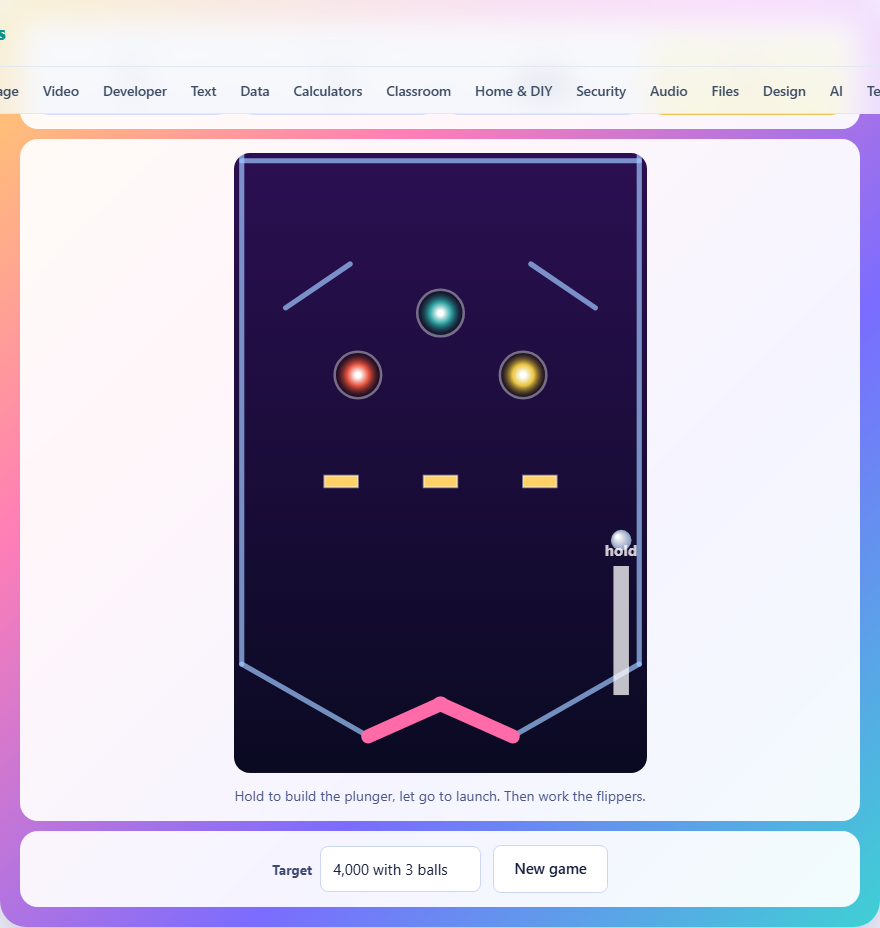
What is on the table
The table is a vertical rectangle with solid rails along both sides and across the top. At the bottom, two angled outlanes funnel the ball toward the drain gap in the middle. Two flippers sit at the base of the outlanes, one on each side, and they are all that stands between the ball and the drain.
Three circular bumpers sit in the upper half of the table. Each one is a filled circle that kicks the ball away when it makes contact, adding speed in the process. Below the bumpers are three rectangular drop targets in a row. Two slingshot rails near the middle of the table deflect the ball but do not add energy.
On the right side of the table, a plunger launches the ball. A green power bar shows how hard the plunger will fire when you release it. The ball enters the table from the right side and curves around the top.
Controls on keyboard and touch
On a keyboard, the left arrow key or Z works the left flipper. The right arrow key or X works the right flipper. Hold the space bar to charge the plunger and release it to launch the ball. The longer you hold, the harder the launch.
On a touch screen, hold anywhere on the table to charge the plunger and let go to launch. Once the ball is in play, tap the left half of the table to flip the left flipper and the right half to flip the right. Lifting your finger releases the flipper.
The flippers stay up as long as the key or touch is held. Releasing the key or lifting your finger lets the flipper drop back to its resting position. Timing the press to match the ball's arrival is the central skill of the game.
How scoring works
Every bumper hit pays one hundred points. The ball bounces off the bumper and picks up speed, so a ball caught in the bumper cluster can rack up several hundred points in a few seconds without any action from you.
Each drop target pays two hundred and fifty points when you knock it down. There are three targets in a row. When all three are down, you earn a bonus of one thousand points and the targets stand back up, ready to be scored again. A full set of targets is worth one thousand seven hundred and fifty points: three individual hits plus the completion bonus.
The stats bar shows your current score, how many balls you have left, and the target score you need to beat. Floating numbers appear briefly on the table whenever you score, showing what each hit was worth.
The physics of flippers and bounces
A flipper that is already at the top of its swing behaves like a wall. The ball bounces off it and dribbles away with no useful speed. A flipper that is still rising when the ball arrives transfers its rotational speed to the ball, throwing it forcefully up the table. The difference between a dead bounce and a powerful shot is entirely about when you press the button.
Bumpers are the only objects on the table that add energy to the ball. Every bounce off a bumper kicks the ball outward with extra speed. Walls, rails, and slingshots reflect the ball but do not speed it up. A ball rolling along a rail arrives at the end no faster than it entered.
The ball falls under constant gravity. There is no tilt, no magnetic save, and no hidden assist. A ball heading straight down the middle between the two flippers is lost. The table does not cheat to keep it alive.
Strategy for keeping the ball alive
The single most important skill is patience. Do not mash the flipper the instant the ball comes near. Wait until the ball is close to the flipper, then press and hold. Catching the ball on the rising edge of the flipper sends it up the table with real force. Flipping early means the flipper is already raised and stationary when the ball arrives, producing a weak bounce.
Try to aim for the bumper cluster in the upper half of the table. A ball in the bumpers earns points on its own and stays up the table longer, giving you more time before it falls back toward the drain. The bumpers also redirect the ball unpredictably, which sometimes sends it straight into the drop targets.
When the ball is rolling slowly near a flipper, let it roll onto the flipper before you flip. A ball sitting on a resting flipper can be launched cleanly because the full upswing catches it. This is safer than flipping at a ball that is dropping fast.
Targeting the drop targets
The drop targets are where the real score is. Three individual targets at two hundred and fifty each plus one thousand for clearing the set adds up to one thousand seven hundred and fifty, which is more than seventeen bumper hits. Clearing the set twice on a single ball is often enough to win on normal difficulty.
The targets sit in a horizontal row below the bumpers. To hit them, you need to send the ball upward from a flipper at an angle that reaches their height. A powerful flip from the left flipper tends to send the ball toward the right side of the table, and a flip from the right sends it left. Use whichever flipper gives you a line on the targets that are still standing.
When all three targets go down, they reset immediately. This means a ball that clears the set can start working on the next set right away, and there is no limit to how many sets you can clear on a single ball.
Launch power and the plunger
The plunger has variable power. A short hold sends the ball gently into the table. A full hold sends it hard around the top rail. A full-power launch often sends the ball all the way around the top and straight back down the middle, which can drain it before you have a chance to react.
A gentler launch drops the ball into the bumper area from the right side, where it bounces around and earns points on its own before rolling down to the flippers. This is often the better choice, especially on your last ball when survival matters more than a dramatic entrance.
Experiment with different launch strengths on the easy setting, where you have four balls to work with. Once you find a power level that reliably feeds the ball into the bumpers, use it consistently.
Common beginner mistakes
Flipping too early is the number one mistake. New players slam the flipper the instant they see the ball coming. By the time the ball arrives, the flipper is already up and stationary, producing a weak bounce that barely leaves the flipper. Wait for the ball to reach the flipper before you press.
Ignoring the drop targets is the second most common error. Bumpers are fun because the ball bounces around and the score ticks up steadily, but bumpers pay one hundred at a time. You cannot reach four thousand points on bumpers alone in three balls. The drop targets are the path to the target score.
Launching at full power every time is the third mistake. A full-power launch looks dramatic but often drains the ball within seconds. A controlled launch puts the ball where it can do the most work.
The three difficulty settings
Easy asks you to reach two thousand five hundred points and gives you four balls. The target is low enough that clearing the drop targets once and hitting a few bumpers is usually sufficient. The extra ball provides a comfortable safety net.
Normal sets the target at four thousand with three balls. Clearing the drop targets twice is roughly enough, but you need to keep the ball alive long enough to do it. Flipper timing becomes critical at this level.
Hard raises the target to six thousand with three balls. You need multiple target clears and steady bumper hits across all three balls. Losing a ball early without scoring much is very hard to recover from.
Privacy and where the game runs
The entire game runs inside your browser. Nothing is uploaded to any server, there is no account, and your best score is stored only on this device in your browser's local storage. Once the page has loaded the game works offline.