
Mastering the swing and release in Pendulum Drop
A parcel hangs on a rope and swings back and forth. Your only job is to let go at the right instant. After that, gravity and the speed of the swing decide where it lands. There are no mid-air controls, no nudges, no second chances once the parcel is airborne. The whole game lives in that single moment of release.
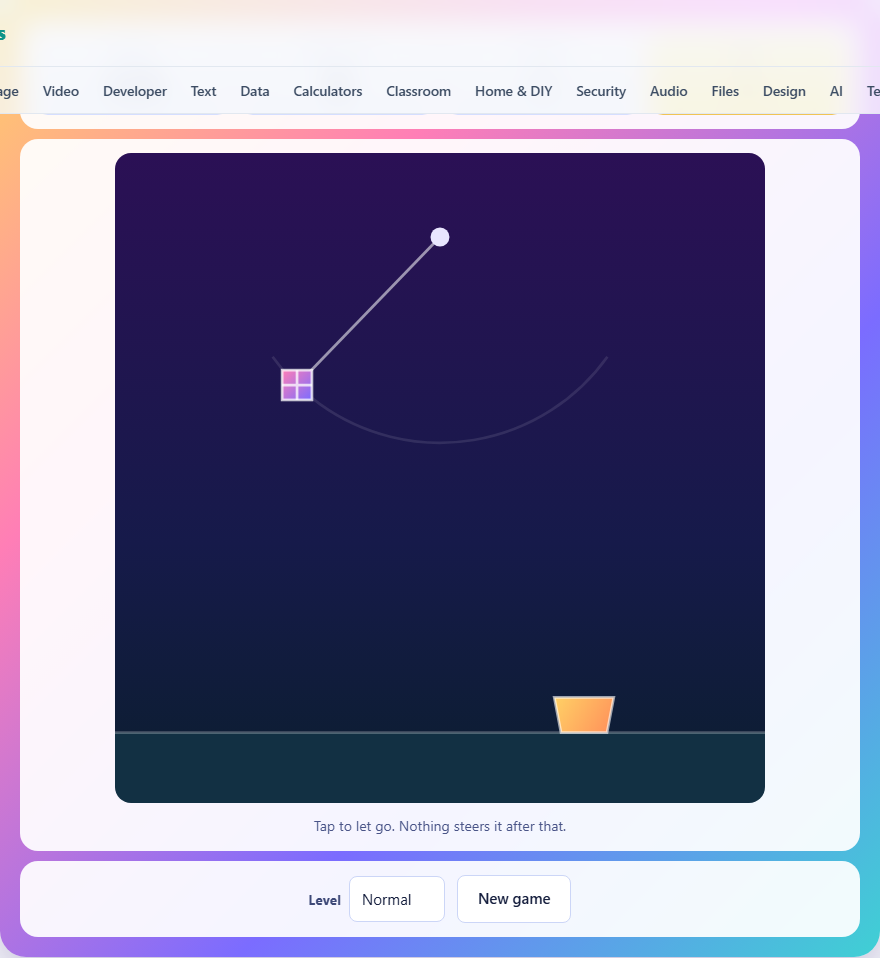
What the game asks you to do
A pendulum swings above a ground line. Attached to it is a small parcel, drawn as a coloured square. Somewhere along the ground sits a basket. Your task is to release the parcel so that its arc through the air lands it inside that basket.
Each round places a new basket in a different spot. Fill every basket before you run out of drops and you win. Miss too many times and the game ends. The number of baskets and the number of drops you are allowed depend on the difficulty you choose.
Every basket the game places is guaranteed to be reachable. The placement works backwards: the game picks a release moment, runs the physics forward to see where that throw would land, and puts the basket there. A basket you cannot hit is a bug, not a feature, and this method rules it out.
Controls on every device
On a computer, press the space bar to release the parcel. That is the only key you need. On a phone or tablet, tap anywhere on the game area. The parcel lets go immediately and follows the path that the swing gave it.
There is no dragging, no aiming, and no power bar. The speed and angle come entirely from where the pendulum happens to be in its arc at the instant you act. Once released, the parcel travels in a parabola under gravity and you cannot influence it at all.
How the scoring works
The stats bar shows three numbers. Basket tells you which basket you are on and how many you need to fill. Drops left counts your remaining attempts. Closest shows the distance in pixels between your last landing and the centre of the basket.
When a parcel lands in the basket, sparks fly and you move to the next round. When it misses, a note tells you how many pixels you were off and whether you landed past the basket or short of it. Fill all the baskets and the game reports how many drops you had to spare. Run out of drops before filling them all and the game is over.
The physics behind the swing
The pendulum follows the real equations of a simple pendulum. The bob traces an arc, and its speed changes continuously along that arc. At the very bottom of the swing, the bob moves at its fastest. At each end of the swing, where it reverses direction, it stops dead for an instant.
When you release, the parcel carries the exact velocity the bob had at that moment. The direction is tangent to the arc, meaning it shoots off at a right angle to the rope. At the bottom of the swing that direction is almost perfectly horizontal, so the parcel flies flat and far. Near the top of the swing the direction is nearly vertical, so the parcel lobs upward a little and drops almost straight down.
This is the core insight of the game: the same swing, at different moments, produces wildly different throws. The bottom is a long, flat drive. The top is a short, high lob. Everything in between is an arc of varying length and height.
Strategy for reading the swing
The most important habit is to watch one full swing before you act. The arc drawn faintly behind the bob shows the full range of motion, and it lets you judge where the bottom is relative to the basket. If the basket is far from the pivot point, you need a fast release near the bottom. If it is close and roughly below the pivot, you need a slow release nearer the top.
Direction matters as much as position. The bob passes through the same point twice per swing, once heading left and once heading right. Those two passes throw the parcel in opposite directions. A basket on the left side of the board demands a release while the bob is moving to the left, and a basket on the right demands the opposite. Misjudging the direction is a reliable way to send the parcel flying to the wrong side of the board entirely.
Small timing changes produce large landing differences in the middle of the swing, where the speed is changing rapidly. Near the ends of the swing the speed changes slowly, so the landing does not shift as much. Use the middle of the arc for distance baskets and the edges for close ones. The sweet spot for most baskets is about a third of the way between the bottom and the top of the arc, where the parcel leaves at a useful angle and still carries a good amount of speed.
Adjusting after a miss
The note after each throw tells you how far off you were and in which direction. Use that information directly. If you landed thirty pixels past the basket, release a fraction later on the next swing so the parcel leaves the arc at a slower moment and falls shorter. If you landed short, release a fraction earlier to catch more speed.
The word fraction is doing real work here. A change of a tenth of a second moves the landing by a large margin, so your adjustment should be tiny. Overreacting is the fastest way to bounce between overshooting and undershooting on alternate throws.
On hard difficulty the baskets are narrow and the number of rounds is higher, so you have less room for error and more baskets to fill. Developing a feel for the swing rather than guessing randomly becomes essential at that level.
Common beginner mistakes
Releasing too late is the most frequent error. New players often wait until the swing reaches a point that looks right rather than releasing while the bob is moving through the right part of its arc. By the time the visual registers and the brain sends the signal to act, the bob has already moved on and the throw goes somewhere else entirely.
Another common trap is releasing at the ends of the swing. The bob barely moves at the extremes, so the parcel drops almost straight down with hardly any horizontal travel. Unless the basket is directly below the pivot, an end release almost never works.
Ignoring direction is the third mistake. Beginners often focus on where the bob is without considering which way it is heading. The same point on the arc, approached from different directions, sends the parcel to two completely different parts of the board.
The three difficulty levels
Easy gives you a wide swing angle, large baskets, four rounds, and eight drops. The baskets are forgiving enough that being roughly right is usually good enough. This is the place to build intuition about the relationship between release point and landing spot. A new player can often clear all four baskets on the first try at this level.
Normal tightens the baskets, increases the swing angle further, and adds a fifth round. The margin for error shrinks noticeably, and guessing your way through five baskets with eight drops is unlikely. You need to learn from each miss and make real adjustments. The feedback note telling you how many pixels you were off and in which direction becomes essential rather than decorative.
Hard uses the widest swing, the smallest baskets, and six rounds. At this level a successful run requires a solid understanding of the physics and the patience to make small, deliberate corrections after each miss. The difference between landing inside the basket and just outside it is often a matter of a few pixels. Expect to use most of your eight drops, and treat each miss as information rather than failure.
Privacy and where it runs
The entire game runs inside your browser. Nothing is uploaded to any server, there is no account to create, and your best score is stored only in this browser on this device. It will not follow you to another computer. Once the page has finished loading the game works offline.