
Peg Solitaire: a guide to the classic board puzzle
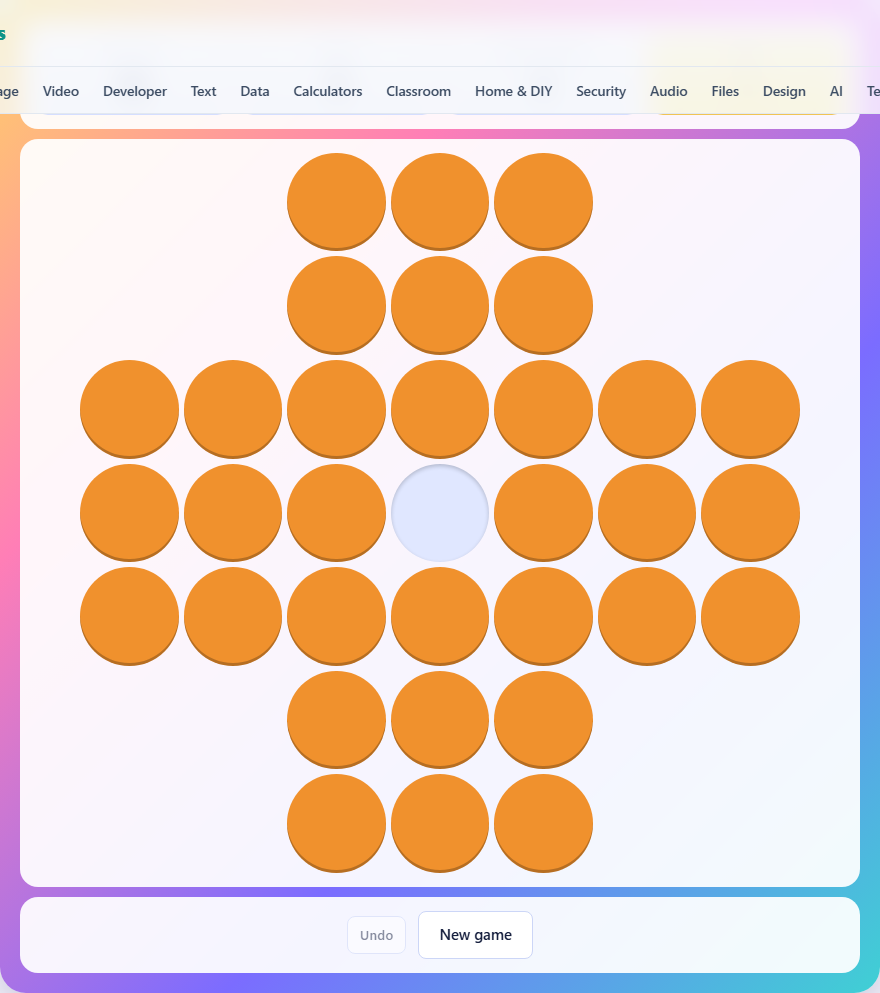
Peg Solitaire is a single-player board puzzle that has been played for centuries. The board starts with thirty-two pegs and one empty hole in the centre. Jump pegs over each other to remove them, and try to finish with a single peg remaining. Here is how every rule works, why the puzzle is always solvable, and the habits that lead to a clean finish.
The rules in full
The board is a cross-shaped grid of thirty-three holes. At the start, every hole holds a peg except the one in the centre. A move consists of jumping one peg over an adjacent peg, straight into an empty hole two squares away. The jumped peg is removed from the board. Jumps may only go up, down, left, or right. Diagonal jumps are not allowed.
There are only these three conditions for a valid jump. The starting hole must contain a peg. The hole being jumped over must contain a peg. The landing hole must be empty. When all three conditions are met, the jumping peg moves two squares, the jumped peg is taken off, and the board has one fewer peg. The game ends when no more jumps are possible.
Controls and interface
Tap or click a peg to select it. The game highlights every hole that peg can legally jump to. Then tap one of the highlighted holes to make the jump. If you change your mind, tap a different peg or tap an empty area to deselect.
An Undo button sits below the board. Pressing it restores the board to the state before your last jump. You can undo as many times as you like, all the way back to the starting position if needed. The undo count is added to your jump total on the scoreboard, so using it is not free, but it is far cheaper than restarting the whole puzzle.
The scoreboard shows three numbers: how many pegs remain on the board, how many jumps you have made, and how many jumps are currently available. When the available jumps reach zero, the game ends automatically and tells you how many pegs are left.
Why one peg is always possible
The standard English cross-shaped board with the centre hole empty can always be reduced to a single peg in the centre. This is a proven mathematical result, not a matter of luck. A perfect game takes exactly thirty-one jumps, removing one peg per jump until the last one stands alone.
Not every sequence of jumps leads to a solution. Many paths strand pegs in positions where they can never be reached. The challenge is not whether a solution exists but whether you can find a path that avoids dead ends. Two pegs left is a very respectable result. One peg is the perfect finish that the puzzle is designed to allow.
Strategy: work from the outside in
The cross-shaped board has four arms extending outward from a central square. Pegs left out on the tips of the arms are the hardest to deal with later, because there are fewer neighbours and fewer holes to jump into. Clear the arms first and consolidate pegs towards the centre.
Think of the board as having layers. The outer ring is the tips and edges of the arms. The inner ring is the area around the centre hole. If you leave outer pegs for last, you will find them stranded with no neighbours to jump over and no empty holes to land in. Early jumps should bring pegs inward, not push them outward.
Strategy: avoiding islands
An island is a peg that has no neighbours. It cannot jump anywhere, because there is nobody to jump over. It also cannot be removed, because no peg from two squares away can reach it. Once a peg is isolated, it stays on the board forever.
Before making a jump, look at what happens to the surrounding pegs. If removing the jumped peg leaves another peg with no neighbours, that jump is likely a mistake. The undo button exists for exactly this situation. When you spot an island forming, step back and try a different path.
Two pegs sitting next to each other with nothing around them are nearly as bad. One can jump the other, leaving a single peg, but that peg is then isolated. You need a third peg nearby to continue the chain. Always check that a region has enough pegs and holes to sustain a sequence of jumps.
Strategy: chain jumps and sequences
Although the game counts each jump individually, the strongest moves are ones that set up a sequence. Jump peg A over peg B, and the hole left by peg A opens a path for peg C, which can then jump over peg D. These chain reactions clear several pegs in rapid succession and are the key to reaching one peg.
Planning a chain requires looking two or three jumps ahead. After your current jump, ask where the peg will land and what new jumps that landing creates. The best chains sweep across an arm of the board and leave it empty in three or four jumps. If you find yourself making disconnected jumps in different parts of the board, you are probably not using chains enough.
A useful habit is to look for lines of three or more pegs with an empty hole at one end. The peg at the far end can jump towards the hole, and each landing opens a new hole for the next peg in line. These line sweeps are the simplest chains to spot and they clear an arm quickly.
Common beginner mistakes
- Jumping randomly and hoping for the best. The puzzle is deterministic. Every outcome is the result of your choices, not chance.
- Leaving pegs on the tips of the arms for last. Those pegs need to be cleared early, while there are still neighbours to help them.
- Creating islands by removing the only neighbour a peg has. Always check what happens to the surrounding pegs before you jump.
- Refusing to use undo. A single bad jump can make the board unsolvable. Undo lets you explore different paths without restarting from scratch.
- Focusing on one side of the board and ignoring the other. The cross has four arms and a centre. All of them need attention, and neglecting any arm makes it harder to finish.
- Pushing pegs outward instead of inward. The centre is the destination. Jumps that move pegs away from the centre are almost never correct.
The endgame
When only five or six pegs remain, the puzzle enters its most delicate phase. Every jump matters, and the order must be exact. A wrong jump at this stage is usually fatal, leaving two or three pegs that cannot reach each other.
At this point, look at the whole board and plan the finish before you move. Count the pegs, note their positions, and trace a path that removes them one at a time until the last peg lands in the centre. If the path does not work out in your head, use undo to back up and try a different sequence from an earlier point.
The game detects when no jumps remain and ends automatically. If you finish with one peg, you see a victory message. If you finish with two or three pegs, the game acknowledges the result, because even that is a strong performance on this board.
How the game detects a dead end
After every jump, the game checks every peg on the board for legal moves. It tests all four directions from each peg: is there a peg to jump over, and is the landing hole empty? When no peg on the entire board has a legal jump, the game ends and shows how many pegs are left.
This check runs instantly, so you never waste time hunting for a move that does not exist. The available-jumps counter on the scoreboard updates after every move. When it drops to zero, the game is over. Watching this counter shrink gives you early warning that the board is getting tight.
Nothing leaves your browser
The board logic, the jump checker, and your best scores all run inside this page. There is no server, no account, and no data sent anywhere. Your best result, measured as the fewest pegs remaining, is saved in local storage on this device and stays there. Once the page has loaded the game works without a network connection.