
Peg Drop: how ten coin flips make a bell curve
Peg Drop is a bean machine you can play. The bean machine is real teaching equipment. A Victorian scientist named Francis Galton built one to show a room full of people where the bell curve comes from. Balls fall through rows of pegs, hop left or right at each one, and pile up at the bottom in a shape that nobody drew for them. This page explains how the board is built, what the numbers really are, and how to reach the score you need before the balls run out.
How a turn goes
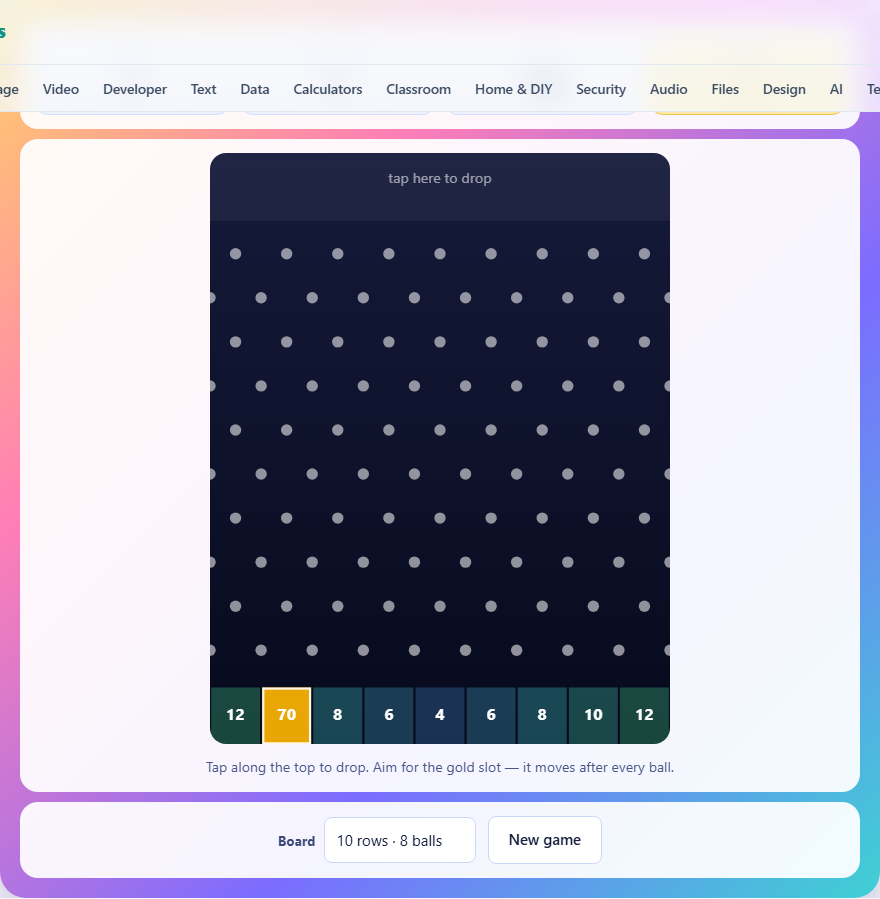
Tap anywhere along the top of the board to let a ball go. It falls under gravity into a field of pegs set out in staggered rows. Each time the ball meets a peg it rolls off one side of it. When it clears the last row it drops into one of the nine bins along the bottom.
Every bin has a number printed on it, and that number goes on to your score. One bin is gold, and it pulses so you can pick it out at a glance. A ball that finishes in the gold bin adds sixty points on top of the bin's own number. The moment the ball lands, the gold moves somewhere else, so the shot you just worked out is never the shot you face next.
You start with a set number of balls and a score to reach. Reach the score and you win. Run out of balls first and the round ends. Your score only ever climbs, so a drop that goes badly costs you a ball and nothing more.
The three boards
The Board menu offers three sizes. Eight rows of pegs comes with ten balls and a goal of a hundred and seventy points. Ten rows comes with eight balls and a goal of a hundred and sixty. Twelve rows comes with six balls and a goal of a hundred and forty-five.
More rows means more scatter. Every extra row is one more left-or-right hop, so the ball wanders further from the point where you let it go. That is why the tall board hands you fewer balls. Each drop is less certain, so the goal comes down to match.
The bin numbers are the same on all three boards. Read from the left edge, they run twelve, ten, eight, six, four, six, eight, ten, twelve. The middle bin is the cheapest one on the board and the two ends are the richest. That is the reverse of what most people expect, and there is a good reason for it that you will see in a moment.
What a peg actually does
A ball that hits a peg does not spring off it the way a ball springs off a wall. It lands on top, loses most of its falling speed, and rolls off one shoulder. The board picks that shoulder with a fair coin. Left and right are equally likely every single time, and the coin has no memory of the flip before it.
The sideways speed the ball picks up is worked out from the shape of the board itself. It is just enough to carry the ball half a gap across while it falls to the next row. The rows are staggered by half a gap, so the ball arrives on top of the next peg instead of sliding past it. There the choice is wide open again.
That is the whole engine. Ten rows of pegs is ten coin flips. The bin a ball ends up in is simply a record of how many of those flips sent it right and how many sent it left.
Where the balls really land
Here is the measured result, not a guess. Twenty thousand balls were dropped down the exact centre of the ten-row board. They finished in the nine bins in these shares, reading from left to right: one, four, twelve, twenty-one, twenty-four, twenty, twelve, four and one per cent.
That is the bell curve, drawn by nothing but coin flips. Almost a quarter of the balls land in the single bin under the drop point. Another forty per cent land in the two bins on either side of it. The two end bins collect about one ball in a hundred each.
The shape tightens on the short board and spreads on the tall one. On the eight-row board, twenty-eight per cent of centre drops finish in the middle bin. On the twelve-row board it is twenty-two per cent. Eight coin flips simply cannot carry a ball as far across as twelve can.
Now look at what this does to your score. A drop down the middle is worth about six and a half points on average, because the ball nearly always finishes in the low-numbered middle of the board.
Aim straight above the bin you want
There is no clever angle in this game. The ball has no spin, and you cannot push it sideways once it is falling. The spread of landing points is centred on the spot where you let go. So the spot to let go from is directly above the bin you want. Nothing else helps.
Move your drop two columns off the gold bin and you have not really aimed at it. You have shifted the whole curve two columns across and left the gold bin out in the thin part of it. Your chance of hitting it falls from about one in four to about one in eight. Move three columns off and it is closer to one in twenty-five.
So each ball asks you one question. The gold bin sits somewhere on the board. How far across are you willing to reach for it, and what do you give up on the way? The next two sections are about answering that.
The walls are on your side
The board has a wall down each side, and the wall barely springs the ball back. A ball pressed against it cannot drift any further out. Every coin flip that would have pushed it outward does nothing at all. That turns the wall into a quiet helper for the two end bins.
The numbers make it plain. A ball dropped down the middle of the ten-row board reaches the far left bin about one time in a hundred. A ball dropped as far left as the game allows finishes in that same bin forty-five times in a hundred. The pegs did not change. The walls did all of it.
This is why the end bins carry the highest numbers and still do not spoil the game. An edge drop finishes in one of the two richest bins more than three quarters of the time. Averaged out, an edge drop is worth about ten points, against about six and a half for a drop down the middle. And if the gold bin happens to be an end bin, aim into the wall and take it.
Making eight balls reach a hundred and sixty
Work through the ten-row board. Eight balls, and a hundred and sixty points to find. A gold hit is worth sixty plus whatever the bin itself is worth, so somewhere from sixty-four to seventy-two points. A plain bin is worth four to twelve.
Two gold hits and one solid edge drop win the round outright. But a one-in-four shot taken eight times will not hand you two gold hits as often as you would like, so it helps to keep a steady plan running underneath the ambitious one.
Eight edge drops at about ten points each come to eighty, which is halfway there on its own. So mix the two. Take the gold shot when the gold bin sits at an edge, because the wall nearly doubles your chance of reaching it. Take it in the middle too, where a straight drop gives you one in four. When the gold bin sits somewhere awkward, drop on an edge and take the ten points instead.
Keep counting what you still need against what you still have. A hundred points to find with two balls left means gold or nothing, so aim at gold. Thirty points with four balls left means the edges will carry you home with room to spare.
What trips people up
- Aiming to one side of the gold bin. The ball has no curve on it. Straight above is always the strongest drop.
- Letting every ball go from the same spot. The gold bin moves as soon as a ball lands, so the right answer changes every time.
- Ignoring the plain numbers. An end bin is worth three times the middle bin, so a drop that misses the gold can still be a fine drop.
- Waiting for one ball to land before letting the next go. You can have several in the air at once, and they fall through the pegs without touching each other.
- Reading a run of centre landings as a pattern. Every peg is a fresh coin flip, so five balls down the middle tell you nothing at all about the sixth.
- Playing the twelve-row board like the eight-row one. Twelve rows scatter more and you get only six balls, so the plain bins matter more there.
Francis Galton and his box of beans
Galton was a Victorian scientist with a habit of counting things. In the eighteen seventies he built a tall wooden box with a glass front. Inside he fixed rows of pins, and at the bottom he set a row of narrow channels. Then he poured beans in at the top and let them rattle down.
The point was that he never arranged the result. Each bean took a long string of small blind hops. Yet the pile they made came out the same shape every time: high in the middle, thin at both ends. That shape is the normal distribution, and his box made it appear in front of a whole room in about ten seconds.
The idea reaches a long way past beans. Heights in a crowd, small errors in a set of measurements, the sum of many little independent nudges: they all lean towards that curve for the same reason the beans do. Peg Drop runs the same experiment with a ball, gravity, and a fair coin at every pin.
Knowing all this will not let you cheat the board. It does tell you exactly what to expect from each drop, and on a board this random, expecting the right thing is the only advantage there is.
Everything runs in your browser
The physics, the drawing and your best score all live inside this page. Each peg contact is a fair coin flipped on your own device, not an outcome chosen in advance by a script. There is no account and no server, and nothing is sent anywhere. Your best score is kept in local storage on this device alone, where you can clear it at any time along with the rest of your browsing data. Once the page has loaded, the game keeps working with the network switched off.