
Pearl Loop: drawing a single loop through every pearl
Pearl Loop is a logic puzzle where you draw one closed path through a grid, visiting every pearl while obeying two opposite rules about straight runs and turns. Here is how the puzzle works, what each pearl demands, and the deduction habits that will get you to the answer without guessing.
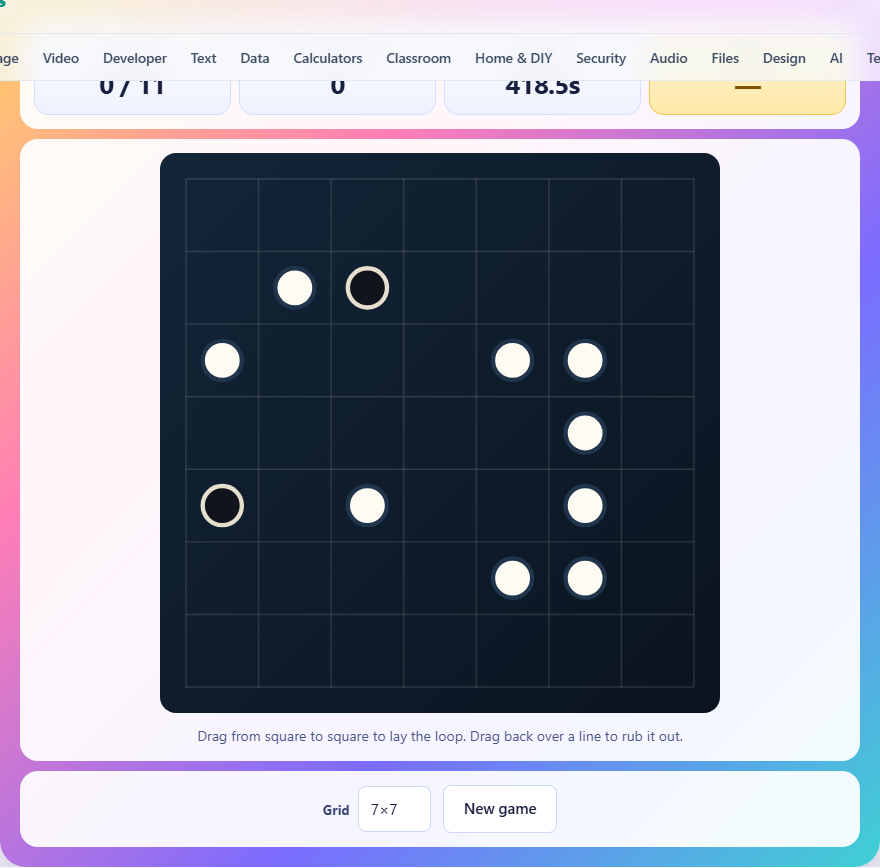
The two pearl rules
The board is a square grid scattered with pearls. Some pearls are white and some are black. You must draw a single closed loop that passes through every pearl on the board. The loop travels through the middle of each square, turns only at right angles, and never crosses itself.
A white pearl means the loop runs straight through it. The loop does not turn on that square. However, in at least one of the two squares directly beside it along the line the loop is following, the loop must make a turn. So a white pearl is always next door to a bend.
A black pearl means the loop turns on it. The loop changes direction by ninety degrees at that square. After the turn, the loop must then run straight for at least two squares in both directions leaving the pearl. A black pearl is always the corner of a long straight run.
Controls and input
To draw the loop, hold and drag from one square into the next. A line segment appears between them. Keep dragging to extend the path across several squares in one motion. To remove a segment, drag back over it. The loop does not need to be drawn in order. You can lay pieces anywhere on the board and connect them later.
The game tracks how many pearls your loop currently satisfies and how many line segments you have drawn. A timer counts down from the time limit, which depends on the grid size. When your loop is complete and correct, the game ends and shows your remaining time as the score. Higher remaining time is better.
Grid sizes and time limits
Three sizes are available. The six-by-six grid gives you five minutes, the seven-by-seven grid gives you seven minutes, and the eight-by-eight grid gives you nine minutes and twenty seconds. Larger grids have more pearls and more empty squares, so the puzzles are harder and take longer to solve.
Each board is generated fresh by drawing a random loop first and then reading the pearl types off it. The generator then removes pearls one at a time, checking after each removal that the board still has exactly one solution. The result is a puzzle that always has an answer and never has two.
Strategy: start at the edges
A pearl near the edge of the board has fewer ways the loop can reach it. A white pearl in the top row cannot have the loop cross it vertically, because there is no room above for the required bend. So the loop must run through it horizontally, left to right. That one deduction often pins the squares on either side as well.
A black pearl near a corner is even more constrained. The loop must turn on it and then run straight for two squares in both directions. If two of those squares would be outside the grid, only one orientation is possible. Edges are where the puzzle is most constrained, so they are where your deductions start.
Once you have resolved the edge pearls, the settled segments reach inward and constrain the interior. A segment that runs along the top row eventually turns downward, and that turn point is now fixed. Wherever the loop enters the interior from a resolved edge, it carries certainty with it. This ripple effect is why edge-first solving is so much faster than working from the middle outward.
Strategy: using black pearl pairs
Two black pearls sitting two squares apart in a line are a powerful clue. Each one needs the loop to run straight for at least two squares in both directions after turning. If another black pearl sits exactly two squares away, only one of the directions can accommodate both pearls at once. The loop through each pearl is decided, and the straight segments between them lock several squares into place.
Look for these pairs early. They settle large sections of the board in a single deduction. Even a black pearl sitting three or four squares from the edge can often be resolved, because the straight run it demands must fit inside the grid. Once you have fixed both pearls, the straight segments between them act as walls that divide the board and constrain everything nearby.
Strategy: chains of white pearls
Two white pearls sitting side by side must both be run straight through, and they must be run in the same direction. If one is horizontal, the other must be horizontal too, because the loop cannot turn between them without violating the straight rule on one of them. A chain of three or four white pearls in a row fixes an entire stretch of the loop at once.
This also works with white pearls separated by one empty square. If the only way for both of them to satisfy the adjacency rule is to share a common bend in the square between them, then both orientations are settled. Scan the board for clusters of white pearls and use them as anchors.
Avoiding the small loop trap
The most common mistake is closing a tidy little loop that visits only some of the pearls. The rules demand a single closed loop through every pearl. A ring that shuts early is wrong no matter how clean it looks. Before you connect two ends of a partial path, check whether all pearls are already on that path.
A related mistake is leaving two separate loops on the board. Even if each one individually satisfies the pearl rules, two loops are not one loop. The puzzle requires exactly one closed ring. If you find yourself with two disconnected paths that both seem finished, one of them is wrong and needs to be reworked.
The safest way to avoid this trap is to keep the loop as one continuous growing path for as long as possible. Work outward from a resolved edge rather than drawing isolated fragments in the middle. Fragments are fine when you are certain where they belong, but connecting them later is where the accidental closure usually happens.
Common beginner mistakes
- Starting in the middle of the board where the squares are least constrained. Edges and corners give you forced deductions. The centre is for later.
- Ignoring the adjacency rule on white pearls. A white pearl demands a turn next door, not just a straight run through itself. Missing this makes the pearl look satisfied when it is not.
- Forgetting that the loop must turn on a black pearl. Drawing a straight line through a black pearl will not be flagged until you try to close the loop and the check fails.
- Trying to force the loop through empty squares that do not need it. The loop does not have to visit every square, only every pearl. Plenty of squares stay empty in a correct solution.
- Letting the timer pressure you into guessing. Random segments create contradictions that cost more time to untangle than careful deduction would have taken.
Reading the pearl counter
The scoreboard shows how many pearls your current partial loop satisfies, out of the total number on the board. A pearl counts as satisfied only when the loop passes through it with exactly two segments and the pearl rule is fully met, including the adjacency condition for white pearls and the straight-run condition for black ones.
This counter is your main progress indicator. When it matches the total, and the loop is a single closed ring, the puzzle is solved. If the counter stalls, look for a pearl whose rule is not yet met and work outwards from there.
Nothing leaves your browser
The board generator, the uniqueness checker, and your best scores all run inside this page. The loop is built and then pearls are stripped away while a solver proves that only one answer remains. There is no server, no account, and no data sent anywhere. Your best time is saved in local storage on this device and stays there. Once the page has loaded the game works without a network connection.