
Mastering Peal: a guide to change ringing puzzles
Peal is a puzzle rooted in English change ringing, where heavy tower bells can only shift one place at a time and no arrangement may ever be repeated. Here is how the game works, what makes it hard, and how to ring the bells into order without wasting a single change.
How the game works
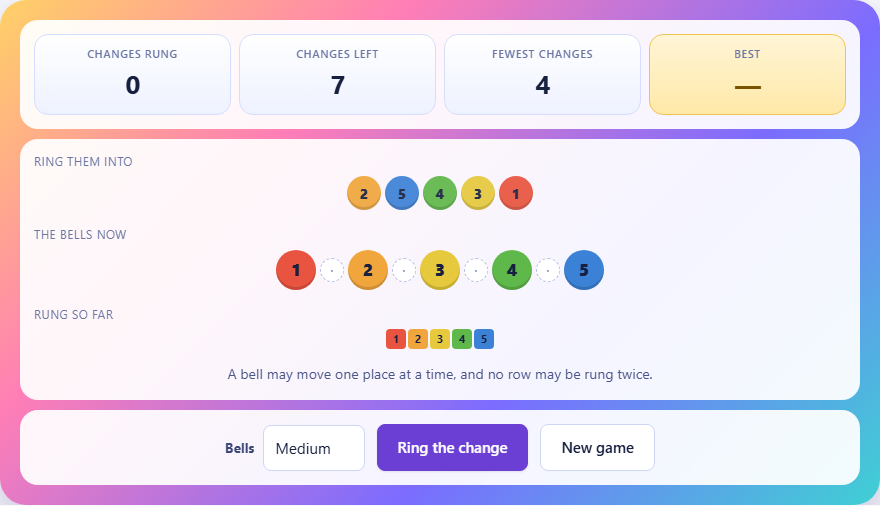
The bells start in a row, numbered from the lightest to the heaviest. Above the row you can see the target order you need to reach. Your job is to swap neighbouring pairs of bells, one change at a time, until the current row matches the target.
A change is a set of swaps. You may swap as many neighbouring pairs as you like in a single change, provided no bell appears in two swaps at once. On four bells you can swap up to two pairs. On five bells the limit is still two pairs, and on six bells you can swap three pairs in one go. Every change must move at least one bell, because standing still would repeat the row you are already on.
After each change, the new row is added to a sheet of rows already rung. If you ever produce a row that appears on that sheet, the game refuses it. You must find a path from the starting row to the target row that never revisits any arrangement.
Controls and interface
Between every pair of neighbouring bells sits a small dot. Tap or click a dot to mark that pair for swapping. The dot changes to show the swap is planned. Tap it again to cancel. If a dot is greyed out, it means one of the bells in that pair is already involved in another swap you have selected.
Once you have chosen your swaps, press the Ring the change button. The game plays the new row as a short melody, with each bell sounding in order from the front. Every bell has a different pitch, lower for the heavier bells, just as in a real tower. The Bells selector at the top lets you choose between Small, Medium, and Large, which correspond to four, five, and six bells.
Scoring and the par system
The game calculates the fewest changes needed to reach the target by searching every possible arrangement the bells can stand in. This figure is exact, not an estimate, because the total number of arrangements is small enough to search completely. On five bells there are a hundred and twenty arrangements. On six there are seven hundred and twenty.
You are given a budget of changes equal to the par plus a few spare. The spare count depends on the difficulty. If you use all your changes without reaching the target, the ringing breaks down and you lose. Your score is the number of changes you actually used, and fewer is better. The game saves your best score for each difficulty level.
Why the rules come from real bells
A tower bell weighs as much as a small car. It swings through a full circle on each stroke, and the ringer controls when it sounds by holding the wheel at the top of its swing for a fraction of a second longer or shorter. This means a bell can be hurried or held up by about one place in the row, but no more. That single physical fact produces the rule that a bell may only move one place at a time.
Because you cannot play a tune on bells that only shift by one place, English ringers instead set out to ring every possible order, moving each bell one step at a time and never repeating an arrangement. On seven bells that means five thousand and forty rows, which takes about three hours. The named methods, such as Plain Bob and Grandsire, are simply agreed routes through all those orders that a ringer can learn from memory.
Strategy: reading the distance
Before you make your first move, look at how far each bell has to travel. A bell that needs to move three places to the right will need at least three changes to get there, because it can only shift one place per change. If two bells are far from home, you need to start moving both of them early.
Pair up your swaps to do double duty. A change that swaps two pairs advances two bells at once, which is better than two changes that each move one bell. On six bells, swapping three pairs in a single change is the fastest possible progress. Look for changes where every swap moves a bell closer to its target position.
Strategy: avoiding repeated rows
The no-repeat rule is the trap that catches most players. Early on there are few rows on the sheet, so almost anything works. But as the sheet fills up, your options shrink. A swap that looks efficient might produce a row you rang three changes ago.
Think of the arrangements as places on a map and your changes as roads between them. The shortest route from start to target never visits the same place twice, so par and the no-repeat rule are naturally compatible. The problems start when you take a wrong turn and need to reach the target without retracing your steps. Once you have used a row, it is gone, and a detour costs extra changes you may not have.
Before pressing Ring the change, scan the sheet of rung rows. If the row you are about to create looks familiar, check whether it already appears. The penalty for a rejected change is not losing a turn but losing time and confidence.
Strategy: working from the ends
Bells at the ends of the row are the hardest to move. A bell at position one can only swap with bell two, so it can only move right. A bell at the far end can only move left. Any bell that needs to cross the entire row will take the most changes, and it will need to start moving immediately.
If the target has the first bell at the far end, or vice versa, expect the par to be high. Prioritise those long journeys first. Bells in the middle of the row have two neighbours and can move in either direction, so they are more flexible and can wait a turn or two.
Common beginner mistakes
- Moving one pair at a time when you could swap two or three. Every change you waste brings you closer to the budget limit.
- Ignoring the sheet of rung rows until a change is rejected. Checking the sheet before each move saves wasted attempts.
- Focusing on one bell and pushing it home while leaving the others behind. All bells need to reach their targets, and a bell sitting in the right place can still be moved by a neighbouring swap you did not plan for.
- Pressing Ring the change with no swaps selected. The game requires at least one swap per change, just as real ringers must move something every time.
- Choosing the largest bell count without practising on smaller ones. Four bells has only twenty-four arrangements and the puzzles are gentle. Five and six bells are much harder.
Difficulty levels
Small uses four bells. The arrangements are few, the par is low, and the spare changes are enough to recover from a mistake or two. This is the right place to learn the swapping interface and get used to reading the sheet.
Medium uses five bells. The number of arrangements jumps to a hundred and twenty, and the puzzles can demand five, six, or seven changes. The spare budget is three, so you have some room but not much. This is where the no-repeat rule starts to bite.
Large uses six bells. Seven hundred and twenty arrangements and the chance to swap three pairs at once make for a richer puzzle. The spare budget is four, which sounds generous until you realise that a par of seven or eight is common. Every wasted change is a step closer to breaking down.
Nothing leaves your browser
The puzzle generator, the path search, and your best scores all run inside this page. The shortest route is found by a breadth-first search through every arrangement, which happens in a fraction of a second on any modern device. There is no server, no account, and no data sent anywhere. Your best score is saved in local storage on this device and is never uploaded. Once the page has loaded the game works without a network connection.