
Filling a square where no regiment or rank repeats
This article explains the three rules that govern the officers puzzle, how to split the work into two passes, the history behind the impossible six by six board, and how to clear the counter without going in circles.
The three rules of the parade ground
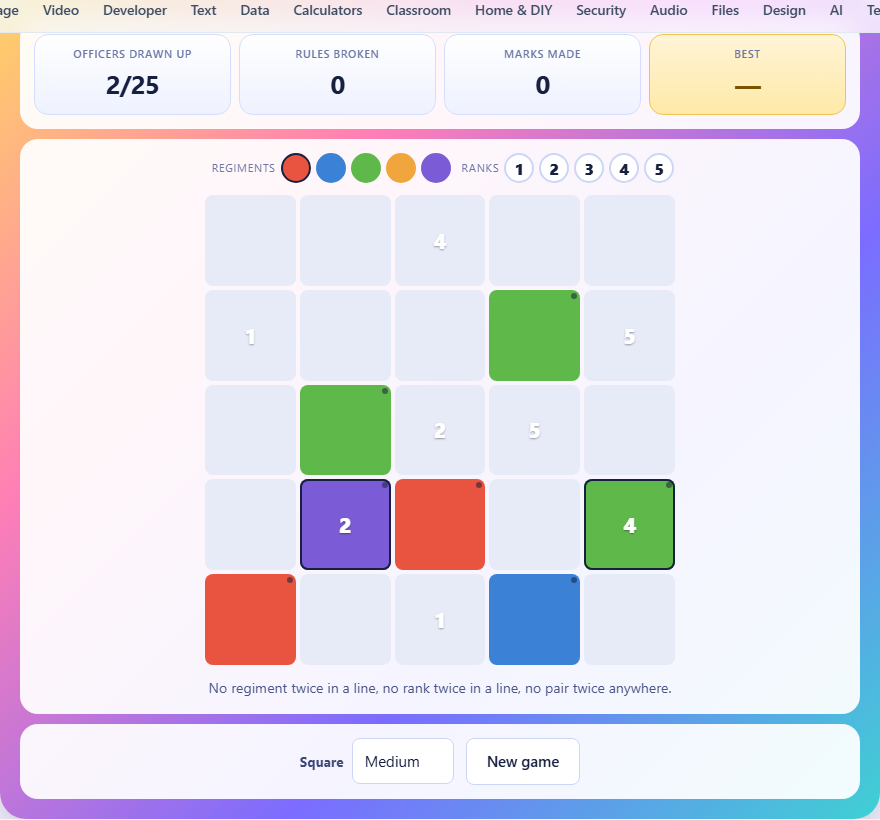
Every square on the board holds one officer. Each officer belongs to a regiment and holds a rank. Regiments are shown as colours. Ranks are shown as numbers. The three rules are: no regiment may appear twice in any row or column, no rank may appear twice in any row or column, and no two officers anywhere on the board may share the same combination of regiment and rank.
On a five by five board there are five regiments and five ranks, making twenty-five colour-number pairs and twenty-five squares. Every pair appears exactly once. When all three rules hold at once and every square is filled, the puzzle is solved. The counter at the top shows how many rules are currently broken. Your aim is to watch it drop to zero.
How the controls work
A toolbar above the board shows all the regiments as coloured dots and all the ranks as numbered dots. Tap a regiment dot to arm that colour. Then tap any square on the board to paint it with that regiment. Tap a rank dot to arm that number, then tap a square to assign that rank to it.
To clear a square, tap it with the same value it already holds. If a square is painted red and you arm the red regiment and tap it, the red clears. Nothing is ever stuck.
Some squares are pre-filled when the puzzle starts. These are outlined in dark and cannot be changed. They give you a starting scaffold to build from.
Splitting the work: colours first, then numbers
The easiest way to solve a parade is to split it into two separate problems. First, ignore the ranks entirely. Arm one regiment colour at a time and fill it into every row and every column exactly once. This is a Latin square on its own, and you can verify it independently. Each row gets one of each colour. Each column gets one of each colour.
Once the colours are right, switch to the ranks. Arm one number at a time and fill it in so that each row and each column gets one of each number. This is a second Latin square laid on top of the first.
If both Latin squares are correct, the third rule about pairs almost always follows. Every colour-number combination will appear exactly once because the two squares together form what mathematicians call a Graeco-Latin square.
Working from the fullest row or column
When a row already has four of its five colours set by the starting clues, the fifth colour has only one place it can go. Start there. Fill in the forced squares first, then move to the rows and columns with fewer clues.
Every forced square you fill in makes some other row or column more constrained. A cascade of forced moves can carry you through half the puzzle before you have to make a real choice. The more you fill from the edges inward, the fewer choices remain at the centre.
If you ever get stuck, try a different colour or number for the square you are on. The tap-to-clear control means nothing is permanent until the puzzle is complete.
Checking the counter as you go
The faults counter counts every broken rule. A regiment that appears twice in one row is one fault. The same regiment appearing twice in one column is another. A repeated colour-number pair anywhere on the board is a third. They all add up.
Watch the counter fall as you work. If it goes up after a move, something you placed is clashing with something already on the board. Undo it immediately. If it stays the same, the move was neutral and you may have placed it in a row that is not yet full.
The counter does not tell you which square is wrong. It only tells you how many rules are broken. Finding the offending square is your job, and that is part of the puzzle.
The history: why six by six does not exist
In 1782, the mathematician Leonhard Euler asked whether thirty-six officers from six regiments, each sending one officer of each of six ranks, could be drawn up in a six by six square with no regiment or rank repeated in any row or column. He could not do it. He guessed that it was impossible, and impossible for ten, fourteen, and every size two more than a multiple of four.
Gaston Tarry proved him right about six in 1901, checking every possible arrangement by hand. But in 1959, three mathematicians showed that Euler was wrong about everything else. Ten works. Fourteen works. Every size works except two and six.
The sizes in this puzzle are all ones that work. On the Small board the grid is three by three. On Medium and Large it is five by five. Six is missing because it truly cannot be done.
Strategy: elimination by row and column
When you are stuck, pick one colour and ask: where can it go in this row? Cross off every column where that colour already appears. Cross off every square that is pre-filled with a different colour. What remains is the short list of places it could sit. If only one square is left, that is where it goes.
Do the same exercise for every colour in that row, then move to the columns. Then repeat with the ranks. Each time you place one officer by elimination, the remaining squares become more constrained, and the next elimination gets easier.
This kind of pencil-and-paper reasoning is the core skill. Guessing works on the three by three board but it falls apart on the five by five. Elimination always works.
Mistakes that raise the counter
Common errors come from working too fast and not checking rows and columns before placing.
- Placing a colour without scanning the full row and column first. A regiment that looks free in the row might already appear in the column.
- Filling ranks before the regiments are correct. If the colours still have faults, adding numbers on top makes the mess worse. Finish one layer before starting the other.
- Ignoring the pre-filled squares. They are there to constrain the puzzle. Skipping over them and placing freely leads to clashes that are hard to trace back.
- Trying to fix faults by adding more officers instead of removing wrong ones. If the counter is high, clear some squares and start that colour or rank over.
- Placing every colour in one row at once instead of spreading across the board. One row can look perfect while causing five columns to break.
The three board sizes
Small is a three by three grid with three regiments and three ranks. Nine squares, nine officers, and only nine possible colour-number pairs. About half the squares are given, so the puzzle is quick and works well as a tutorial.
Medium is five by five with five regiments and five ranks. Twenty-five squares and twenty-five combinations. About two fifths of the squares are pre-filled. This is where the two-pass method becomes important because there are too many squares to hold the whole picture in your head at once.
Large is also five by five but with fewer starting clues. Roughly a third of the squares are given, which means more choices and more chances to create a fault that takes time to track down. The puzzle often has more than one valid solution, so you are not searching for the one right answer. Any arrangement that obeys all three rules is accepted.
Everything runs on your device
The puzzle, the fault counter, and your best mark count all run inside your browser on this page. Nothing is sent to a server. There is no account and no sign-up required. Your best score is saved in local storage on this device only and is never uploaded anywhere. Once the page has loaded, the puzzle works fully offline and does not need an internet connection.