
Winning the seven-point rally with angle and position
This article covers how the ball bounces, why the computer can be beaten even though it always knows where the ball is, and which paddle positions turn a losing game around.
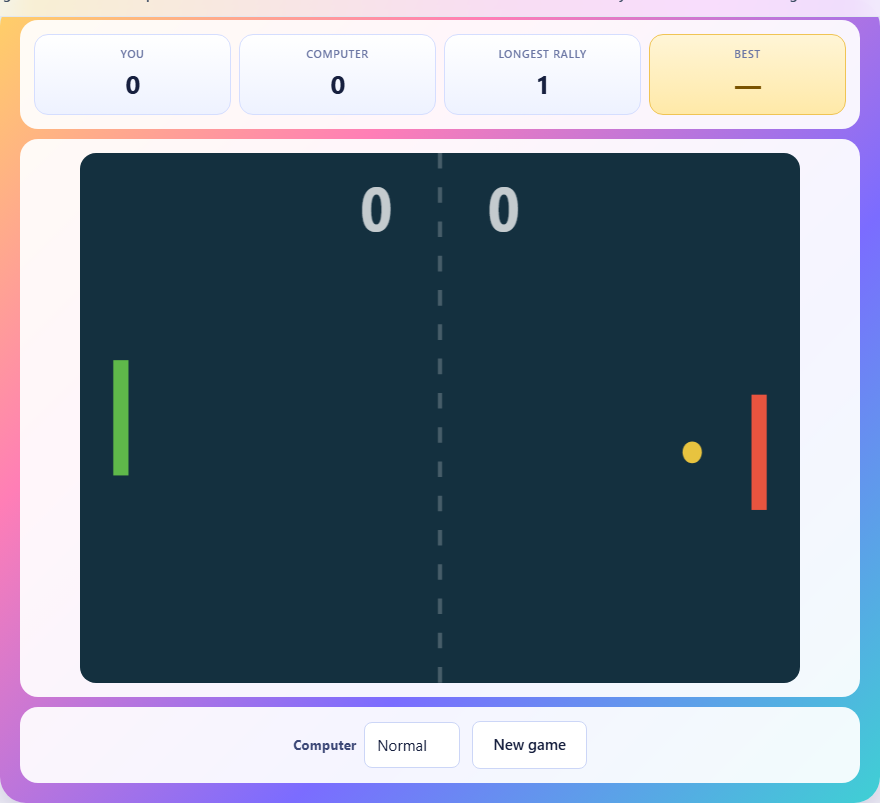
The court and the goal
Two paddles face each other across a dark court. You control the green one on the left. The computer controls the red one on the right. A yellow ball bounces between them. If the ball passes your paddle, the computer scores a point. If it passes the computer's paddle, you score. The first side to reach seven points wins.
After each point there is a short pause before the next serve. The ball starts from the centre of the court and flies toward the player who just lost the point. That pause matters. It gives you a moment to bring your paddle back to the middle before the next ball arrives.
Controls on every device
On a desktop, move the mouse up and down over the game area. The paddle follows your pointer. On a phone or tablet, slide your finger up and down anywhere on the court. The paddle tracks wherever your finger goes.
Keyboard players can press the up arrow or the W key to move up, and the down arrow or the S key to move down. Each press shifts the paddle by a fixed step. Holding the key sends it gliding in that direction.
The game scales to your screen. On a wide monitor the court fills the space. On a small phone the court shrinks to fit, and the touch target stays big enough for a thumb. Whichever input you use, the paddle only moves up and down. There is no forward or backward movement. Your job is to be in the right vertical position when the ball arrives.
How the bounce angle works
Where the ball hits the paddle decides the angle it leaves at. Hit the dead centre and the ball goes back roughly straight. Hit the top edge and it flies upward at a steep slant. Hit the bottom edge and it flies down steeply.
This is the only aiming tool you have. There is no spin button or power shot. You steer the ball by placing your paddle so the ball meets the part that sends it the way you want. Want the ball high? Let it catch the top of the paddle. Want it low? Let it catch the bottom.
The steepest angles come from the very tip of the paddle. A ball that just clips the top or bottom leaves at nearly a right angle to the way it came in. Those are the hardest returns for the computer to chase down.
The ball speeds up every hit
Each time the ball touches a paddle it gets a little faster. The ball starts at a speed of five. Every hit adds a quarter of a unit. It can climb all the way to eleven, more than double its starting pace.
After five or six hits the change is barely visible. By twenty hits the ball is noticeably quicker. Near the cap it crosses the court so fast that you have almost no time to react. That is what makes long rallies risky. The ball you caught with ease on hit five is the same ball that slips past you on hit thirty.
The lesson is simple. Do not try to keep rallies going forever. End them. A sharp angle that scores in four hits is safer than a long rally that leaves you chasing a ball at twice the starting speed.
How the computer opponent thinks
The computer knows exactly where the ball is at every moment. It never loses track and never blinks. What holds it back is a speed cap. Its paddle can only move so many units per frame, and that cap is what makes the game fair.
On Easy the computer paddle moves at a speed of about three and a half. On Normal it moves at five. On Hard it moves at nearly seven. The ball itself starts at five and can reach eleven, so even on Hard the ball can outrun the computer if the angle is steep enough.
Because the computer is limited by speed rather than random chance, it never throws a point away for no reason. Every point you score is a point you earned by making the ball travel further than the computer's paddle could follow.
Strategy: send the ball where the computer is not
Watch the computer's paddle before you return. If it is near the top of the court, send the ball low. If it is near the bottom, send it high. The goal is to force the computer to cover the greatest possible distance before the ball arrives.
The strongest pattern is a two-shot setup. Send one return to the top corner so the computer races up. When it sends the ball back, catch it on the opposite edge of your paddle and fire it low. The computer has to reverse and sprint the full length of the court. If the ball is fast enough by then, the computer will not reach it.
Do not try for the steepest angle on every shot. If you stretch too far you will miss the ball yourself. A moderate angle to the opposite side of the court from the computer is safer and still scores.
Strategy: return to the centre after every shot
After each return, bring your paddle back toward the middle of the court. The centre is the spot from which you can reach either a high ball or a low ball with the least travel. Leaving your paddle at the top after a high shot means a sharp low return will catch you stranded.
The computer does this on its own because it always tracks the ball, and the ball crosses through the middle on every exchange. You have to build the habit yourself. Return the ball, then slide back to centre before it comes back.
Centering is most important on a fast ball. A slow ball gives you time to react from any position. A fast one does not. If you are already in the middle when it arrives, you only need to move half the court at most. If you are stuck at one edge, you need to cross the whole thing.
Mistakes that cost points
Most points are lost to habits that feel safe but leave you open. Here are the ones to watch for.
- Hitting every ball with the middle of the paddle. Straight returns are the easiest for the computer because it barely has to move.
- Staying at one end of the court after a shot. This gives the computer a free path to the opposite corner.
- Ignoring the speed increase. The ball after twenty hits is far quicker than the ball you launched. If you still play at launch speed, you will miss.
- Extending rallies on Hard. The computer on Hard is fast enough to chase most returns, so long rallies let the ball speed climb without giving you an edge. Score early with steep angles instead.
- Chasing the ball after it passes your paddle. Once the ball is behind you, the point is already gone. Focus on getting ready for the next serve.
What the three levels change
The level selector changes one thing: how fast the computer's paddle can move. Your paddle speed stays the same. The ball speed and the speed gain per hit stay the same. The score needed to win stays at seven.
On Easy the computer is slow enough that a wide angle to the far corner will score most of the time. On Normal the computer can reach most returns unless the angle is steep and the ball has picked up speed. On Hard the computer gets to nearly everything, and you need sharp angles combined with a fast ball to break through.
Start on Easy to learn aiming with different parts of the paddle. Move to Normal once you win easily. Try Hard when you want a real fight.
Everything runs on your device
The ball, the paddles, and the score counter all run inside your browser on this page. Nothing is sent to a server. There is no account and no sign-up. Your best rally length is saved in your browser's storage on this device alone. Once the page has loaded, the game works offline. Close the tab and the session ends.