
Aligning planets by nudging their starting positions
What the rings and meridian represent, why some arrangements can never align no matter how long you wait, how shared factors between ring sizes create the real difficulty, and the thinking that turns a confusing readout into a solved puzzle.
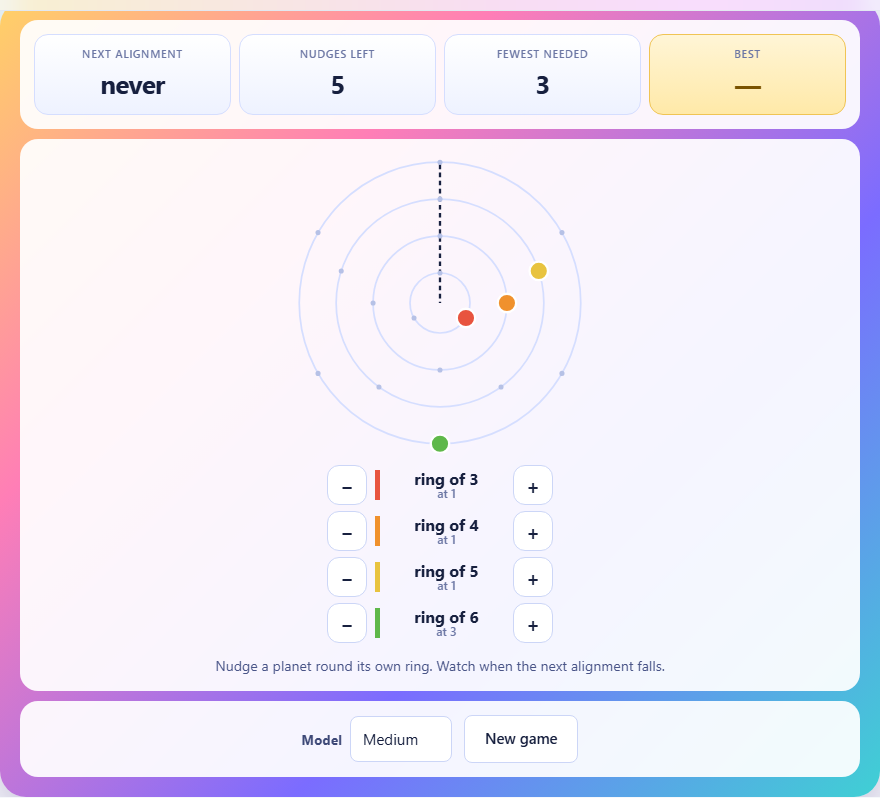
The setup
Concentric rings sit around a central point. Each ring has a planet on it and a fixed number of equally spaced stops. A ring of five has five stops. A ring of eight has eight. Every year, every planet advances one stop around its own ring. A planet on a ring of five returns to the same position every five years.
A dashed line runs from the centre straight up. That is the meridian. The puzzle is solved when every planet sits on the meridian at the same moment. You cannot speed up or slow down any ring. The only thing you can do is nudge a planet forward or back by one stop on its own ring.
What the readout tells you
The scoreboard shows when the next alignment falls. If every planet is already on the meridian, it says now. If they will all land on the meridian in twelve years, it says year 12. If no year satisfies every ring at once, it says never.
That single word is the entire feedback loop. Every time you nudge a planet, the readout updates. Your goal is to make it say now. Not year 3, not year 50. Now. An alignment in the future means the planets will line up eventually, but the puzzle asks you to line them up at year zero.
Nudges and the budget
Each nudge moves one planet by one stop. The plus button advances it clockwise and the minus button moves it the other way. Both cost one nudge from your budget. You get a fixed number of nudges, shown on the scoreboard alongside the fewest needed.
The fewest needed is the number of nudges used to scramble the puzzle before it was shown to you. That is the par. Your budget is the par plus a few extra. On the Small model the slack is two. On Medium it is also two. On Large it is three.
Every nudge matters. A wrong nudge does not just waste one move. It can push the alignment from a few years away to never, and then you need another nudge to undo it.
The three models
The Small model has three rings with 3, 4 and 5 stops. These are small numbers with few shared factors, so the alignment year is usually within a short range. Two scramble nudges make the par, and you get four total.
The Medium model has four rings with 3, 4, 5 and 6 stops. The ring of 6 shares a factor with both the ring of 3 and the ring of 4, which creates entangled constraints. Three scramble nudges and five total.
The Large model has five rings with 4, 5, 6, 7 and 9 stops. The shared factors multiply here. The rings of 4 and 6 share 2. The rings of 6 and 9 share 3. Four scramble nudges and seven total. On this model, every nudge is a careful decision.
Why shared factors make rings difficult
Two rings whose sizes share a factor can only agree if they start in step with each other. Take two rings of 6. They both return to the meridian every 6 years. If one is at stop 0 and the other is at stop 2, the first hits the meridian in years 0, 6, 12. The second hits in years 4, 10, 16. They never meet.
No amount of waiting fixes this. The mismatch repeats forever. Only a nudge can close the gap. This is the central idea of the puzzle. Rings with coprime sizes, meaning they share no factor except 1, will eventually align by themselves if you just wait. Rings with a shared factor might never align unless you nudge one of them.
On the Medium model, the ring of 6 and the ring of 3 share the factor 3. If they are out of step by one position, you must nudge one of them to fix it. The ring of 6 and the ring of 4 share the factor 2, adding another constraint on top.
Fix the biggest ring first
A large ring constrains the alignment year tightly. A ring of 9 only visits the meridian every 9 years, so the alignment year must be a multiple of 9 minus the planet's current offset. That narrows the choices far more than a ring of 3, which visits the meridian three times as often.
Start with the biggest ring. Nudge it so that its planet sits at stop 0, right on the meridian. Now the alignment year must be a multiple of the ring size. From there, work down to the next largest ring. Nudge it until the readout moves from never to a real year.
This order is not the only one that works, but it avoids the trap of fixing three small rings only to discover that the large ring refuses to cooperate and undoing the whole sequence.
Nudging backward is often shorter
On a ring of 6, nudging forward by 5 stops lands on the same position as nudging backward by 1 stop. Both reach the same place. But nudging forward 5 times costs 5 from your budget. Nudging backward once costs 1.
Before you nudge forward several times to reach a target stop, check whether going the other way is shorter. On a ring of 7, forward 4 is the same as backward 3. On a ring of 9, forward 5 is the same as backward 4. Always count both directions and pick the cheaper one.
The readout reacts instantly to each nudge. If you are not sure which direction helps, nudge once and read the result. If it got worse, nudge back and try the other way. That costs two nudges but settles the question.
Reading the position display
Each ring shows a label like ring of 5 with a smaller note saying at 3. The at number is the planet's current stop. Stop 0 is the meridian. Stop 1 is one place past it. Stop 4 on a ring of 5 is one place before it, because one more step forward would bring it back to 0.
The at number tells you exactly how many nudges you need to bring that planet to the meridian, in either direction. On a ring of 5 at stop 3, you can nudge forward twice to reach 5, which wraps to 0. Or you can nudge backward three times. Forward costs 2, backward costs 3. Forward wins.
A worked example on the Medium model
The rings are 3, 4, 5 and 6. The positions are at 1, at 2, at 0, at 4. The readout says never. The ring of 5 is already on the meridian, which is good.
Start with the ring of 6 at stop 4. Nudge forward twice to reach stop 6, which wraps to 0. Budget spent so far is 2. The readout changes from never to year 12.
Now the ring of 4 at stop 2. Nudge forward twice to reach stop 4, which wraps to 0. Budget is 4. The readout changes to year 3.
The ring of 3 at stop 1. Nudge backward once to stop 0. Budget is 5. The readout says now. Solved in 5 nudges.
Common mistakes
- Nudging without reading the readout first. One blind nudge can push the alignment to never and waste a move you cannot afford.
- Fixing the smallest ring first. Its constraints are the loosest. Save it for last, when the bigger rings have locked down the year.
- Forgetting that backward is cheaper. Always count both directions before committing.
- Assuming the alignment year must be zero from the start. The readout might say year 4, and that is fine as long as your remaining nudges can bring it to now.
- Spending all slack nudges early. The extra nudges are your error margin. If you use them all on the first ring, one mistake later will end the game.
How the puzzles are built to be fair
Every puzzle starts with a real alignment. The game picks a year, places every planet exactly where it needs to be for that year, and then scrambles the positions a known number of times. The par is that scramble count. If the scramble lands back on an alignment by accident, one more nudge is added.
Because the puzzle is made by undoing a known arrangement, it can always be solved within the budget. The challenge is finding the path back, not wondering whether one exists.
Your data stays on your machine
The rings, positions and alignment search all run inside your browser. No data is sent to any server. Your best score is saved locally and stays on this device alone. Once the page has loaded, you can disconnect from the internet and keep playing without any change in how the game works.