
Training your eyes to catch a tiny brightness shift
What the game tests, why only the lightness changes and never the hue, how the three difficulty levels shape the rounds, and the visual habits that let you find the tile before conscious searching kicks in.
What you are looking at
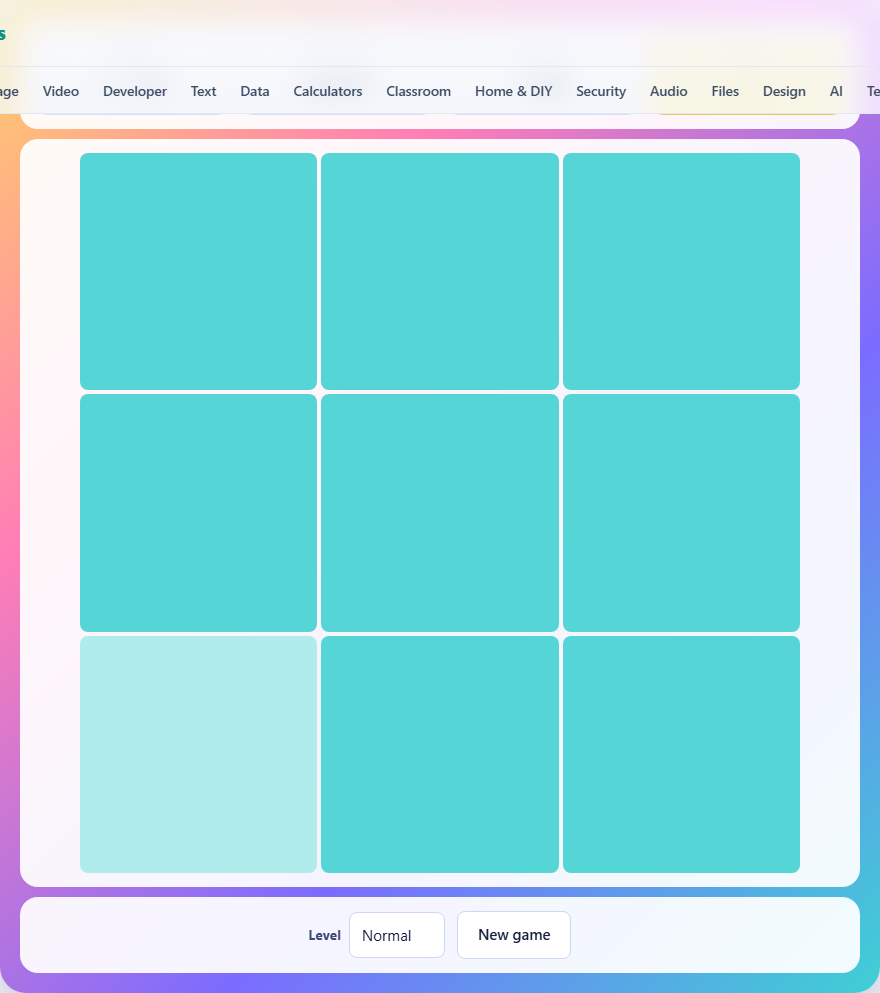
A grid of coloured tiles fills the play area. Every tile is the same colour except one. That tile is very slightly lighter than the rest. Your job is to find it and tap it. Each round picks a new random hue, but the odd tile always differs in lightness, never in hue.
The reason is biology. Human vision is far more sensitive to a change in colour than to a change in brightness. Two shades of the same blue are much harder to tell apart than a blue tile next to a green tile. By keeping the hue identical, the game tests the limit of your brightness perception.
How the difficulty climbs
Every round, the lightness gap between the odd tile and the others shrinks by a fixed proportion. On Normal mode it shrinks by 12 percent each round. On Easy it shrinks by 10 percent, and on Hard by 14 percent. The starting gap is also different for each level. Easy begins at a 26 percent difference. Normal starts at 22. Hard starts at 18.
The grid itself grows too. It starts at three by three and adds a row and a column every three rounds, topping out at seven by seven. A bigger grid means more tiles to scan and a smaller chance that the odd one is right where your eyes land first.
The result is a smooth ramp. Round one is obvious. By the middle rounds you have to look carefully. By the final rounds the difference is barely visible, somewhere around one or two percent in lightness.
The three levels and their targets
Easy asks you to complete 12 rounds in 90 seconds. The lightness gap starts wide and shrinks slowly, so you have time and the difference is forgiving.
Normal asks for 16 rounds in the same 90 seconds. The gap starts smaller and shrinks faster. By round 12 you are already past what Easy ever reaches.
Hard asks for 20 rounds in only 75 seconds. The gap starts small, shrinks the fastest, and you have less time per round. Finishing Hard without a wrong tap is a genuine test of colour perception.
What happens when you tap wrong
A wrong tap does not end the game. It takes three seconds off the clock. This penalty is deliberate. When the difference is very small, an honest mistake should cost you time, not the entire run. You can keep tapping, but each wrong answer eats into your remaining seconds.
The tile you tapped flashes briefly so you know which one it was. Use that feedback. If you tapped a tile near the middle and it was wrong, the odd tile is probably somewhere else. Scan the edges before you try again.
Defocusing and peripheral vision
The best technique is counterintuitive. Do not stare at individual tiles. Instead, soften your focus so the whole grid becomes a blurred mass. A tile that is a fraction lighter will jump out of a blurred field far more readily than a sharp one.
The reason is that peripheral vision is good at detecting differences across a wide area, even though it cannot read fine detail. When you focus hard on one tile, you compare it to its immediate neighbours and nothing else. When you defocus, your brain compares the entire grid at once.
This technique works best in the early and middle rounds, where the gap is still large enough for peripheral vision to catch. In the final rounds, you may need to switch to a systematic scan because the difference is too small for any shortcut.
Your screen changes the game
Brightness, viewing angle and ambient light all affect how small a difference you can see. A phone screen at full brightness in a dim room gives the clearest image. The same phone at half brightness in direct sunlight turns a visible difference into a guessing game.
Some displays have better colour uniformity than others. A monitor with uneven backlighting might make one corner slightly brighter than the other, adding a false signal that confuses the search. If you play on a large screen, sit directly in front of it so the viewing angle is the same across the whole grid.
None of this is a flaw in the game. It is part of what makes the challenge interesting. You are testing your screen as much as your eyes, and the combination of the two is what your score measures.
Where to look when you are stuck
Attention drifts to the centre of a grid. If you have been staring at the middle tiles for three seconds and nothing jumps out, force your eyes to the corners. The odd tile is just as likely to be at the edge as the centre, but your gaze goes to the middle by default.
Another trick is to scan in a cross pattern. Look at the top row, then the bottom row, then the left column, then the right column. This covers the four edges in about two seconds and catches anything your central scan missed.
On a seven by seven grid, 24 of the 49 tiles sit on the outside ring. That is almost half the board. Skipping the edges means you are ignoring close to half the possible answers.
Timing and rhythm
Each round should take between three and six seconds. In the early rounds, where the difference is large, you can find the tile in under two seconds and bank time. Use those fast rounds to build a cushion for the hard ones at the end.
If you cannot find the tile within five seconds, try the defocus trick or the edge scan. Do not freeze and stare. A wrong tap costs three seconds, but so does staring at the same spot for three seconds without tapping. Sometimes a guess in the right area is better than no guess at all.
On Hard mode, the 75-second clock means you average under four seconds per round across all 20. That is tight. Any round that goes past six seconds puts you behind.
Mistakes that eat time
- Scanning tile by tile in order. This is slow and fights your peripheral vision instead of using it.
- Playing at low screen brightness. Turn it up before you start. The difference between tiles shrinks with brightness.
- Tapping fast without checking. Two wrong taps cost six seconds. One careful look costs less.
- Ignoring the edge tiles. Nearly half the grid sits on the border and your eyes skip it by habit.
- Playing in bright sunlight. Glare washes out the small lightness differences that decide the late rounds.
A worked example across four rounds
Round one. The grid is three by three, so nine tiles. The hue is a warm orange and the odd tile is clearly lighter. You find it in a second, top right corner.
Round four. The grid is still three by three but the gap has shrunk to about 16 percent. You defocus and it jumps out, centre left. Two seconds.
Round seven. The grid is now four by four. Sixteen tiles. The hue is a deep purple and the gap is around 10 percent. Your peripheral scan catches a slightly paler tile on the bottom row. Three seconds.
Round twelve. Five by five. Twenty five tiles. The gap is below 6 percent. You scan the edges first, find nothing, defocus across the whole board, and the tile appears in the second row. Five seconds and you barely saw it.
What happens after the last round
If you finish all the target rounds before the clock runs out, the game reports how small the final gap was and how many wrong taps you made. Reaching the end with zero wrong taps is a clean run.
Your best score is saved in your browser on this device. It records the number of rounds completed, so finishing all 16 on Normal is the goal. If the clock runs out, your score is the last round you cleared.
Improving over multiple sessions
Colour perception is partly trainable. The more you play, the better your brain becomes at detecting small lightness differences. After a few sessions, rounds that once felt impossible start to feel merely hard.
Try playing at different times of day. Your eyes are more sensitive in the evening when they have adapted to indoor light. Morning sessions in a bright room tend to produce lower scores because your pupils are constricted and the contrast on screen looks weaker.
If you want to push your limits, play Hard mode until you can finish it, then try Normal mode again. The Normal rounds will feel almost generous by comparison.
Everything runs locally
The grid is generated entirely in your browser. A random hue is chosen, the lightness gap is calculated, and one tile is painted a fraction lighter. Nothing is sent anywhere. There is no server involved in the colour generation or the scoring. Your results stay in your browser and vanish when you clear your data.