
Reading the clues and filling the grid in picture logic puzzles
How to read the row and column clues in a nonogram, the overlap technique that gives you free squares, why marking empties is just as important as filling, and a full walkthrough of a five-by-five puzzle.
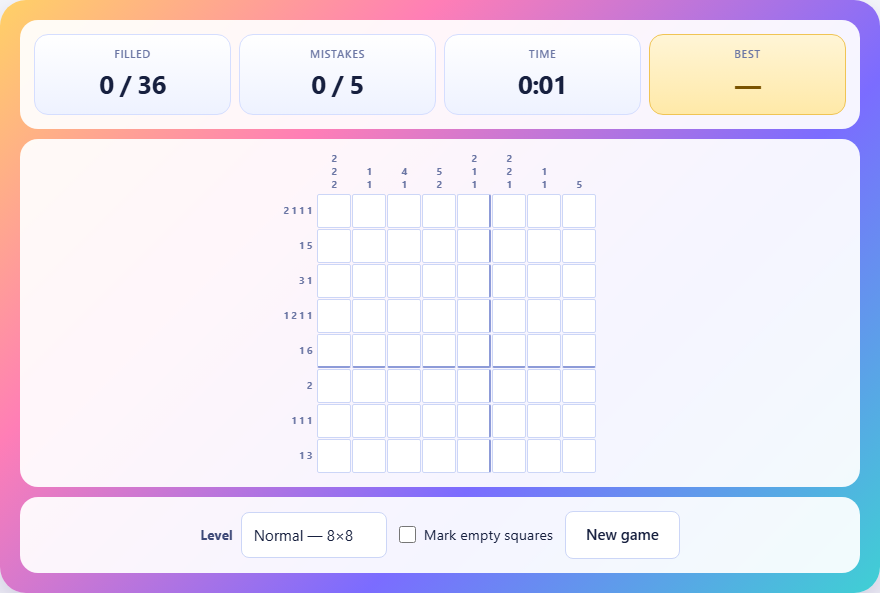
What the numbers are telling you
Every row has a set of numbers on its left side. Every column has a set of numbers above it. Those numbers describe the groups of filled squares in that line.
A single number, say 4, means there is one unbroken run of four filled squares somewhere in that line. The run could be at the start, the end or anywhere in the middle. The rest of the squares in that line are empty.
Two numbers, say 2 and 1, mean there are two separate groups. First a run of two filled squares, then at least one empty square, then a single filled square. The order is fixed - the 2 always comes before the 1 when you read from left to right or top to bottom. The gap between the groups is at least one square wide but could be more.
Controls and the three board sizes
Tap or click a square to fill it. If the square is part of the solution it turns dark. If it is not, it counts as a mistake and gets crossed out automatically. You are allowed five mistakes before the game ends.
Right-clicking a square marks it as empty with a cross. On touch screens, tick the checkbox labelled Mark Empty Squares and then tap normally - each tap places a cross instead of filling. Tap the crossed square again to clear the mark.
The level dropdown offers three sizes. Easy is a 5 by 5 grid, which takes a minute or two once you know the method. Normal is 8 by 8 and takes longer. Hard is 10 by 10 and can take a fair while, though the solving technique is identical at every size.
The overlap technique
This is the single most important idea in nonograms. When a clue is large relative to the length of the line, some squares must be filled regardless of where the run is placed.
Take a row of 10 squares with a clue of 8. The run of 8 can start at the first square and end at the eighth, or it can start at the second and end at the ninth, or start at the third and end at the tenth. Those are the only three positions. The middle six squares - squares three through eight - are filled in all three cases. You can fill them right away without knowing the exact position of the run.
The formula is simple. If a run of length R sits in a line of length L, the overlap is R minus the amount of wiggle room. The wiggle room is L minus R. So the overlap is 2R minus L. When that number is positive, the central squares of the run are guaranteed. For a run of 8 in a line of 10, the overlap is 16 minus 10, which is 6 squares in the middle.
When a line has multiple runs, the same logic applies to each one separately, but the available space for each run is reduced by the space the others must occupy. The arithmetic gets a little more involved, but the idea is the same: find the squares that every valid arrangement agrees on.
Why marking empties changes everything
New players focus on filling squares and ignore the empty ones. This is a mistake. Knowing that a square is empty is exactly as valuable as knowing it is filled, because both reduce the number of unknowns in every line that passes through that square.
When you complete a run, every square adjacent to it that is not part of another run must be empty. Mark those with crosses immediately. Each cross shortens the effective length of the line for the remaining clues, which tightens the overlap calculation and often produces more filled squares.
A clue of 0 means the entire line is empty. Cross out every square in it. That gives you information about every column that crosses that row. Always check for zero clues at the start of a puzzle - they are the easiest free progress you will find.
Cross-checking rows and columns
Every square sits at the intersection of one row and one column. When you fill a square because its row clue forces it, that filled square is now also a known cell in its column. The column clue can then be re-examined with this new information, which may force more squares in that column. Those new squares feed back into their own rows.
This back-and-forth between rows and columns is how the puzzle opens up. A single filled square from an overlap can trigger a chain that crosses the whole board. The chain stops when no line has enough information to deduce anything new, at which point you look for the next line with a tight clue.
Think of it as weaving. You work across a row, pick up whatever falls out of it, move down into the columns those squares belong to, work across those columns, and then bring the results back to the next row. The pattern is always the same.
A walkthrough on a five-by-five grid
Suppose the row clues, top to bottom, are 5, 1 1, 3, 1 and 2 1. The first row has a clue of 5 in a grid that is 5 squares wide. The run fills the entire row. All five squares are filled.
Now look at the columns. Each column just received a filled square in its top cell. Check each column clue against what is already known. If a column has a clue of 1 and its top square is now filled, the rest of that column is empty. Cross out the four squares below.
Return to the rows. The second row, clue 1 1, now has some crossed squares from the column work. If two of its squares are already crossed, the two runs of one must fit into the three remaining squares. That means the middle remaining square is empty - the two runs need a gap between them - and each run is exactly one square. Fill those two and cross the gap.
Keep alternating. Each pass through the rows and columns narrows the remaining unknowns until the picture appears. On a 5 by 5 board the whole process takes under a dozen steps.
Handling harder grids
On the 8 by 8 and 10 by 10 grids, the method is the same but the puzzles take longer because fewer lines have large enough clues to produce an immediate overlap. You may need to work through several rows and columns before anything falls out.
Start by scanning every line for the largest clue. A clue of 6 in a row of 10 gives an overlap of 2, which means the two middle squares of that run are filled. A clue of 3 in the same row gives no overlap at all. Prioritise the big clues.
Then look for lines with many runs. A row with clues 2 3 2 in a 10-square line leaves very little wiggle room because the three runs plus their mandatory gaps already consume 9 of the 10 squares. That row is almost fully determined.
Mistakes that slow you down
- Guessing when stuck. Every puzzle on this page is verified to be solvable by logic alone before it is shown to you. If you feel the need to guess, there is a line somewhere that gives more information. Scan every row and every column before trying a coin flip.
- Filling without checking the column. A square you fill in a row must also be consistent with its column clue. Getting excited about a row deduction and ignoring the column is how wrong guesses happen.
- Skipping the empty marks. Leaving unknowns unmarked hides information. Two minutes of careful crossing saves five minutes of confusion later.
- Starting in the middle of the grid. The edges and corners have the shortest lines and the tightest clues. Work from the outside in.
- Losing track of completed runs. Once a run is finished - all its squares are filled - mark the squares on either side of it as empty. Forgetting to do this leaves you with a row that looks half-done when it is actually almost solved.
How the puzzles are built
The generator creates a random picture by flipping each square to filled with about a 55 per cent chance. It then calculates the row and column clues from that picture and asks a solver to check whether pure logic can reconstruct the picture from those clues alone.
If the solver cannot finish - meaning the puzzle would require guessing - the picture is thrown away and a new one is generated. This loop runs up to 40 times, which is more than enough to find a clean puzzle at every size. What you see is guaranteed to have exactly one answer reachable by reasoning.
Your puzzle stays on your own device
The grid, the clues and your progress are all handled inside your browser. Nothing is uploaded and there is no account to sign up for. Your best time is stored in local browser storage and belongs to this device only. Close the tab and the only trace left is that stored time, which vanishes if you clear your browsing data.