
Training working memory with the n-back task
What the n-back test measures, how the three difficulty levels differ, why balanced accuracy stops guessing from working, and the mental technique that makes two-back manageable.
What happens during a round
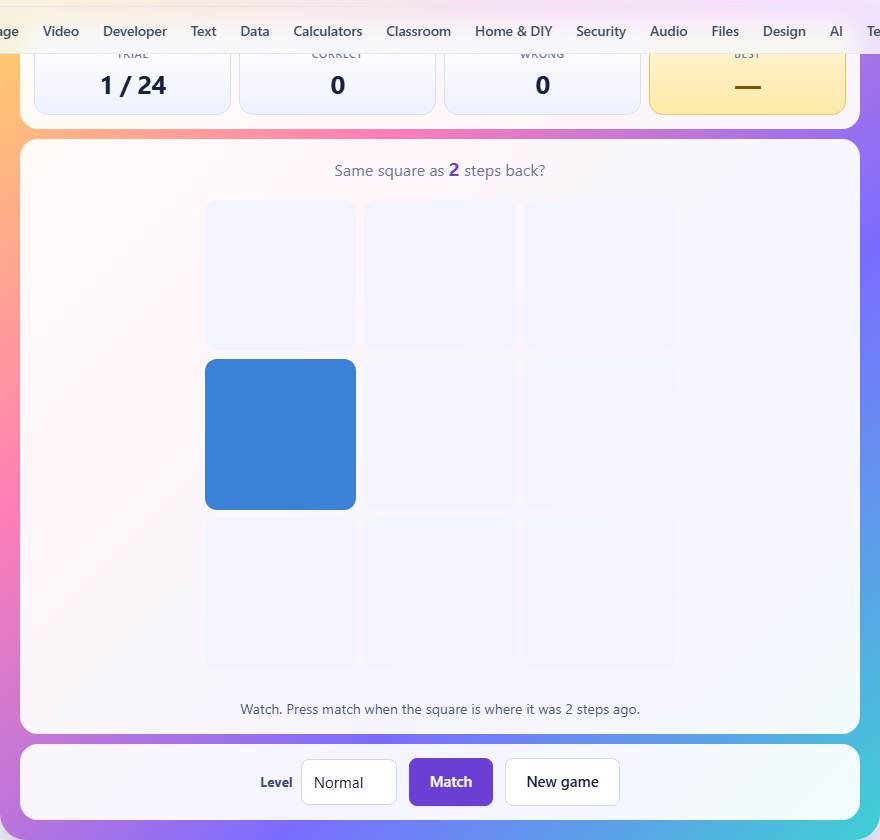
A three-by-three grid sits on the screen. One square lights up for less than a second, then goes dark. A moment later, a different square lights up. The sequence keeps going until the round ends.
Your job is to press the Match button whenever the current square is in the same position it was N steps earlier. At one-back, you are comparing the current flash to the one right before it. At two-back, you compare it to the one two flashes ago. At three-back, three flashes ago.
That is the entire task. There are no combos, no power-ups and no way to interact with the grid itself. You either press Match or you stay quiet, and the sequence moves on regardless.
Controls and input
Press the Match button on screen, or hit the spacebar, Enter or the A key on your keyboard. Any of those registers your answer for the current trial. You can only press once per flash - after that the input is locked until the next square appears.
There is no button for saying the square does not match. Silence is the answer. If the current position is not where the square was N steps ago, you do nothing and wait for the next one. This feels odd at first because most games ask you to respond to every prompt. Here, doing nothing is half of the correct behaviour.
The three difficulty levels
Easy runs a one-back test. You compare the current flash to the one immediately before it. The round has 20 trials, each lasting 2.4 seconds, and the pass mark is 85 per cent.
Normal runs two-back. You skip over the most recent flash and compare to the one before that. There are 24 trials at 2.2 seconds each, and the pass mark drops to 80 per cent. This is the version used in most published research, and it is harder than it sounds.
Hard runs three-back. You must hold three positions in memory and compare the current one to the oldest of the three. There are 28 trials at 2 seconds each, and the pass mark is 75 per cent. Even experienced players find three-back demanding.
How scoring works
The score is not a simple count of correct presses. It is balanced accuracy, which averages two separate rates: how many real matches you caught, and how many non-matches you correctly left alone.
This matters because the sequence is designed with roughly a third of its trials being matches. If you pressed Match on every single trial, you would catch every real match but you would also produce a false alarm on every non-match. Balanced accuracy for that strategy lands at about 50 per cent, which is below every pass mark.
The formula works the other way too. If you never press at all, you get a perfect score on non-matches but zero on real matches, and your balanced accuracy is again about 50 per cent. You have to actually distinguish the two cases to score well.
Why the square goes dark
The lit square disappears well before the next one appears. That gap is not a mistake. It is there to force you to answer from memory rather than from a side-by-side comparison.
If both the current and the previous square stayed lit at the same time, one-back would be a pattern-matching test instead of a memory test. Making the square vanish is what turns the task into a genuine measure of working memory. You have to hold the position in your head because the screen will not do it for you.
The dark window is also a natural moment to make your decision. If you know the position matched, press during the dark gap. If you are not sure, let the pause run out and watch the next flash.
The rolling pair technique for two-back
The biggest mistake at two-back is trying to remember a growing list of positions. By trial ten you are juggling five or six locations in your head and the list collapses.
People who perform well on two-back do something different. They keep exactly two positions in mind at all times. When a new flash appears, they compare it to the older of the two. Then they drop the older one and slide the newer one into its place, making room for the current one. It is a first-in, first-out pair.
In practice this feels like a slow mental swap. Flash appears at top-right. You compare it to whatever you had two back. Then you forget that old one, shift the recent one to the back slot and put top-right in the front slot. Two positions, always two, and the swap happens every trial.
This technique does not make two-back easy. It makes it possible. Without it, most people hit a wall around trial eight and start guessing.
Extending the technique to three-back
Three-back uses the same idea but with a rolling group of three instead of two. When a new flash appears, you compare it to the oldest of the three, drop that oldest one, and shift everything forward.
The difficulty is that three things are near the limit of what most people can hold and update at once. The swap step takes longer, and if you fumble it the whole chain breaks. The lower pass mark at three-back reflects this - even getting 75 per cent right requires solid focus for the full 28 trials.
If three-back feels impossible at first, spend more time on two-back until the rolling pair is automatic. The mechanics are the same, and the extra position is a matter of practice rather than a completely new skill.
Common mistakes and how to avoid them
- Pressing on instinct. A familiar position feels like a match even when it appeared three trials ago instead of two. Pause long enough to check which slot you are comparing before you press.
- Spamming the button. Pressing on every trial guarantees you catch every match, but it also produces a false alarm on every non-match. Balanced accuracy will sit at about 50 per cent, which fails every level.
- Trying to remember too many positions. You only need N of them. A one-back task needs one stored position, two-back needs two and three-back needs three. Anything else is clutter.
- Giving up after a miss. One missed match or one false alarm does not end the round. The sequence keeps going and there are plenty of trials left to recover. Stay in it.
- Comparing to the most recent flash instead of the one N steps back. At two-back, the square that just disappeared is the distractor, not the target. The target is the one before that.
What the research says
The n-back task has been used in working memory research since the 1950s. Two-back is the standard benchmark version. It measures how well you can hold spatial information in mind and update it on the fly.
Whether playing the task repeatedly makes your memory better in general is a separate question, and the evidence is mixed. Some studies found transfer to other tasks, others did not. What is clear is that the test itself is a reliable gauge of working memory capacity. If you score well at two-back, you are good at holding and updating short-term information.
Treat it as a game and a measure, not as guaranteed brain training. The task is interesting on its own terms, and beating your previous score is satisfying whether or not it changes anything outside this tab.
One thing the research does agree on is that people get better at the task itself with practice. Your first few rounds at two-back will feel chaotic. After a dozen sessions the rolling pair technique becomes smoother and your scores climb. That improvement is real, even if the debate about transfer to everyday life continues.
Your results stay on this device
The entire task runs inside your browser. No trial data, no score and no response time is sent anywhere. The sequence is generated locally, scored locally and shown to you locally. Your best score is kept in your browser's own storage and belongs to this device only.
You can verify this by loading the page and then switching off your internet connection. The game works exactly the same way, because there was never a server involved in the first place.