
Learning Morse code by rhythm, not by counting dots
How the trainer presents each letter, why the timing ratios matter more than the marks on the page, the learning order that operators have used for over a century, and the pairing trick that cuts your study time in half.
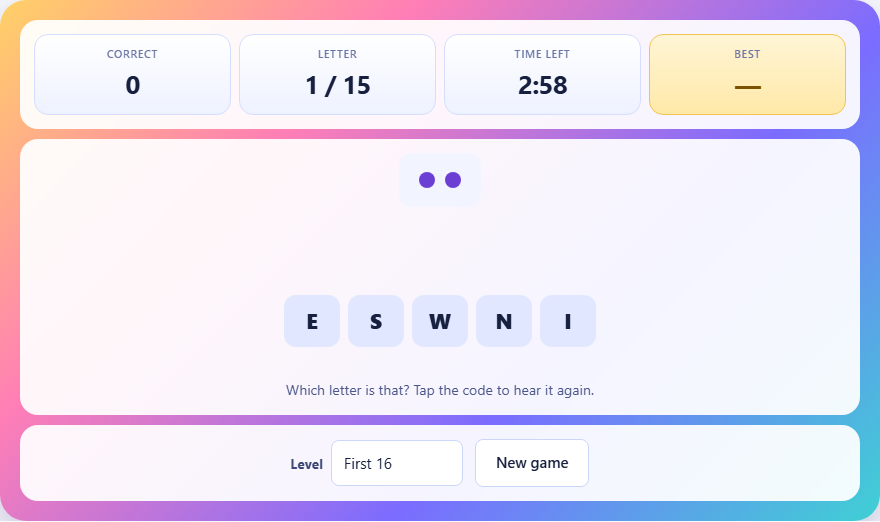
What the trainer does
A letter is beeped out through your speakers and drawn on screen as a row of dots and dashes at the same time. Underneath the pattern sits a row of letter buttons. Your job is to pick which letter was just played. Get it right and you move on to the next one. Get it wrong and the game shows you what the letter was, so you learn from the miss before the next round starts.
Each game is a fixed number of rounds. On easy you face twelve. On normal, fifteen. On hard, eighteen. You need to get at least seventy percent right to pass. That means at least nine correct on easy, eleven on normal, and thirteen on hard. A countdown timer runs alongside the rounds, so you cannot sit and think forever.
How a round works, step by step
The game picks a random letter from the pool for your level, plays its Morse pattern as beeps, and draws the dots and dashes on screen. You see between four and six letter buttons below, depending on the level. One of them is the right answer. The others are randomly chosen from the same pool.
If you want to hear the pattern again, tap the dots and dashes at the top. You can replay it as many times as you like before you answer. Once you pick a letter, the game tells you whether you were right. Either way, the correct letter and its Morse pattern are shown. After a short pause the next round begins automatically.
You can also answer by pressing the letter key on your keyboard. If the letter you press is one of the visible choices, it counts as your answer. This is faster than tapping on screen once you start to recognise the patterns.
The three difficulty levels
Easy uses the first eight letters in the learning order. Those are E, T, I, M, S, O, A, and H. They have the shortest, simplest patterns and sound the most different from each other. You face twelve rounds, each offering four choices, and you have three minutes.
Normal uses the first sixteen letters, adding N, R, D, G, U, K, W, and V. Fifteen rounds, five choices per round, and the same three minutes. The extra letters start to overlap in rhythm, so listening carefully becomes more important.
Hard uses all twenty-six letters. Eighteen rounds, six choices, and two minutes and forty-five seconds. The last letters in the order are Q, Y, C, X, Z, and J. They have long, awkward rhythms that sound alike at first. This is where pairing and pattern recognition pay off.
Why the timing is the real thing
Morse code is defined by its timing, not by the marks on paper. A dash lasts exactly three times as long as a dot. The gap between two symbols inside one letter is the length of one dot. The gap between separate letters is three dots long. These are the ratios the international standard sets.
The trainer uses real ratios because learning with sloppy timing teaches you a version of the code that does not match what you would hear on an actual radio. A dash that sounds like a slightly long dot is not a dash. The difference between dot and dash should be obvious to your ear, and correct timing is what makes it obvious.
You do not need to have your sound on to play. The dots and dashes are drawn on screen as well as beeped. But learning the sound is the whole point, because nobody sending real Morse draws the dots for you.
The learning order and why it is what it is
The letters are introduced in a specific order that goes back to the earliest days of radio training. The sequence starts with E and T because they are one dot and one dash, the two simplest patterns and the two most common letters in English. Samuel Morse knew this when he designed the code. He counted the letters in a printer's type case to decide which ones deserved the shortest signals.
After E and T come I, M, S, O, A, and H. Each one is short and sounds different from the ones before it. As the pool grows, new letters are added only when they bring a rhythm that does not easily confuse with something already learned. Q and Z come last because their patterns are long, rare in English, and easy to mix up with G and S.
Listen for the rhythm, not the count
Beginners count the dots and dashes: two dots is I, three dots is S, four dots is H. This works at first, but it is slow and breaks down when the patterns get longer. Nobody reading Morse at speed counts. They hear the rhythm of the letter the way you hear the shape of a spoken word.
The letter V, for example, is three dots and a dash. Instead of counting three-then-one, listen for the rhythm: dit-dit-dit-dah. It has the feel of a short run ending with a punch. That shape is unique, and once you learn to hear it, you will never confuse V with anything else.
The trainer helps you build this skill by playing the sound before you answer. Resist the urge to look at the dots on screen and count. Close your eyes, listen, and let the rhythm land before you pick your answer. Speed comes from pattern recognition, not from faster counting.
The pairing trick that cuts study in half
Many Morse letters come in mirror pairs. A is dot-dash and N is dash-dot. They are the same rhythm played backwards. D is dash-dot-dot and U is dot-dot-dash. G is dash-dash-dot and W is dot-dash-dash. B is dash-dot-dot-dot and V is dot-dot-dot-dash.
Learning each pair together is faster than learning them one at a time. Once you know A, you already know what N sounds like because it is just A in reverse. Your brain only needs to file one new pattern instead of two, and the mirror relationship gives you a hook to hang it on.
Not every letter has a clean mirror partner, but enough of them do to make the trick worthwhile. When you meet a new letter, check whether its reverse is another letter you already know. If it is, lock the pair in your memory together.
A fact about SOS that most people get wrong
SOS is three dots, three dashes, three dots. Most people believe it stands for Save Our Souls or Save Our Ship. It does not stand for anything. The pattern was chosen in 1906 because it is unmistakable even through heavy static and interference. The letters S, O, and S just happen to spell something memorable, which is convenient but was not the reason.
Knowing this helps you understand how Morse was designed. The code is not an alphabet of clever abbreviations. It is a set of distinct rhythms, assigned to letters by frequency of use. The most common letters get the shortest rhythms. The rest is engineering.
Common mistakes and how to get past them
- Counting dots instead of hearing rhythm. It works for E and S, but by the time you reach L and F it is too slow and error-prone. Practise hearing the shape instead.
- Skipping the replay. If you are not sure, tap the code to hear it again. The replay is free and costs no time penalty. Using it is better than guessing wrong.
- Learning all twenty-six at once. Start on easy with eight letters and move up only when you pass reliably. Adding too many new rhythms at once means you confuse the new ones with each other.
- Relying only on sight. The dots and dashes on screen are there as a crutch. Real Morse is heard, not read. Practise with sound on whenever you can.
- Ignoring wrong answers. When you miss one, the game shows the correct letter and its pattern. Pause and say the rhythm out loud before the next round starts. That brief review is where most learning happens.
- Rushing the last few rounds. The timer is generous on easy and normal. Spending three extra seconds on a tricky letter is almost always better than a fast wrong guess.
Everything happens on your own machine
The game, the beeps, and your scores all run inside your browser. No audio, no answers, and no progress data leave your device. Your best scores are kept in browser storage on this machine and will not show up on another computer. The page works offline after the first load. There is no account and nothing to sign up for.