
Placing pieces, forming mills, and winning the oldest board game
How the board works, the three phases of play, why the double mill decides most games, and the placement and movement strategies that beat the computer on every difficulty level.
A game that predates chess
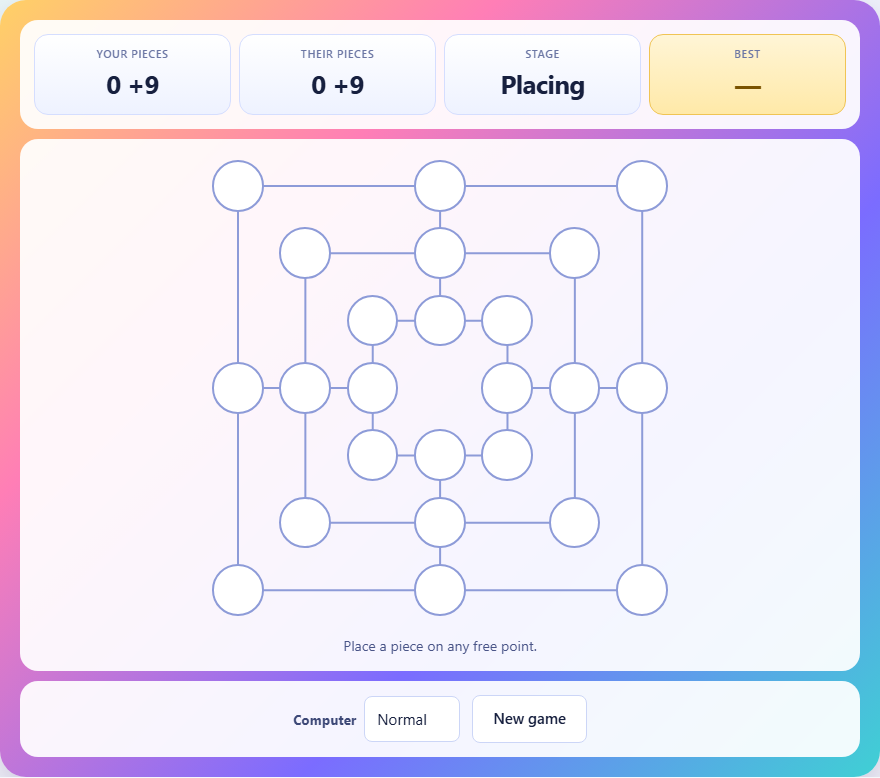
Nine Men's Morris is played on a board of three nested squares joined at the midpoints of their sides. That gives twenty-four points connected by lines. Two players take turns, each starting with nine pieces. The goal is to reduce your opponent to two pieces or leave them with no legal move.
The board looks simple, but the game has been played for thousands of years because simple rules do not mean simple play. The key move is the mill, and the key structure is the double mill. Every game revolves around building one and stopping the other player from doing the same.
The board and its twenty-four points
Three concentric squares sit one inside the other. Lines connect each midpoint of the outer square to the matching midpoint of the middle square, and again from the middle to the inner square. Every corner and every midpoint is a point where a piece can sit.
Some points connect to only two neighbours. Others, at the midpoints of the outer and middle squares, connect to three or four. The points with more connections are more valuable because a piece there can be part of more possible mills and can slide in more directions later in the game.
The three phases of play
The game has three phases. In the placing phase, you and the computer alternate putting one piece on any empty point until all eighteen pieces are on the board. In the sliding phase, you take turns moving one piece along a line to a neighbouring empty point. If either player is reduced to three pieces, that player enters the flying phase and may jump to any empty point on the board, not just a neighbour.
The placing phase is where most games are decided. The positions you choose in the first nine moves set up everything that follows. A strong placement gives you open mills to close. A weak one leaves you boxed in with no useful moves once the sliding phase begins.
What a mill is and what it does
A mill is three of your pieces in a row on one of the marked straight lines. The board has sixteen possible mills, eight running across and eight running up and down. Every time you complete a mill, you take one of the opponent's pieces off the board.
There is one restriction on which piece you can take. You may only remove a piece that is not currently part of a mill. If every one of the opponent's pieces is in a mill, the restriction is lifted and you may take any of them. This rule stops you from building an unbreakable fortress of mills, because your opponent can always be broken out of it.
Making the same mill twice is allowed. If you slide a piece out of a mill and then slide it back on your next turn, you have made that mill again and you take another piece. This is the heart of the double mill tactic.
Controls for placing, sliding, and taking
During the placing phase, tap any empty point to put your piece there. During the sliding phase, tap one of your own pieces to select it, then tap an empty neighbouring point to move it there. Legal destinations light up once you select a piece. Tap the same piece again to deselect it if you change your mind.
When you make a mill, the game tells you to take one of their pieces. Opponent pieces you can take are highlighted. Tap one to remove it from the board. If the opponent has pieces outside of mills, you must take one of those. You can only take a piece inside a mill when every opponent piece is in one.
On a phone the board scales to your screen and the points are large enough to tap with a thumb. The game note below the board always tells you what to do next.
The double mill and why it wins games
A double mill is two mills that share one piece. Imagine three pieces in a row on one line and three on another, and one piece sits at the intersection of both lines. Slide that shared piece out of one mill and into the other. You just made a mill, so you take a piece. Next turn, slide it back. Another mill, another piece taken. This continues every single turn and there is no defence against it.
Building a double mill requires control of an intersection point with two lines already loaded with your pieces. The setup usually happens during the placing phase. If you see the computer placing pieces along two lines that share a midpoint, block the intersection before the third piece lands on each line.
The four midpoints of the middle square are the strongest positions for a double mill because each one connects four lines. Getting even one of these points early and building outward from it is the single best opening strategy.
Placement strategy and the value of mobility
During the placing phase, prefer the points where four lines meet over the corners. Corners connect to only two neighbours, which limits your sliding options later. Midpoints connect to three or four neighbours, giving you more escape routes and more lines to mill along.
Mobility matters more than raw piece count. A player with seven pieces and no legal moves loses, even if the opponent only has five. Do not crowd your pieces together for the sake of closing one more mill if it means you cannot move afterward.
Watch the computer's placements. If it puts two pieces on the same line, it is threatening a mill on the third point of that line. Block it if the third point is still open. But do not chase every threat. Sometimes letting the computer mill once, while you set up a double mill, is the stronger play.
The flying phase and finishing the game
When either player is down to three pieces, that player can jump to any empty point instead of sliding to a neighbour. This makes the endgame surprising. A player who looked finished can suddenly form mills from across the board, and a comfortable lead can slip away.
If your opponent reaches three pieces, do not relax. Close in carefully. Try to leave them with no empty point that completes a mill for them. If you are the one down to three, fly aggressively and look for mills the opponent left open while they were chasing you.
The game ends when one player has fewer than three pieces or has no legal move. Pieces taken off the board are gone for good. There is no way to earn them back.
Common mistakes and how the computer punishes them
- Placing in corners first. Corners are dead ends with only two connections. The computer will take the midpoints and have far more options in the sliding phase.
- Ignoring the computer's two-in-a-row. Every pair of pieces on a line is one move away from a mill. Block it or lose a piece.
- Trading pieces when behind. If the computer has more pieces than you, every trade brings you closer to three and the flying phase while doing nothing to hurt it.
- Boxing yourself in. Filling every point around your own pieces means you have nowhere to slide. The computer wins by default because you have no legal move.
- Forgetting that all mills can be reopened. Closing a mill and leaving the shared piece in place is a waste. Slide it out on the next turn so you can close it again.
- Failing to block the double mill setup. If the computer has two pieces on each of two lines sharing a midpoint, that midpoint must be blocked immediately. One more turn and it is over.
Choosing the right computer difficulty
The computer setting controls how far ahead the opponent looks. On easy it searches two moves deep, which means it reacts to what you just did but does not plan far ahead. On normal it searches three deep and will set up mills one move before closing them. On hard it searches four deep and rarely misses a double mill opportunity.
Start on easy to learn the board and the feel of sliding pieces. Once you can win reliably, move to normal. Hard is where the computer starts to feel like a serious opponent and will punish every careless placement.
The game never leaves your browser
The entire game runs on your own device. No moves, board states, or scores are sent anywhere. Your best result is stored in your browser on this machine only. Disconnect from the network after the page loads and the game keeps working. There is nothing to sign up for.