
Filling a grid when the signs tell you which way the numbers lean
What a Latin square puzzle with inequality signs asks you to do, how to read chains of signs to lock numbers in, the three strategies that solve every grid without guessing, and the mistakes that burn through your five allowed errors.
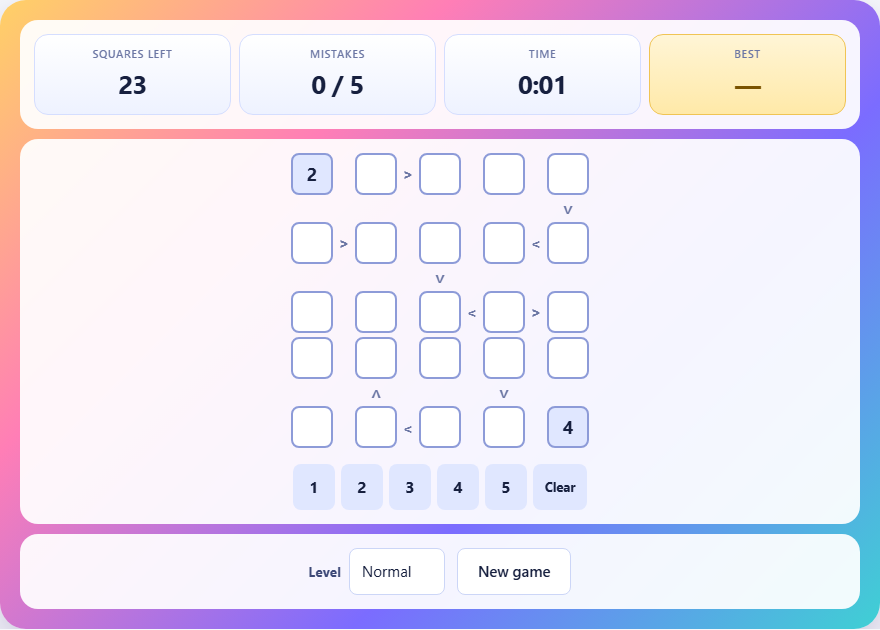
The puzzle in one sentence
Fill the grid so every row and every column contains each number exactly once, and every inequality sign between two squares is satisfied. On a five by five grid that means each row holds 1 through 5, and each column does the same. Between some pairs of neighbouring squares there is a sign showing which one must be bigger. Get every square right, with no more than five mistakes, and you win.
Every puzzle has exactly one solution. It is not a guessing game. The signs and the given numbers always narrow the answer down to a single possible grid, even when the board looks wide open at first glance.
What the signs mean
A greater-than sign between two squares means the square on the open side of the sign is the bigger number. If the sign reads left to right, the left square is larger. If it reads right to left, the right square is larger. Vertical signs work the same way but between the row above and the row below.
Not every pair of neighbours has a sign. Where there is no sign, the two squares can be in any order as long as the row and column rules still hold. A missing sign is not an oversight. The puzzle was tested to make sure it can still be solved without it. Missing signs simply mean that particular relationship is not needed to find the answer.
The vertical signs use a wedge shape that points up or down. A wedge pointing down means the upper square is bigger. A wedge pointing up means the lower square is bigger. It follows the same open-side-is-bigger rule as the horizontal signs.
Controls on desktop and mobile
Tap or click a square to select it. A highlight appears around it. Then tap a number from the row of buttons below the grid, or press that number on your keyboard. The number fills the square. If you want to remove a number, press the Clear button or hit Backspace or Delete on the keyboard.
If the number you placed is wrong, the square is marked and your mistake counter goes up. You get five mistakes in total. After the fifth, the game ends. Numbers that were given at the start of the puzzle cannot be changed. They sit in a different style so you can tell them apart from your own entries.
The game tracks your time in the stats bar. There is no time limit, but the clock is there so you can try to beat your own record.
Grid sizes and what changes at each level
Easy gives you a four by four grid with three numbers already filled in. The numbers run from 1 to 4. Fewer squares and more given numbers mean fewer choices at each step, which makes it a good place to learn the sign rules.
Normal is a five by five grid with two numbers filled in, using 1 through 5. This is the standard size and where the puzzle starts to require real reasoning. Most of your time goes into working out which numbers a sign chain forces into place.
Hard is a six by six grid with only one number given, using 1 through 6. The grid is bigger, the numbers range wider, and there are far more sign relationships to keep in your head. A single wrong deduction can cascade into several mistakes before you catch it.
Strategy one: chains of signs
Three squares in a row connected by two signs that both point the same way form a chain. If the signs say A is less than B and B is less than C, then the three numbers are in strict increasing order. On a four by four grid, a chain of three increasing numbers can only be 1-2-3, 1-2-4, 1-3-4, or 2-3-4. That already cuts the options in half.
Longer chains are even more powerful. On a five by five grid, a chain of four increasing squares leaves only one possibility for each position because there is only one set of four increasing numbers from 1 to 5 that also fits the column rules. When you find a chain, trace it to both ends before you fill anything in.
A chain that runs into a wall matters too. If a square at the edge of the grid has a sign saying it must be smaller than its only neighbour, that square cannot be the biggest number available. Often the edge squares are the first ones you can fill in with certainty.
Strategy two: treat it as a Latin square first
Before you even look at the signs, check the row and column rules. If a row already contains 1, 3, and 4, the remaining squares can only hold 2 and 5. That leaves two choices for two squares, and the signs between them settle it immediately.
This works especially well in the late game, when most squares are filled. A column missing only one number has no ambiguity at all. The sign rules matter most early on, when the grid is mostly empty. As you fill squares, the Latin square rules take over and the signs become less important.
Combining both is the fastest approach. Use signs to fill the first few squares where chains force a unique answer, then switch to row and column scanning as the grid fills up.
Strategy three: find the extremes
A square that has greater-than signs pointing at it from every direction must hold the smallest number available. It has to be less than every one of its neighbours with signs. On a five by five grid, that square is usually a 1.
The reverse is true for a square with every sign pointing away from it. That square must hold the largest number available. Look for these first. They are the freebies that the puzzle gives you before you have to start reasoning.
On the hard level, with a six by six grid, the extremes are harder to spot because the signs are sparser. But even one extreme in a row that already has a few numbers placed can open up the rest of the row.
A worked example on normal
You have a five by five grid. The first row has a 3 in the second square and a sign between the fourth and fifth squares saying the fourth is bigger. No other numbers are given in that row.
The row needs 1, 2, 4, and 5 in the remaining four squares. The sign says the fourth square is bigger than the fifth. If the fourth square were 1, the fifth would need to be less than 1, which is impossible. So the fourth square is 2, 4, or 5. You check the column of the fourth square and find a 4 already there. That rules out 4. Now the fourth square is 2 or 5.
You check the column of the fifth square. It already has a 2. If the fourth square were 2, the fifth square would need to be 1, and 1 is still available. If the fourth square were 5, the fifth would need to be less than 5 and not 2, leaving 1, 3, or 4. Both seem possible for now. You move on to other rows, come back later, and a column constraint has ruled one of them out.
Common mistakes and how to avoid them
- Entering a number without checking the column. The row might look fine, but if that number already appears in the same column you burn a mistake.
- Reading the sign backwards. The open side of the sign always points at the bigger number. Double-check which way the angle opens.
- Guessing when stuck. Every puzzle has a unique solution reachable by logic. If you feel stuck, scan for a chain or a lone missing number before you try a coin flip.
- Ignoring missing signs. A blank space between two squares means no constraint, not that the two must be equal. Do not assume they are in any particular order.
- Forgetting the Clear button. If you place a wrong number and catch it yourself, clear it before the game marks it. You only lose a mistake when the number stays.
Nothing leaves your browser
The grid, your entries, and the timer all run on your own device. No data is sent to a server. Your best time is kept in your browser's storage on this machine and does not sync to other computers. After the page loads you can disconnect from the network and keep playing. There is no account and nothing to sign into.