
Mixing colours by ratio, not by volume
How the colour pot works, why two drops of red and two of blue give the same result as one of each, what the six lamps can and cannot reach, and the strategies that save drops on every level.
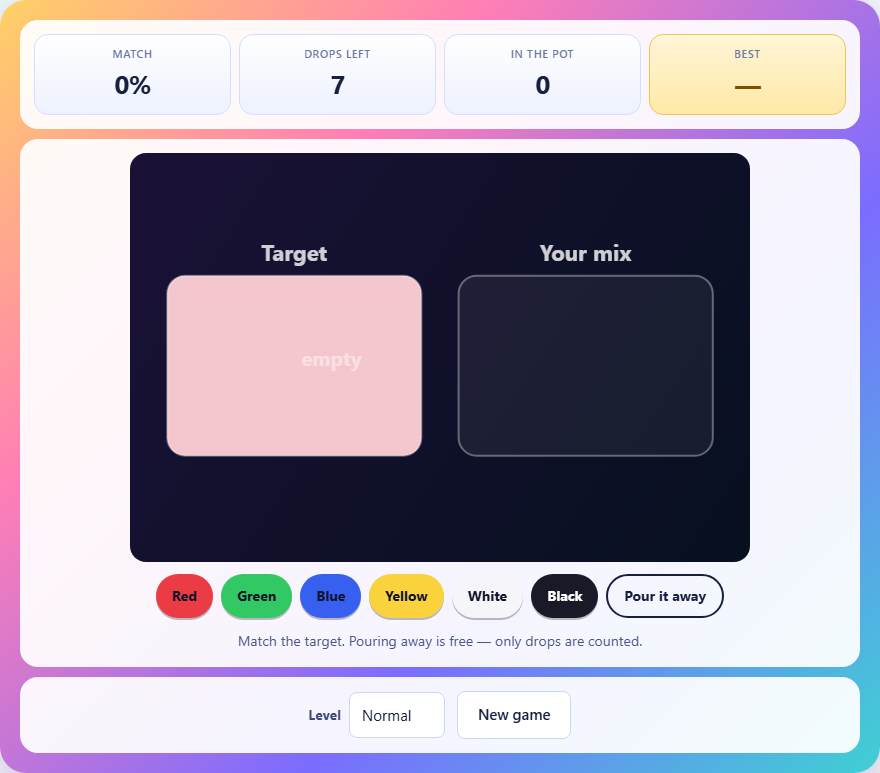
What the puzzle asks of you
You are shown a target colour and given a handful of drops to spend. Six coloured lamp buttons sit below the canvas. Each time you press one, a drop of that lamp falls into the pot. The pot shows the result right away, and a match percentage tells you how close you are.
Win by getting the pot within a set distance of the target before you run out of drops. The distance is measured in colour space, and the allowed margin depends on the level you chose. On easy you have room to be a little off. On hard the margin is tight and every drop counts.
The six lamps and what they cover
The lamps are Red, Green, Blue, Yellow, White, and Black. The first four supply the hue. White and Black control brightness without changing the hue itself. Between them the six can reach any colour the target might be, because the target is always made by mixing these same lamps before the recipe is thrown away.
That last point matters. No target is impossible. Somewhere in the six lamps there is a combination that hits it exactly, and you are always given more drops than that recipe uses. The puzzle is finding the ratio, not wondering whether an answer exists.
How the pot works
The pot is the plain average of everything in it, channel by channel. If you add one drop of red and one drop of blue, the pot sits halfway between the two. Add a second drop of red and the pot shifts towards red, because two of the three drops are now red.
This means two red and two blue produce exactly the same colour as one red and one blue. The ratio decides the colour. The number of drops does not, which is why dropping more than you need is pure waste. A three-drop pot and a six-drop pot can show the same colour if their ratios match.
Every new drop has less effect than the one before it. The first drop into an empty pot decides the colour completely. The second splits it in half. The sixth barely nudges it. This is useful late in a game, because a small correction only costs one drop.
Controls and how to play
Tap any of the six lamp buttons to add a drop of that colour to the pot. The canvas updates instantly, showing the target on the left and your mix on the right, side by side. The match percentage in the stats bar tells you how close the two colours are.
Below the lamp buttons is a Pour it away button. Pressing it empties the pot without spending any drops. Your remaining drop count stays the same. Use it when the mix has gone in a direction you cannot fix. The drops you already used are gone, but the ones you have left are still in play.
A note under the canvas tells you how far off your pot is from the target and how close you need to get. On a phone, tap the lamp buttons the same way. The two colour swatches sit side by side so you can compare them at a glance.
Difficulty levels and what changes
Easy targets are made from three lamp drops, and you get four extra. The tolerance is 26, so you can be fairly rough and still win. Normal uses four drops in the recipe with three spare, and the tolerance drops to 18. Hard uses five drops and gives you only two spare, with a tight tolerance of 12.
The recipe length matters because a target made from more lamps is harder to read by eye. A three-lamp mix is usually two colours and white or black, which is easy to spot. A five-lamp mix can be subtle, and guessing wrong eats into your slim margin.
Reading the target before you start
Before you spend a single drop, look at the target for a few seconds. Ask three questions. Is it warm or cool? That tells you whether red and yellow are in it, or green and blue. Is it bright or dark? Brightness points at white or black. Is it vivid or muted? A muted colour is usually a mix of opposites pulling each other down.
A pale sky blue, for example, is mostly blue with some white. A burnt orange is red, yellow, and possibly a touch of black. A brownish grey has a little of everything. The more you practise reading colours this way, the fewer drops you waste on early guesses.
If the target is very dark, black is almost certainly in the recipe. If it is very bright and washed out, white is there. These two lamps do not change hue, so they are safe to add once you have the base colour roughly in place.
Working with ratios to save drops
Suppose the target looks like two parts red to one part yellow. You could add two red and one yellow, spending three drops. Or you could add four red and two yellow, getting the same colour but spending six drops. Always use the smallest set of drops that gives the ratio you need.
If your pot is close but slightly too blue, adding one drop of the opposite will fix it faster than pouring away and starting over. Because each new drop has a smaller effect, you can nudge a large pot with a single drop and land inside the tolerance.
Pouring the pot away and rebuilding is only worth it when the mix is so wrong that no single correction can save it. If you are within about half the tolerance, a nudge is almost always cheaper than a reset.
A worked example on normal
The target is a warm olive green. You read it as mostly green with some yellow and a little black to darken it. On normal that recipe uses four drops, and you have seven in total.
You start with one green and one yellow. The pot is a bright lime. The distance says 34 and you need to be within 18. One more green brings it down to about 25, closer but still too bright. One drop of black darkens it, and the distance drops to 11. That is inside the limit, and you win with three drops left over.
Now imagine you had guessed wrong and dropped a red first. The pot would lean towards brown, and a single corrective drop of green would not pull it back far enough. That is where pouring away saves the game. You lose the one wasted drop, but you can rebuild cleanly with the six that remain.
Common mistakes and how to avoid them
- Dropping the same lamp over and over to make the colour stronger. Two reds are the same as one red when nothing else is in the pot. You are spending a drop for no change.
- Ignoring white and black. If the hue is right but the brightness is off, the answer is white or black, not more colour. Adding more colour shifts the hue away from where you want it.
- Pouring away too early. A pot that looks wrong after two drops might only need one corrective drop. Check the distance number before you empty it.
- Not reading the target first. Jumping straight into drops means you are guessing, and every wrong guess costs a drop you cannot get back.
- Forgetting that each new drop matters less. Your first drop is a big commitment. Your fifth is a nudge. Plan the big strokes first and save the corrections for last.
- Using all six lamps when the target only needs three. A target made from red, white, and black will never need green, blue, or yellow. Adding them drags the pot away from the answer.
Everything stays on your machine
The entire game runs in your browser. No colours, scores, or moves are sent to a server. Your best score is saved in your browser's own storage on this device and will not appear on another computer. Once the page has loaded, the game works even if you go offline. Closing the tab is all the cleanup there is.