
Defending six cities with slow shots and fast thinking
How the batteries fire, why you need to aim ahead of every target, how the blast radius creates chain kills, and the wave-by-wave habits that keep your cities standing on hard mode.
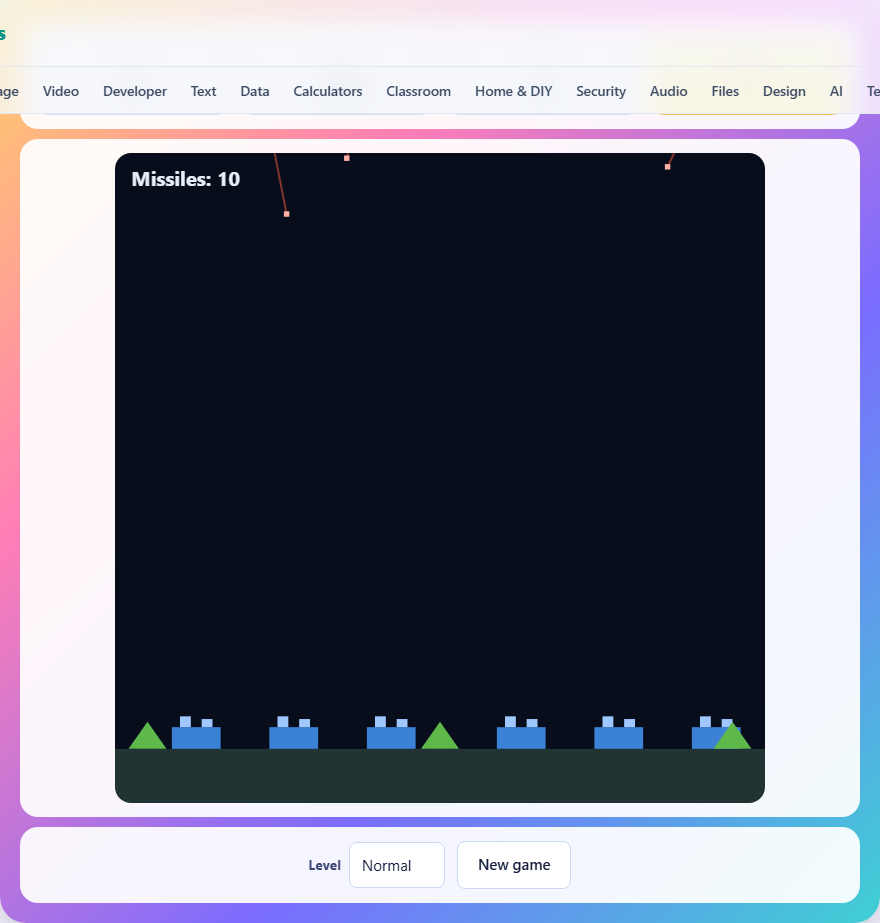
The sky is falling
Six cities sit along the bottom of the screen. Missiles drop from the top, each one aimed at a living city. They fall slowly enough that you can see them coming, but they do not stop. If a missile reaches the ground near a city, that city is destroyed. Lose all six and the game is over.
You fight back by clicking or tapping anywhere in the sky. A shot launches from the nearest battery, travels to the point you picked, and explodes. The explosion expands into a growing blast that hangs in the air for a moment. Any missile that touches that blast is destroyed. The shot itself does not kill anything. The blast does.
Missiles arrive in waves. Survive a wave and the next one starts with more incoming and less room for error. Clear every wave with at least one city still standing and you win.
How the batteries work
Three batteries sit on the ground: one on the left, one in the centre, and one on the right. When you click a point in the sky, the battery closest to that point fires a shot toward it. You do not choose which battery fires. The game picks the nearest one.
This matters because the shot takes time to travel. A shot from the left battery aimed at a point on the far right of the sky has a long journey. A missile heading for a city on the right edge might reach the ground before your shot arrives if you fired from the left. The corners of the sky are the slowest places to defend.
There is a short cooldown between shots. You cannot fire as fast as you can click. That pause forces you to pick your targets rather than spraying the sky.
Leading the target
Your shot does not arrive instantly. It takes roughly a second to travel from the battery to the point you clicked. During that second the missile keeps falling. If you click on a missile itself, the blast will land where the missile was, not where it is. The missile will have moved past.
You need to aim ahead of the missile, at the point where it will be when your blast arrives. For a missile falling straight down, that means clicking below it. For one falling at an angle, click below and in the direction it is drifting. The faster the missile, the farther ahead you need to aim.
This is the core skill of the game. Everything else builds on it. A player who can consistently lead targets will survive waves that overwhelm someone who fires at where the missile is.
Chain kills and blast grouping
When a missile is destroyed, it creates its own small blast at the point where it died. That new blast can catch other missiles nearby. A well-placed shot that detonates between two incoming tracks can set off a chain that takes out three or four missiles from a single round of ammunition.
Chains are the real strategy of the game. Ammunition is limited per wave. On normal difficulty you get ten shots per wave, but late waves send more than ten missiles. The only way to survive is to kill multiple missiles with single shots.
Watch the incoming tracks. Missiles arrive in loose groups. When two or three trails converge toward the same part of the sky, that convergence point is where your shot belongs. One blast there is worth three separate shots spread across the board.
The three difficulty levels
Easy gives you four waves, slow missiles, and twelve shots per wave. It is forgiving enough to learn the mechanics without losing cities. Normal runs six waves with faster missiles and ten shots per wave. This is the standard game and where most players spend their time. Hard sends eight waves at full speed with only eight shots per wave. Every shot must count.
On easy, you can afford to miss. The missiles are slow and the ammunition is generous. Use this mode to practice leading targets. On normal, you start feeling the pinch in the later waves. By wave five or six the sky is busy and you cannot waste shots. On hard, you need chain kills from the first wave onward. Eight shots against a sky full of fast missiles leaves no room for stray clicks.
Each wave sends a few more missiles than the last. Wave one on normal sends about seven. Wave six sends around seventeen. The spawn rate also climbs, so later waves feel denser even though the total count only grew by a few.
Scoring and what earns points
Every missile you destroy scores twenty-five points. At the end of a wave, you also earn five points for every shot you did not use and fifty points for every city still standing. That bonus structure rewards two things: accuracy and conservation.
Spraying shots to cover the whole sky might save a city, but it burns through ammunition that would have scored at the end of the wave. A player who kills ten missiles with six shots and keeps four in reserve earns more than one who kills the same ten with all ten shots.
Cities are worth the most. Fifty points per surviving city is double the value of a missile kill. Protecting your cities is always worth a shot, even if it costs ammunition. But spending three shots on a single missile that was heading for a city you already lost is pure waste.
Defending high, not low
A common instinct is to wait until a missile is close to the ground and then fire. That feels safe because the missile is near its target and easy to track. But it is a trap.
A blast near the ground has almost no time to expand before the missile passes through. If you aim too low, the missile hits the city before the blast finishes growing. And a ground-level blast cannot catch a second missile that is still higher up. You lose the chance for a chain kill.
Firing higher up gives the blast time to reach full size before missiles arrive. It also places the blast in the path of anything else falling through that part of the sky. The sweet spot is about a third of the way down from the top. High enough to intercept early, low enough that your shot does not take too long to arrive.
Managing lost cities
A destroyed city does not come back. Every city you lose is gone for the rest of the game. That means early losses compound. Six cities give you coverage across the full width of the ground. Lose the two on the left and every missile aimed at that corner lands without a target to defend, but the gap also means you have fewer things to protect.
Focus your defence on the cities that are still alive. A missile heading for a dead city will hit empty ground and do nothing. Do not waste a shot intercepting it. Save that ammunition for missiles aimed at your surviving cities.
If you are down to one or two cities, the game becomes easier in one sense: you only need to guard a narrow strip. But one hit ends the round, so every shot counts double.
Mistakes that lose cities
- Firing at where the missile is. The shot takes about a second. By the time it arrives the missile has moved. Aim below and ahead of the target.
- Wasting shots on missiles heading for dead cities. They will hit empty ground. Save the ammunition for threats against living cities.
- Firing too low. A ground-level blast has no time to expand and no chance at a chain kill. Intercept higher up.
- Spraying the sky. Every missed shot is five points lost at the end of the wave. Pick your targets and fire with purpose.
- Ignoring the edges. Missiles aimed at the corner cities take longer to reach from the nearest battery. Start those shots earlier than the ones in the centre.
The whole game runs on your device
Every missile, every blast, and every score calculation happens inside your browser. Nothing is sent to a server. Your best score is saved on this device in the browser's own storage. Close the tab and the game stops. Open it again and your record is still there, but nobody else has ever seen it. Once the page loads, the game works without a network connection.