
Designing a coinage that pays for everything
What the puzzle is really asking, how the coin change problem works under the board, why a penny is sometimes a trap, and the thinking that finds the best set of coins on every board size.
The puzzle in plain terms
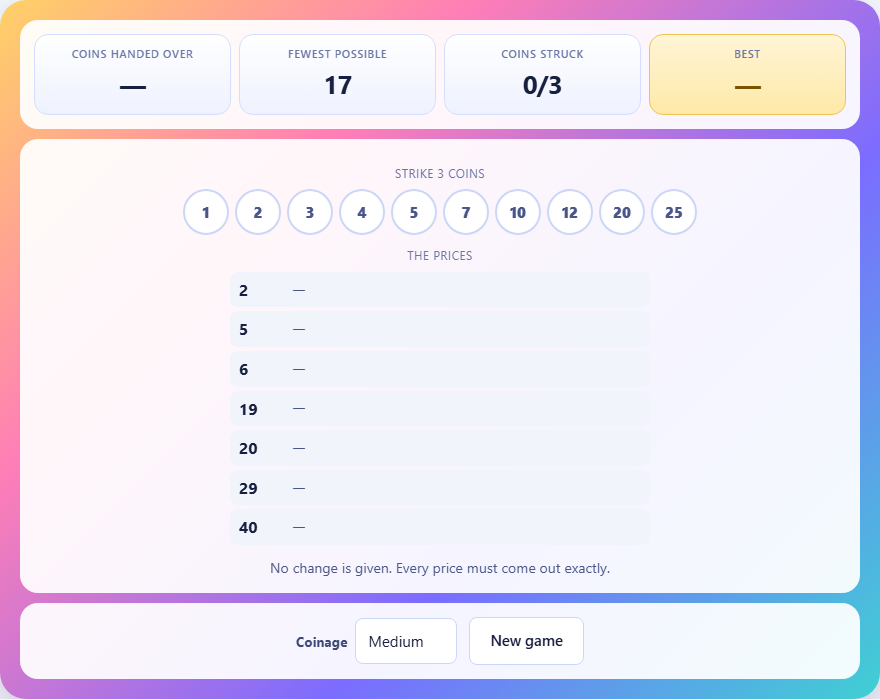
You run a mint. A row of possible coin values sits at the top of the board. Beneath it are prices - fixed amounts that people need to pay. In this country there is no change. A buyer hands over coins that add up exactly to the price, or the sale does not happen.
You get to choose which coins to mint, but you may only mint a fixed number of them. The board tells you how many. On the small and medium boards you pick three. On the large board you pick four. Every coin you mint exists in unlimited supply, so you can use it as many times as needed.
The goal is twofold. First, every price on the board must be payable with your chosen coins. Second, the total number of coins handed over across all prices must be the smallest possible. The board knows the best answer and shows it as a target. Match that target and you win.
Why there is no change
Change makes the problem easy. If a buyer can overpay and get the difference back, then any set containing a one coin will handle every price. The puzzle would have a trivial answer.
Without change, the problem sharpens. You must add up to the exact amount. Some coin sets cannot reach certain prices at all. With only coins worth three and five, you can make eight, nine, ten, and everything above seven, but you can never make one, two, four, or seven. The set fails on those prices.
The question becomes: which set of coins covers every price on the board and does it with the fewest coins changing hands? That is a real question with a real answer, and the board checks every possible set to find it.
The board sizes and what changes
Small gives you five prices with a cap of thirty, and three coin slots. Medium gives seven prices capped at forty-five, still with three slots. Large raises the count to eight prices with values up to sixty, and gives you four slots to fill.
The pool of possible coins is always the same: one, two, three, four, five, seven, ten, twelve, twenty, and twenty-five. On small you choose three from ten. On large you choose four from ten. The bigger board has more prices to satisfy and more room to work with, but the prices climb higher so the trade-offs get sharper.
Every board is checked before it is shown to you. There are always at least three valid sets, so you are choosing among real options rather than hunting for the only answer.
Payability comes first
Before chasing the lowest coin count, make sure every price can actually be paid. A set that leaves even one price unpayable is useless no matter how efficient it is elsewhere.
The trap is dropping the one coin. A one guarantees that every amount is reachable because you can always fill the gap with single units. But using ones to pay a price of twenty costs twenty coins, which is terrible. So you are tempted to drop the one and use bigger coins instead.
That works only if your bigger coins can combine to reach every price on the board. Three and five together miss seven. Two and five together miss one and three. Check every price against your set before you commit. The board shows you instantly which prices fail, so you can spot the gap without doing the arithmetic yourself.
The coin change problem hiding under the board
Once you have a set that pays every price, the board solves a second puzzle for you. For each price it finds the fewest coins from your set that add up to it. A price of ten with coins of two and five takes two fives, which is two coins. With coins of three and five it takes two threes and a four - wait, you do not have a four. So it takes two fives, which is also two coins. The board tries every combination and shows the best.
This is the coin change problem. It is a well-known puzzle in mathematics and computer science. The reason real currencies land on denominations like one, two, five, ten, twenty, and fifty is exactly this: that pattern keeps the average number of coins per transaction low across a wide range of prices. The puzzle lets you discover that pattern on your own.
Why doubling is wasteful
If you have a two coin, adding a four coin buys you less than adding a five. The four is simply two twos, so it never reaches an amount the two could not already reach on its own. The five, on the other hand, opens up odd amounts that the two cannot make.
The same logic applies to other multiples. Having both three and twelve is weaker than having three and ten, because twelve is four threes. A good set spreads its values apart rather than stacking multiples. Look for coins that complement each other instead of overlapping.
A useful rule of thumb is that your coins should have no common factor. If every coin you pick is even, you can never pay an odd price. If every coin is a multiple of three, any price that is not a multiple of three fails. Mix odd and even, and mix values that share as few factors as possible.
Trying the one, two, five pattern
On many boards, picking one, two, and five is close to the best answer. That combination can pay any amount, and it does so with very few coins. A price of thirteen costs a five, a five, and a one and a two, which is four coins. A price of twenty costs four fives, which is four coins.
But close is not always best. If the prices on the board are clustered near multiples of seven, a set like one, two, and seven might beat one, two, and five. The trick is to look at the actual prices and ask which large coin saves the most across all of them. Sometimes a ten or a twelve earns its slot by cutting a handful of ones out of several prices at once.
On the large board with four slots, you have room for a bigger coin without giving up coverage. A set like one, two, five, and twenty is strong on boards with high prices because the twenty slashes the coin count on anything above fifteen.
Swapping is free, so experiment
You can drop a coin and pick another as often as you like. Only the final set is judged. The game tracks how many taps you made, but that count is just a curiosity. There is no penalty for changing your mind.
Use that freedom. Start with one, two, and five. Look at the coin counts the board shows. Then swap the five for a seven and see if the total drops. Swap the two for a three. Each swap takes a second and the board recalculates instantly. The answer is often only one swap away from a good starting guess.
Mistakes that leave coins on the table
- Keeping the one coin when a better option exists. A one guarantees coverage, but it inflates the coin count on every large price. Try dropping it and see if coverage still holds.
- Picking coins that are multiples of each other. Four and twelve do less together than five and twelve, because four is already reachable with two twos.
- Ignoring the small prices. A price of three cannot be paid with fives and sevens. Small prices often decide the smallest coin for you.
- Stopping at the first set that covers everything. Coverage is half the puzzle. The other half is counting how many coins you hand over. A set that covers every price in thirty coins is worse than one that covers them all in twenty.
- Not checking the target. The board shows the best possible total. If your total is higher, a better set exists. Keep swapping.
All the counting happens on your device
Every combination is checked inside your browser. The prices, the coins, and your score never leave this machine. There is no server doing the math. You can disconnect from the internet after loading the page and the puzzle works the same way.