
Nine holes of careful aim and soft putting
How the drag-and-release aiming works, what the sand and water actually do to your ball, why the cup spits out a fast shot, and the approach that keeps your score below par on all nine holes.
Drag length, ball speed, and how far it rolls
The course is measured in its own units rather than in pixels, so a hole looks the same on a phone and on a laptop. The sheet is 100 units wide and 140 tall. The four rails eat into that, leaving a green of 72 units across and 120 from the back wall to the front one. The ball is drawn with a radius of 2.2 units, so it is 4.4 units wide. Every distance in this section is in those units.
To play a shot you press within 12 units of the ball and drag away from it. Only the length of that drag is read. It is capped at 28 units, so pulling further back than that adds nothing at all. A drag shorter than 1.5 units is thrown away, and it does not cost you a stroke. The launch speed is the drag length times 0.13. Full stretch is therefore 3.64 units per frame. You cannot start a new drag while the ball is still rolling.
After the ball leaves, one small sum runs on repeat. Each frame the ball moves by its current speed, and then that speed is multiplied by 0.978. In other words it keeps a bit under 98 per cent of its pace and gives up 0.022 of it. Because the loss is a fixed share, the arithmetic stays tidy. The speed left after rolling a distance D is simply the launch speed minus 0.022 times D. The ball counts as stopped once its speed falls to 0.05 or less.
Turn that around and you get the roll. Take the launch speed, knock off 0.05, and divide by 0.022. Say you drag back 20 units. The launch speed is 20 times 0.13, which is 2.6. The roll is 2.6 minus 0.05, divided by 0.022, which comes to 115.9 units. Running the game's own steps frame by frame gives 115.93 units over 178 frames, so the shortcut matches the code.
The handy version is that one more unit of drag buys about 5.9 more units of roll. A full 28-unit drag rolls roughly 163 units and takes 193 frames to die. That is longer than the green, so a flat-out shot always meets a rail before it runs out of speed.
Sand does one thing only: it swaps the 0.978 for 0.90. The ball is not blocked and it does not bounce off the edge of the patch. It simply gives up a tenth of its speed each frame instead of two hundredths. The same sum works with 0.10 in place of 0.022, which makes the roll about four and a half times shorter. That 20-unit drag covers 115.9 units on grass and only 25.5 units if the whole trip is over sand.
Two small things follow from all this. Friction trims both halves of the speed by the same share, so it shortens the roll but never bends it. Between bounces the ball travels in a dead straight line. And the dashed guide you see while dragging is drawn at 1.4 times the drag length. It shows you the line, not the distance. At full stretch that guide is under 40 units long while the ball will run four times as far.
- Drag 5 units: launch speed 0.65, roll about 27 units.
- Drag 10 units: launch speed 1.3, roll about 57 units.
- Drag 14 units: launch speed 1.82, roll about 80 units.
- Drag 20 units: launch speed 2.6, roll about 116 units.
- Drag 28 units, the cap: launch speed 3.64, roll about 163 units.
The two tests at the cup, and why banks come off flat
The cup is looked at once a frame, after the ball has moved. Two things have to be true at that instant. The ball's centre must be within 3.2 units of the middle of the cup, and its speed must be under 1.35 units per frame. Fail either one and the ball carries on. There is a softer rule as well. If the ball is inside 2.6 units of the middle but is going too quickly to be taken, both halves of its speed are cut in half. That is the lip of the cup knocking the pace out of it.
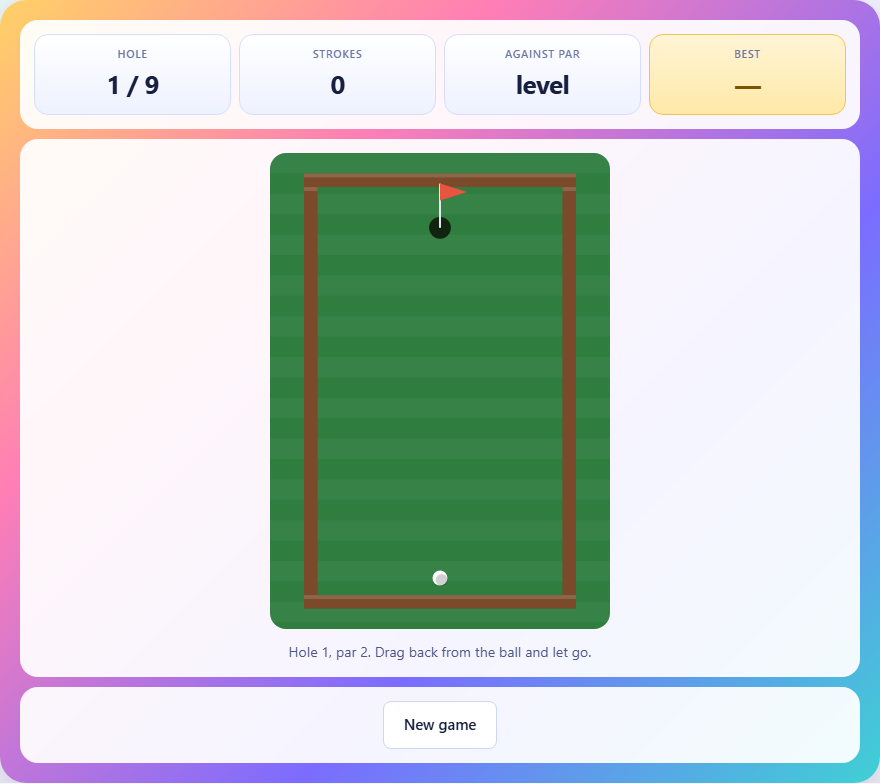
Hole one shows the pair of rules working together. The tee sits at 50, 125 and the cup at 50, 22, so they are 103 units apart. Send a straight putt at full stretch and follow the frames. On frame 41 the ball is 4.0 units short at a speed of 1.46, so it is both too far out and too quick. On frame 42 it is 2.545 units away at 1.43, still above the 1.35 ceiling, so the cup turns it down. But it is now inside 2.6 units, so the lip halves it to 0.715. On frame 43 it sits 1.83 units out at 0.7 and drops. A full-power hole in one, saved by the lip.
The other edge is just as fine. Drag back 17.25 units and the ball rolls 99.66 units and stops dead. It is 3.34 units from the middle at that point, a shade outside the 3.2 ring, so it stays out. Drag 17.5 units and it creeps to 3.19 units and falls in. A quarter of a unit of drag, out of a possible 28, is the whole difference between a ball left sitting on the lip and a ball that drops.
Rails are plain rectangles lined up with the edges of the sheet. When the ball's centre crosses into one, the game works out which face it is nearest, nudges it 0.44 units back outside, and turns the speed around across that face. The part of the speed heading into the rail is multiplied by 0.72. The part sliding along the rail is left untouched. So the ball does not come off at the angle it went in. It comes off flatter. Arrive at 45 degrees to the face and you leave at about 35.75 degrees, holding 87 per cent of your speed.
That changes the old trick of aiming at the cup's mirror image. The mirror is still the right idea, but the image needs to sit further back, by one divided by 0.72, which is about 1.39 times the distance. Here it is in numbers on the right rail, whose inner face is at 86. Put a ball at 50, 100 and a cup at 70, 30. The cup is 16 units in from that face. Aim at the plain mirror point of 102, 30 and the ball crosses the cup's line at 21.6, roughly 8 units past the target. Aim at 108.2 instead, which is 16 divided by 0.72 behind the face, and it arrives at 30 on the nose. Friction does not spoil this, because it shortens the path without turning it.
Movement is chopped into three shorter hops per frame, and the rails are tested after each hop. That is what stops a quick ball slipping through a rail. At top speed each hop is 1.21 units, and the thinnest piece of woodwork on the course is 4 units thick. Two other checks are made only once a frame. Whether the ball is in sand is judged from where it lay when the frame started, so the heavier drag then applies for that whole frame. Water is judged from where the ball finishes the frame.
Nothing here is measured in seconds. The code never looks at a clock; it counts frames. A full-power putt that is left to run takes 193 frames to settle, whatever machine you are on, so it always covers the same ground. It just crosses that ground about twice as fast on a 120 Hz screen as on a 60 Hz one.
One last oddity comes out of the way results are named. A one-stroke hole is announced as a hole in one before any of the under-par names are tested. The first hole is a par two, so a one-shot finish there really is a birdie, yet it is still called a hole in one. The same ladder means an albatross, which needs three under par, can only ever turn up on the ninth. That is the one par five, and it wants a two. Add the nine pars and the course comes to 31, which is the number your round is judged against.
- The green is flat. There are no slopes, no hills and no rise or fall, so a resting ball never drifts.
- The ball has no spin and no swerve. Its path between rails is always straight.
- Walls and hazards see the ball as a single point. Since the drawn ball has a radius of 2.2 units and is pushed only 0.44 units clear of a rail, it visibly overlaps the woodwork it just hit.
- Every rail is a square-cornered rectangle. There are no angled bumpers, no curves and no moving obstacles anywhere on the nine holes.
- The lie is ignored when you strike. Launch speed comes from the drag alone, though a ball sitting in sand loses its pace almost at once because the sand friction applies from the first frame.
- There is no undo and no replay of a shot. The only way back is the water rule, which returns the ball to the spot it last came to rest and adds a stroke.
The course at a glance
Nine holes, played in order, on a miniature golf course with wooden walls, sand patches, and water hazards. Each hole has a par - the number of strokes it was designed to take. Your final score is measured against the total par for the course. Finish at par and you broke even. Finish below and you played well. Go over and the game tells you so.
The holes grow harder as you go. The first is a straight shot with an open path. Later holes put walls in the way, force bank shots, and hide the cup behind obstacles. Some have sand that kills your speed. A few have water that costs you a stroke and sends the ball back.
Aiming and power
Drag backward from the ball to aim. A dashed line appears showing the direction the ball will travel, pointing away from where you drag. It works like pulling back a catapult. Pull left and the ball goes right. Pull down and the ball goes up.
A small bar under the ball fills as you drag farther. That bar is your power gauge. A short drag gives a gentle tap. A long drag gives a full-power shot. The bar caps at maximum, so dragging further than the limit does not add more force.
Let go and the ball launches. It rolls until friction slows it to a stop. The physics are smooth and continuous. You can feel the ball decelerating, which helps you learn how far a given amount of power sends it.
Walls, sand, and water
Wooden walls are solid. The ball bounces off them and keeps going, though it loses some speed on every bounce. Bank shots off walls are a core part of the game. On the dog-leg holes where the cup is around a corner, the only way to reach it in par is to aim at the right point on the wall and let the bounce carry the ball home.
Sand patches are visible as light brown areas. They do not stop the ball or bounce it. Instead they apply much heavier friction. A ball that enters sand crawls to a halt in a fraction of the distance it would cover on grass. Going through sand costs roughly a stroke because you will need another shot to cover the distance it stole.
Water is the harshest hazard. If the ball rolls into a water patch you lose a penalty stroke and the ball goes back to the spot you last played from. It does not land on the far side. It resets. That means water is not a shortcut. Going around it with a longer route is almost always cheaper.
Why the cup rejects a fast ball
The hole only accepts a ball that arrives slowly. A hard shot that rolls across the cup at speed will rim right over it and keep going. This is deliberate. It mirrors real putting, where a ball moving too fast skips past the hole.
The result is that distance to the cup matters in a way it would not if the cup caught everything. A long putt is a gamble. If you hit it too hard the ball sails past. If you hit it too soft it stops short. The safe play is to lag up close on one shot, then tap it in on the next. The bold play is to go for a long putt and accept the risk of overshooting.
On the last hole, which is a par five with walls and sand, the temptation to blast it toward the cup is strong. Resist it unless you can read the line clearly.
Reading the score names
After sinking each hole the game names your result using standard golf terms. A hole in one speaks for itself. One stroke under par is a birdie. Two under is an eagle. Three or more under is an albatross, which is rare on a course this size. Making par exactly is simply called par. One over par is a bogey. Two over is a double bogey. Anything worse than that is listed as over par.
Your running total against par appears in the stats bar throughout the round. A negative number means you are below par, which is good. Zero means level. A positive number means you are trailing. The final total after all nine holes is your score for the round. Finishing at or below par counts as a win.
Playing the bank shots
Half the holes on this course require a bank shot to reach the cup in par. The principle is simple. The ball bounces off a wall at roughly the same angle it arrived, with some speed lost. Aim at the point on the wall that reflects toward the cup.
Finding that point takes practice. A good mental trick is to imagine the cup mirrored on the other side of the wall. Aim at that mirror image and the bounce will send the ball toward the real cup. This works for any flat wall.
On holes with two walls in the way you need a double bank. These are harder to judge and most players take an extra stroke rather than attempt them. That is fine. A safe two-shot path beats a risky one-shot attempt that ends in the sand.
Staying out of trouble
Sand costs roughly a stroke every time you enter it. Water costs exactly one stroke plus the loss of position. Both are avoidable on every hole if you pick the right line.
Before you drag, look at the entire hole. Find the cup, find the hazards, and trace a path that avoids them. A longer route on clean grass is almost always cheaper than a short route through sand. The friction difference is severe enough that even clipping the edge of a sand patch can stall your ball.
Leave yourself straight. A careful first shot that finishes in line with the cup on clean grass beats an ambitious one that ends behind a wall or in the sand. Two simple shots add up to fewer strokes than one flashy shot followed by a recovery.
Mistakes that add strokes
- Full power when the cup is close. The cup rejects fast balls. Ease off when you are within range. A gentle tap from a short distance is almost certain to sink.
- Aiming at the cup instead of at the wall. On a dog-leg hole the straight line is blocked. Pick the wall point that sends the ball where you want, not the cup itself.
- Ignoring sand. It looks harmless. It is not. A ball that enters sand stops almost immediately and you need another shot just to get clear.
- Trying a long putt on every hole. Long putts look heroic but they fail more often than they work, because the cup speed is strict. Lag up close, then tap in.
- Forgetting that water resets your position. A ball that enters water goes back to where you played from, not to the edge of the water. That can cost you two strokes: the penalty plus the shot to cover the same ground again.
Pacing yourself across nine holes
The early holes are short and have few obstacles. Use them to learn how far each level of power sends the ball and how bouncing off a wall changes the angle. A par two on the first hole is easy to get and builds confidence.
The middle holes introduce sand, water, and tighter corridors. Take your time here. A slow careful shot that avoids the hazard is worth more than a fast risky shot that might save a stroke but more often costs two. Study the layout before you drag.
The last hole is a par five with walls, sand, and a winding path. It is the longest and the hardest. Play it safe. Getting par on the last hole while holding a good score from the rest of the round is a solid finish. Going for a birdie on the last hole and landing in the sand is how a good round turns bad.
The course stays on your device
Every hole, every bounce, and every roll happens inside your browser. The physics run on your machine. Your score is stored locally and never sent to a server. Once the page has loaded you can disconnect and keep playing. There is no account, no leaderboard to upload to, and nothing to sign up for.