
Solving a number-cage puzzle from the first clue to the last square
Number Cages gives you a grid, a set of outlined cages, and a target for each cage. This article explains the rules, walks through the logic for cracking a cage, and shows the habits that separate a fast solver from someone who stalls halfway.
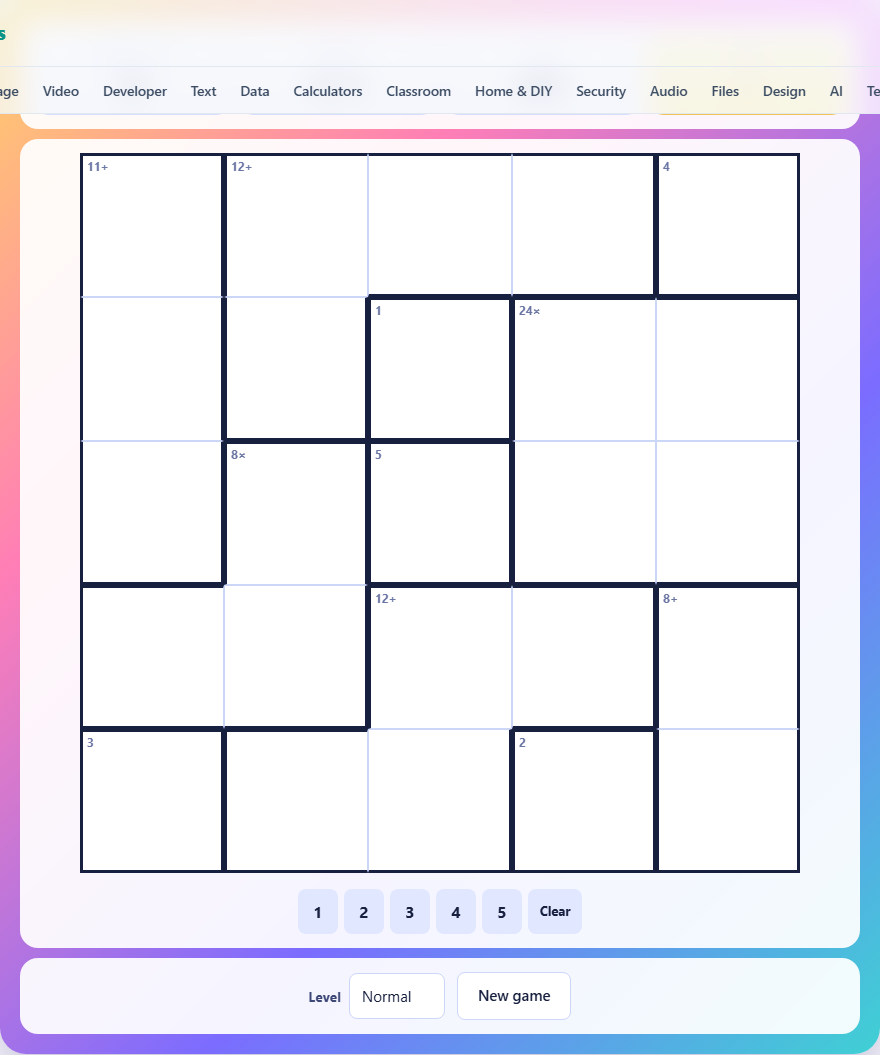
What you see on the board
The grid is a square. On easy it is four by four, on normal five by five, and on hard six by six. Every cell must hold a number. On a four-grid the numbers are 1 through 4. On a five-grid, 1 through 5. On a six-grid, 1 through 6.
Thick outlines divide the grid into groups called cages. Each cage has a small label in its top-left corner. The label shows a target number and an operation sign. For example, 12+ means the numbers in that cage must add up to twelve. 20x means they must multiply to twenty.
The two rules that govern every cell
Rule one: every row must contain each number exactly once. On a five-grid, every row has one 1, one 2, one 3, one 4, and one 5. No repeats. The same rule applies to columns. This is the Latin square constraint, and it is where most of your logic comes from.
Rule two: the numbers inside each cage must combine to the target using the given operation. A cage labeled 8+ with two cells needs two numbers that add to eight. A cage labeled 6x with two cells needs two numbers that multiply to six.
For subtraction and division, order does not matter. A cage labeled 2- could hold 5 and 3 or 3 and 1. You always subtract the smaller from the larger. Division works the same way: you divide the larger by the smaller, and the result must match the target.
Controls for placing and clearing numbers
Tap a cell to select it. It highlights to show it is active. Then tap a number on the keypad below the grid, or press a number key on a keyboard. The number fills the cell.
To clear a cell, select it and tap the Clear button on the keypad, or press Backspace, Delete, or 0. You can change any cell at any time as long as the puzzle is still running.
If the number you place is wrong, the game counts it as a mistake. Five wrong placements end the puzzle. The counter at the top shows how many mistakes you have used.
Start with the cells that solve themselves
A cage with a single cell has the operation sign = and a target that is just the number itself. If a cage says 3=, the cell is 3. Fill those in first. They are free and they narrow down the rest of the row and column.
Next, look for two-cell cages where only one pair of numbers can hit the target. On a five-grid, a multiplication cage of 20x can only be 4 and 5. There is no other pair of numbers from 1 to 5 that multiplies to twenty. Write down both numbers mentally. You do not yet know which cell gets which, but you know the pair.
Similarly, a subtraction cage of 4- on a five-grid can only be 5 and 1. No other pair in the range gives a difference of four.
Using row and column sums to find missing numbers
On a five-grid, every row and every column adds up to 15. That is 1 + 2 + 3 + 4 + 5. On a four-grid the total is 10. On a six-grid it is 21.
This total is a powerful tool. Suppose a row on a five-grid has three cells already filled with 1, 3, and 4. The remaining two cells must hold 2 and 5, because the row needs one of each number from 1 to 5. If one of those two cells is in a cage that narrows it further, you can pin down both.
You can also use the total to check cage math across a row. If cages cover cells 1 through 4 of a row and their combined targets add up to 12, then the fifth cell must be 15 minus 12, which is 3. This works even when you have not solved any of those cages yet.
Subtraction and division cages need extra thought
Addition and multiplication cages are straightforward. A 9+ cage with three cells has many possible combinations. You list them and use row-column logic to narrow the list.
Subtraction and division are only used for two-cell cages. The tricky part is that they often have more than one valid pair. A 1- cage on a five-grid could be 1 and 2, 2 and 3, 3 and 4, or 4 and 5. All four give a difference of one.
Do not try to solve these cages on their own. Instead, look at the row and column each cell belongs to. If one cell is in a row that already has 1 and 2 filled, then that cell cannot be 1 or 2. That eliminates two of the four pairs and often leaves just one.
Big cages and how to break them open
Cages with three or four cells are harder because the number of possible combinations grows quickly. A 10+ cage with three cells on a five-grid could be 1+4+5, 2+3+5, or 1+3+6, except 6 is out of range, so it is only the first two.
The approach is the same: list the combinations, then eliminate. If any cell in the cage shares a row or column with a cell you have already filled, that limits which combinations survive.
Multiplication cages grow even faster. A three-cell cage labeled 30x on a five-grid can only be 2, 3, and 5. That is the only triple from 1 to 5 that multiplies to thirty. When a multiplication cage has a large target, the constraint is actually tighter because fewer triples hit it.
Difficulty levels and grid sizes
Easy is a four-by-four grid. The numbers only go up to four, so cages have very few possible fills. Most puzzles on this size can be finished in under three minutes once you know the method.
Normal is five by five. The extra number and extra row open up many more combinations per cage. This is where the row-sum trick becomes essential. Without it, you end up guessing, and guessing burns through your five allowed mistakes fast.
Hard is six by six. The jump from five to six is bigger than it sounds, because each cage has more candidate combinations and the grid has eleven more cells to fill. Expect to spend five to ten minutes on a hard puzzle until you are practised.
Common mistakes and how to stop making them
- Placing a number that already appears in the same row or column. Always scan the row and column before you commit. This is the most common mistake and the easiest to avoid.
- Trying to solve cages in isolation. Cages do not live alone. A cage's answer depends on the numbers already placed in its rows and columns. Work outward from what you know, not inward from the cage target.
- Forgetting that subtraction and division ignore order. A 3- cage does not require the left cell to be bigger. Either cell can hold the larger number.
- Spending too long on a big cage without checking single-cell and two-cell cages first. The small cages give you free information. Fill them in and half the big cages will solve themselves.
- Not using the row total shortcut. On a five-grid, if you know four of the five cells in a row, the fifth is forced. This is faster than reasoning through cages.
Every puzzle has one answer
The puzzle generator starts with a completed Latin square, carves it into random cages, and reads the targets from the answer. If the resulting puzzle has more than one valid solution, the generator splits the largest cage into smaller ones until only one solution remains. That is why you will sometimes see a single-cell cage in an odd spot. It was created to pin down the answer.
This guarantee matters because it means you can always reason your way to the answer. You never need to guess between two equally valid fills. If you are stuck, there is a deduction you have not spotted yet.
All the logic runs on your device
The grid, the cages, the solution, and the solver all run inside the page on your own machine. No puzzles are fetched from a server and no answers are checked remotely. Your best time is stored in your browser only and never sent anywhere. If you disconnect from the internet after loading the page, everything still works exactly the same.