
How to think about swaps and chains in a match-three puzzle
This article walks through the rules of a fruit-swapping board game, explains how the scoring works, and shows you how to set up chain reactions that turn one move into five times the points.
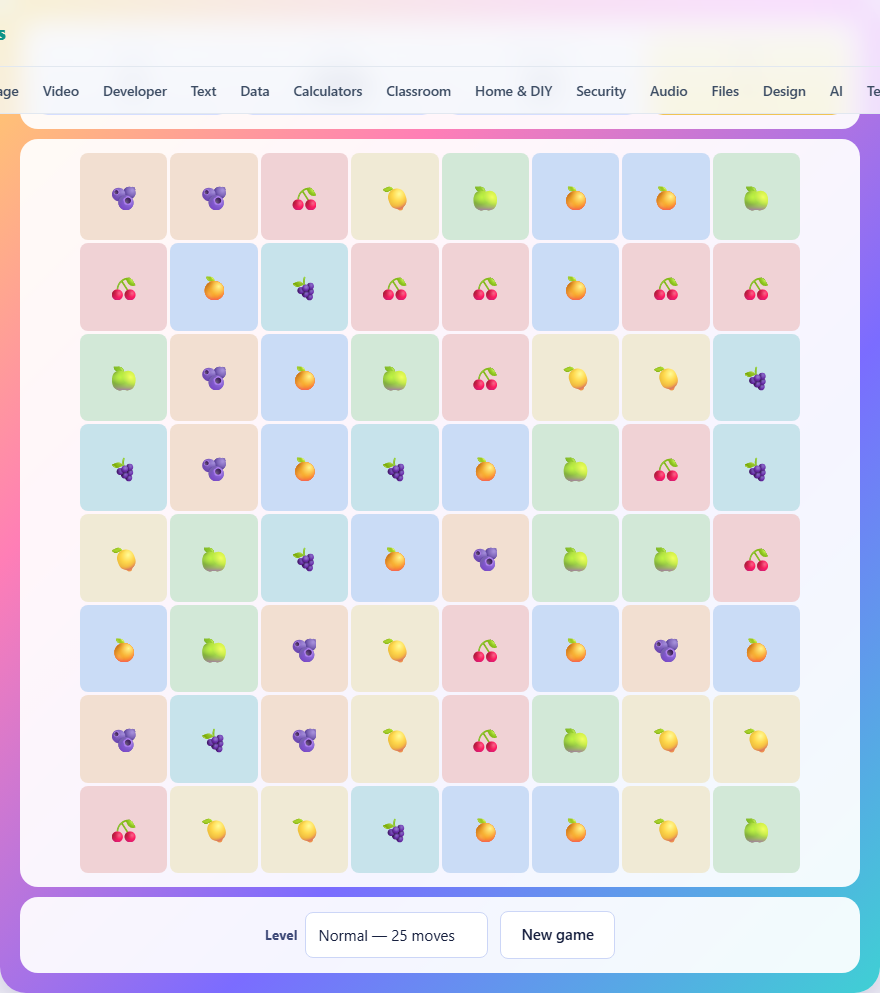
What the board looks like
The playing area is an eight-by-eight grid filled with six kinds of fruit. Each square holds one piece. The colours are bright and the pieces are large enough to tap on a phone without hitting the wrong one.
Above the board sit three numbers. Score shows what you have earned so far. Target is the number you need to reach. Moves left counts down every time you make a valid swap. When that counter hits zero, the game ends.
The rules, piece by piece
Tap one piece of fruit, then tap a piece directly next to it. Up, down, left or right counts as next to it. Diagonal does not. The two pieces trade places.
If the swap creates a horizontal or vertical line of three or more matching fruit, those pieces vanish. Everything above them drops down to fill the gap, and new random fruit falls in from the top.
If the swap does not create any line of three, the two pieces slide back to where they were. That failed swap does not cost a move. Only a swap that actually clears fruit counts against your budget.
How scoring adds up
Each piece in a cleared line is worth 20 points, multiplied by the chain number. The first match you trigger is chain one, so three pieces earn 60 points. Four in a row earn 80.
When the fruit drops down after a match, it can land in a new line of three. That second match is chain two, and each piece in it scores at double rate. A three-piece chain-two match is worth 120. A third chain scores at triple rate, and so on.
This is the entire scoring system. There are no power-ups, no special tiles, and no bonus rounds. Everything comes down to finding matches and, when you can, setting up cascades.
Difficulty levels and targets
There are three levels to choose from. Easy gives you 30 moves to reach 1,500 points. Normal gives 25 moves for 2,500. Hard gives 20 moves for 3,500.
The board itself does not change between levels. It is always eight by eight with six fruit types. What changes is how efficient your swaps need to be. On easy, 50 points per move is enough, and simple three-in-a-row matches will get you there without much trouble. On normal, you need 100 per move, which means you should be looking for longer lines and the odd chain. On hard, you need an average of 175 points per move. That is impossible without chains.
If you are new to this kind of game, start on easy. The generous move count lets you experiment. Once you can hit the target with moves to spare, step up to normal. Hard is for players who have learned to read the board two moves ahead.
Play the bottom of the board first
A match near the top of the board clears three pieces and drops in three new ones. Not much changes. A match near the bottom clears three pieces and causes everything above to shift down, sometimes across half the board.
That large rearrangement is where chains come from. The falling fruit lands in new positions, and if any of those positions complete a line, a second match fires on its own. You did not spend a move on it. It just happened.
Train yourself to scan from the bottom row upward. Look at row eight first, then row seven, then six. When you find two matches at different heights, take the lower one. Over many games this single habit is worth hundreds of extra points.
Spotting a chain before it happens
A guaranteed chain has two parts. The first is a match you can make right now. The second is a group of fruit above that match that would form a line if they dropped one or two rows.
Picture a column where row five and row six are both cherries, but row seven is a grape. Below the grape, in row eight, a swap will clear a line that includes that grape. When the grape goes, the two cherries drop and meet another cherry already sitting at the bottom. That is a free second match.
You will not always see a clean setup like that. But once you start looking at what sits above a match, not just at the match itself, you will spot them more often.
Four and five in a row
A line of four clears four pieces instead of three. At chain one, that is 80 points rather than 60. More importantly, four pieces vanishing from a column pulls more fruit down, which raises the odds of a chain.
A line of five is rare but worth watching for. It clears five pieces for 100 base points and causes a serious cascade in that column. If you see a potential five-in-a-row, take it even if it is at the top of the board. The sheer number of falling pieces almost always triggers something. Lines can also form in an L or T shape where a horizontal and vertical match overlap. The overlapping piece is counted once, but both arms clear.
When the board runs out of moves
After every cascade settles, the game checks whether any legal swap on the board would create a match. If not, the board reshuffles itself and a message tells you what happened. You lose nothing. Your score stays, your move count stays, and play continues on the fresh layout.
This means bad luck cannot trap you. You will never stare at a board with no options. The game handles it for you. The same check runs at the very start of a game, so the opening board is always playable too.
Common mistakes and how to fix them
- Taking the first match you see. Scan the whole board before you move. A match that starts a chain is worth three or four ordinary ones.
- Ignoring the move counter. On normal and hard, every wasted swap is real damage. If a match earns only 60 points, ask yourself whether there is a better one somewhere.
- Matching at the top of the board. Unless the match is four or five in a row, a top-row swap changes very little. Save your moves for the lower half.
- Thinking a reversed swap costs a move. It does not. If you try a swap and it snaps back, your move counter has not changed. Feel free to test a swap you are unsure about.
- Panicking after a reshuffle. The board looks completely different, but nothing bad has happened. Take a moment to read the new layout from the bottom up.
A sample turn in detail
You are on normal difficulty with 18 moves left, sitting at 1,400 points. You need 1,100 more. That is about 61 points per remaining move if you only do single matches, but a couple of chains will cover the gap easily.
You notice two blueberries in column three, at rows six and seven, with a lemon in row eight. Over in the bottom row, swapping column three and column four will make a lemon line. That clears the lemon, the two blueberries drop to rows seven and eight, and if there is a third blueberry nearby, a chain fires.
Even if the chain does not happen, you cleared three lemons for 60 points and repositioned two blueberries for a future move. Good players think two moves ahead like this. They treat each swap as a setup for the next one, not just as a way to score right now.
Nothing leaves your device
The whole game runs inside the page you have open. No fruit data, no score, no move history goes to a server. Your best score is saved in your browser on that device only. Close the tab and there is nothing left to clean up.
You can test this yourself. Open the page, turn off your internet connection, and start a new game. Everything works the same, because there was never a server involved. The random fruit, the cascade logic, the scoring, and the reshuffle check all run in your browser and nowhere else.