
Clearing the marble line before it reaches the hole
This guide covers the marble shooter game where a chain of coloured marbles crawls along a spiral track. It explains aiming and shooting, how matches and chain reactions work, what the three difficulty settings change, and the habits that separate players who survive from players who watch the line disappear into the hole.
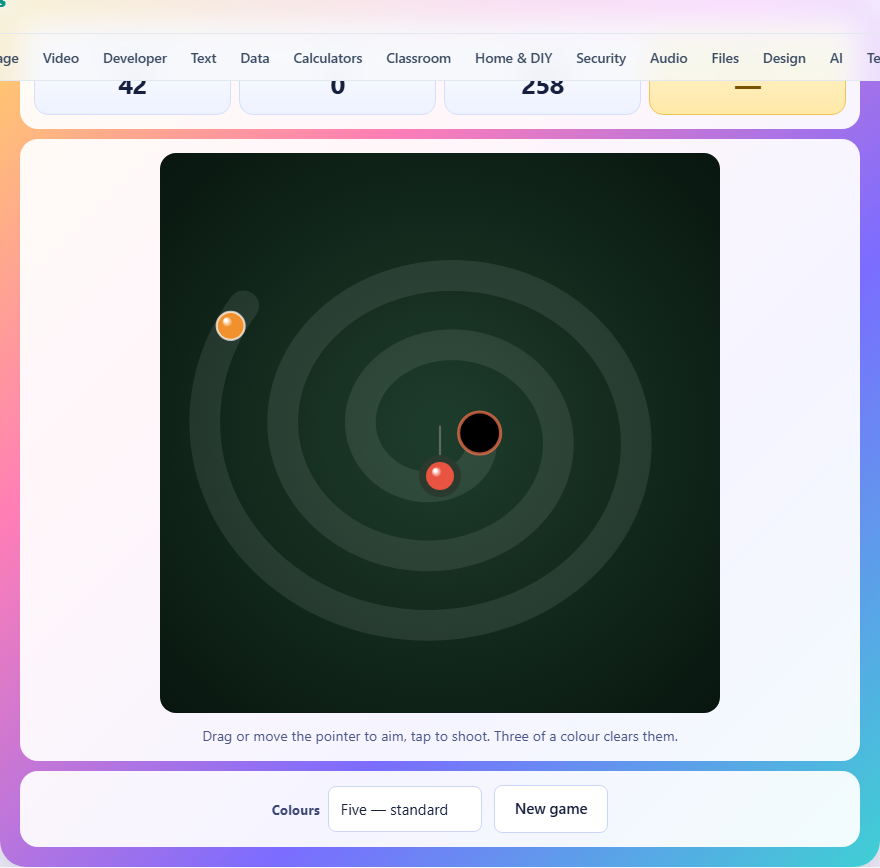
What is happening on the screen
A winding spiral track fills the board. A line of coloured marbles crawls along that track towards a black hole at the end. You sit at a fixed point near the centre with a small shooter. Inside the shooter is a marble of a random colour, and a faint line shows which direction it will fly when you fire.
The marbles move at a steady pace. They do not speed up or slow down during a round. The front marble, the one closest to the hole, is marked with a bright outline so you can always see how close the line is to reaching the end.
Your goal is simple: clear every marble from the track before the first one reaches the hole. If the front marble arrives at the hole, you lose.
Aiming and shooting
Move your mouse or drag on a touchscreen. The shooter rotates to follow the pointer. A thin guide line extends from the shooter in the direction the marble will travel.
Tap or click to fire. The marble flies in a straight line from the shooter towards where you were pointing. Once fired, it travels until it hits a marble in the chain or flies off the edge of the board. A missed shot costs you a marble but nothing else. You get a new colour immediately.
On a phone, drag anywhere on the canvas to aim and lift your finger to shoot. The controls scale to the screen, so the game plays the same way on a small display.
Matching and clearing
When a fired marble hits the chain, it wedges into the line on the side it arrived from. If three or more marbles of the same colour are now touching, all of them vanish at once. The line closes the gap.
This is where the game gets interesting. When the gap closes, the two ends that come together might be the same colour. If they are, those marbles clear too, and the gap closes again. If the new ends also match, they clear as well. Each step of this chain reaction scores more points than the last.
A single good shot that triggers a three-step chain can remove a dozen marbles. A bad shot that adds a marble to the line without clearing anything makes the problem worse, because the chain is now longer and reaches the hole sooner.
Scoring and chain bonuses
Every marble in a cleared group is worth ten points multiplied by the chain step. The first clear in a sequence scores ten per marble. If the gap closes and triggers a second clear, those marbles score twenty each. A third step scores thirty each.
A run of four red marbles cleared as the first step scores forty points. If that clear brings two blue marbles together with three more blue ones, the five blues score one hundred points on the second step. The numbers climb fast when chains land.
The stats panel above the board shows marbles left, your current score, and a distance reading that tells you how far the front marble is from the hole. When the distance drops below twenty, the situation is urgent.
Setting up chain reactions on purpose
Random matching clears marbles. Planned matching clears many more. The trick is to look not just at the pair you are about to complete, but at the colours on either side of it.
Picture a line that goes red, red, blue, blue, blue, red, red. If you fire a blue marble into the middle of those blues, nothing new happens. Three blues were already touching. But if you fire a blue marble next to the blue group on the side where the reds are, you now have four blues. They clear, and the reds on both sides crash into each other. Four reds clear on the second step. That is a two-step chain from one shot.
The habit to build is: before you shoot, glance at what sits on the far side of the group you are targeting. If those marbles match the ones on this side, your clear will trigger a chain. Aim for that setup every time.
Which side of the pair to hit
A fired marble wedges into the chain on the side it arrives from. If you aim at the near edge of a pair, the marble slots in on this side. If you aim at the far edge, it slots in on the far side.
This matters because the position decides whether the new marble joins the right group. Hitting two yellows from the wrong side can push your yellow marble in next to a green, where it does nothing. Hitting from the other side lands it next to the second yellow, completing a trio.
When you have a clear shot at a group, aim for the far side. The marble travels past the near edge and inserts beyond it, joining the group cleanly. Shooting at the near side often puts the marble in the gap before the group rather than in the group itself.
Emergency play near the hole
When the front marble is close to the hole, strategy takes a back seat to survival. Clear whatever you can, as fast as you can, at the head of the line. Points and chain setups do not matter if the line reaches the end.
Look for any match near the front. Even a three-marble clear buys you time because the line gets shorter and the remaining marbles have farther to travel. If the shooter gives you a colour that does not appear near the head, fire it somewhere harmless in the middle of the line and wait for a better one.
The hole pulses with a glow to warn you when the lead marble is close. If that glow is bright, stop planning and start clearing.
The three difficulty levels
The dropdown labelled Colours sets the difficulty. Four colours with the description gentle gives you a shorter line that moves slowly. With only four colours on the board, matches appear often, and chains happen almost by accident.
Five colours at standard speed is the default. The longer line means more marbles to clear, and the extra colour spreads matches thinner. You need to plan your shots rather than relying on random clusters.
Six colours on the fast setting is a genuine test. The line moves noticeably quicker, starts with more marbles, and six colours make long same-colour runs rare. Chain setups are harder to find, and the time pressure leaves less room for careful aiming. Survival demands both speed and target selection.
The level setting also changes the initial count. Four colours starts with around thirty-four marbles. Five starts with about forty-two. Six puts fifty-two marbles on the track. More marbles and faster movement combine to make the difficulty jump between levels feel significant.
Mistakes that cost rounds
- Shooting into the middle of a large same-colour group instead of extending its end. The group was already going to clear. Your marble should be setting up the chain after the clear, not joining a group that did not need help.
- Firing wildly when the line is far from the hole. With plenty of distance, you have time to aim. Use it. One careful chain is worth five scattered clears.
- Ignoring the near and far side rule. Where the marble inserts depends on which side of the target it arrives from. A shot that misses its insertion by one position often does more harm than good.
- Holding fire to wait for the perfect colour. The line never stops moving. A mediocre shot that keeps the chain short is better than a perfect shot that arrives ten seconds too late.
Dealing with leftover colours
Late in a round, after you have cleared most of the marbles, the shooter can load a colour that no longer exists on the track. There are no more greens on the line, but the shooter hands you a green marble.
Fire it somewhere harmless. Aim for a spot between two different colours where it will sit quietly and not block a future clear. Do not hold onto it by refusing to shoot, because the line is still crawling forward while you wait. Take the loss, fire the useless marble, and get the next colour.
Your game stays in your browser
The track, the marbles, the physics, and the scoring all run inside your browser. Nothing about the game is sent to a server. There is no account and no data leaves your device. Your best score is saved in local storage on the machine you are using.
Disconnect from the network and press New game. A new line appears, the track draws, and the game plays exactly as before. No connection was ever part of it.