
Winning at the pit and seed board
This guide covers the ancient sowing game where seeds circle the board and the last one to land decides everything. It explains the board layout, the two rules that carry the whole game, the three computer levels, and the counting habits that turn a beginner into a player who chains free turns and sets up captures.
The board and what sits where
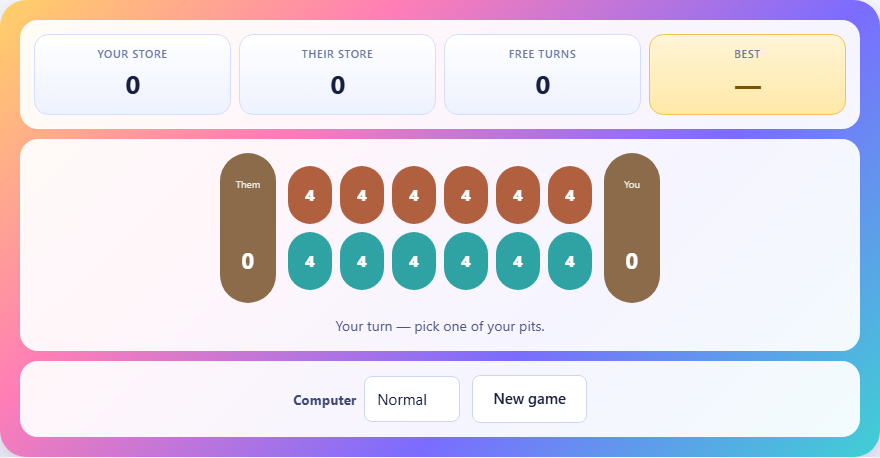
Fourteen containers are arranged in two rows with a large store at each end. The six small pits along the bottom row are yours. The six along the top row belong to the computer. The store on the right is yours. The store on the left is theirs.
Each of the twelve small pits starts the game with four seeds, for a total of forty-eight seeds on the board. No seeds begin in either store. By the end of the game, every seed will have moved into one store or the other. Whoever has more than twenty-four in their store wins. A tie at twenty-four each is a draw.
How sowing works
Tap one of your pits. All the seeds in that pit are picked up and dropped one by one into the pits going anticlockwise. If a pit has four seeds in it, the next four pits each get one seed. The count wraps around the board as many times as it needs to.
Your own store gets a seed as the count passes it. The opponent's store is always skipped. This is the one asymmetry that makes the counting interesting. Seeds only ever enter a store that belongs to the player who is sowing them.
After the last seed lands, something happens depending on where it fell. The two possible outcomes are a free turn and a capture, and together they make up the entire strategy of the game.
Free turns and how to chain them
If your last seed lands in your own store, you go again. The computer does not get a turn between your moves. This is the single most valuable thing that can happen on the board.
Before each move, count the seeds in each of your pits and ask: does this number reach my store exactly? Your store is at position six. A pit with three seeds in it, sitting three pits away from the store, will end its sowing right in the store. That pit gives a free turn.
Chaining means taking several free turns in a row before handing control to the computer. Each free turn deposits one more seed in your store. Two chained turns give you two seeds for free. Three chained turns give three. After a long chain, you have built a real lead before the computer gets to respond.
The best players scan for chains before thinking about anything else. A pit with one seed right next to the store is a guaranteed free turn. Set it up early, then use it at the moment that lets you chain into a second one.
The capture rule
If your last seed lands in an empty pit on your own side, you capture that seed and all the seeds in the pit directly opposite. Both are placed into your store. This can swing the score by six or seven seeds in a single move if the opposite pit is full.
A capture only works from your own side. Landing in an empty pit on the opponent's side does nothing special. And the pit must be empty before the seed arrives. If the sowing fills the pit on the way past, the seed that arrives later is not landing in an empty pit.
To set up a capture, leave one of your pits empty while the pit across from it fills up. Then arrange a sow that ends in that empty pit. The bigger the pile on the far side, the more you take. A capture of eight or nine seeds from a loaded pit can flip a losing game.
The endgame sweep
The game ends when one player's entire side is empty. At that moment, the other player sweeps every remaining seed on their side into their own store. Scores are then compared.
This means running your side dry can be a disaster. If the computer still has fifteen seeds spread across its pits, it collects all of them at once. You gave it a free fifteen seeds by emptying your side too quickly.
It can also be a tactic. If you are ahead by a wide margin and have only a few seeds left on your side, emptying it quickly ends the game before the computer can catch up. Count the totals before deciding. If your store holds thirty and theirs holds ten, ending the game fast locks in the win. If the scores are close, keep seeds on your side to maintain control.
The three computer levels
Easy makes the computer look one move ahead. It picks the pit that gives the best immediate result, which means it takes free turns and captures when it sees them, but it does not plan for them.
Normal looks four moves deep. It sees simple chains and avoids leaving loaded pits opposite your empty ones. This is a solid opponent that punishes careless play.
Hard looks seven moves deep and plays with genuine strength. It chains free turns, sets up captures several moves in advance, and manages the endgame deliberately. Beating it requires planning your own chains and watching both sides of the board at once.
Change the level from the dropdown labelled Computer and press New game. Each game starts with the same forty-eight seeds regardless of difficulty.
Defensive thinking
While you are planning your own captures, the computer is planning its captures from your side. An empty pit on the computer's side, with a loaded pit of yours sitting across from it, is a threat. If the computer can sow a seed into that empty pit as the last one, it takes your pile.
The defence is to keep your pits from getting too heavy. A pit with ten seeds in it is a target. Move seeds out of it before the computer can set up a capture. Spreading seeds around is safer than piling them up.
Also watch for the opponent's free turn setups. If one of the computer's pits has the exact count to reach its store, that pit will give it a free turn next move. You cannot stop it, but you can prepare for it by making sure your board is not leaving captures open when the computer gets its extra move.
A useful habit is to glance at the top row after every move. The computer's pits change on every sow, and a pit that was safe two turns ago might now be one move away from a capture. Quick scans of the upper row catch threats before they cost you seeds.
Counting seeds around the board
Knowing the exact count before you sow saves guesswork. The pits go anticlockwise. Your pit one is the leftmost on the bottom. Counting from it, your store is seven steps away. From pit two, the store is six steps away. From pit six, the store is one step away.
If pit six has one seed, sowing it lands in your store. If pit five has two seeds, sowing it lands in your store. This pattern is the foundation of free turn hunting. Before every turn, find every pit whose count matches its distance to the store.
When pits hold more seeds than the distance to the store, the sowing wraps around. A pit with nine seeds will pass through your store, cross the opponent's side, and keep going. That wrapping can drop a seed in a useful place on the far side, but it is harder to plan and easier to miscount.
Common beginner mistakes
- Moving the first pit that has seeds without counting where the sow ends. Every move should start with the question: does this reach my store?
- Ignoring the other side of the board. The opponent's pit counts tell you what captures and free turns are possible on their next move.
- Leaving a large pile in one pit. A heavy pit is a capture target. It is also harder to control because sowing it scatters seeds everywhere.
- Emptying your side by accident. Running dry triggers the endgame sweep. Make sure the sweep favours you before you let it happen.
- Playing only for captures and forgetting free turns. A chain of three free turns deposits three seeds in your store with no response from the opponent. That is usually worth more than a single capture.
Your game stays on this device
The computer opponent runs entirely in your browser. Its search algorithm thinks through future moves using plain arithmetic on the pit counts. Nothing about the board or your play is sent anywhere. Your best score is stored locally and will not follow you to another device.
Load the page, disconnect from the internet, and the game plays exactly the same way. The computer takes the same time to think and plays the same strength. The network was never part of it.