
Reaching twenty-four with any four numbers
This guide covers the mental arithmetic puzzle where you combine four numbers into exactly twenty-four. It explains how the controls work, why every hand is solvable, what the clock and skip button do, and the handful of thinking habits that turn slow guessing into fast solving.
The goal in one sentence
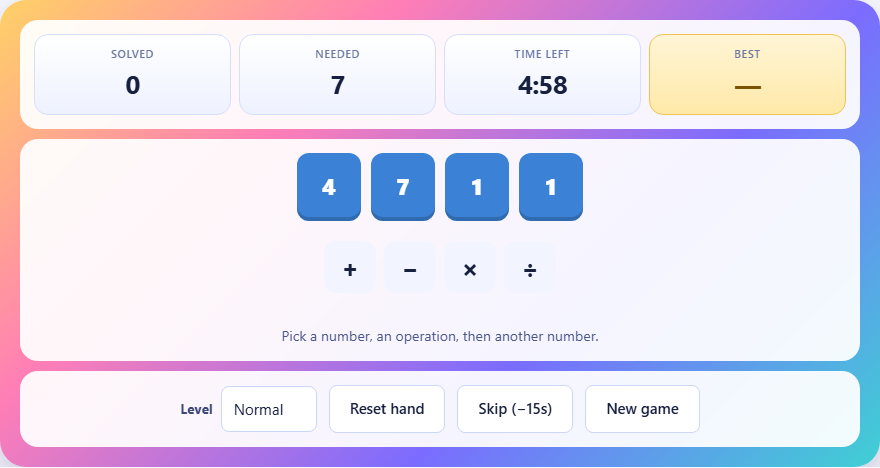
You are given four numbers. Using each number exactly once, and any mix of addition, subtraction, multiplication, and division, make the result come out to twenty-four. You combine two numbers at a time. Pick a number, pick an operation, pick a second number, and the two collapse into one new number. Do it again with what is left until a single number remains. If that number is twenty-four, the hand is solved.
The game runs on a clock. You need to solve a target number of hands before the time runs out. Easy asks for five solved hands in five minutes. Normal asks for seven. Hard asks for nine in four and a half minutes, and the numbers go higher.
Controls step by step
Four number tiles sit in a row. Below them are four operation buttons: plus, minus, times, and divide. Tap a number tile and it lights up. Tap an operation. Tap a second number tile. The two numbers merge into one tile showing the result. Keep combining until one tile remains.
Below the operation buttons are three controls. Reset hand puts the same four numbers back the way they were dealt, so you can try a different approach without losing the hand. Skip moves on to a new hand but takes fifteen seconds off the clock. New game restarts everything from the beginning with a fresh clock.
The order you tap matters for subtraction and division. Tapping five, then minus, then three gives two. Tapping three, then minus, then five gives negative two. Both are legal as intermediate steps, but the final number must land on twenty-four exactly.
Every hand has at least one answer
Before a hand is dealt, the game tries every way of pairing the four numbers and combining them with the four operations. If none of those paths reach twenty-four, the hand is thrown away and a new one is drawn. This matters. Roughly a third of random four-number hands have no solution at all. If those were left in, you would spend minutes on a puzzle that cannot be cracked, which is not a challenge. It is a trap.
Because every hand is checked, a hand you cannot solve is always your puzzle to crack, not the deal being unfair. The answer exists. You just have not found the right combination of operations yet. Sometimes the path requires an unusual first step, like dividing two small numbers to get a fraction. The solver does not care whether the path looks natural. It only checks that at least one sequence of operations lands on twenty-four.
Thinking in factor pairs
Twenty-four breaks down into useful pairs: six times four, eight times three, twelve times two, and twenty-four times one. Getting one half of any pair usually makes the other half obvious.
Say you are dealt 2, 3, 5, and 8. You notice 8 times 3 is twenty-four, which uses two of the four numbers. That leaves 2 and 5. You need them to go away without changing the product. 5 minus 2 is 3, and 3 times 1 is 3, but you have already used the 3. Try the other direction. 2 minus 5 is negative 3, which is awkward. Instead, look at the other pair: (5 minus 2) is 3, then 3 times 8 is twenty-four. That uses 5, 2, and 8, but the dealt 3 is left over. Reset. Try: 5 minus 3 is 2, then 2 times 2 is 4, then 4 times 8 is 32. Not quite. Reset again. 8 divided by 2 is 4, then 4 plus 5 is 9, then 9 times 3 is 27. Close but wrong. Keep going. 8 times 2 is 16, 16 plus 5 is 21, 21 plus 3 is 24. That is it.
Division is the hidden tool
Most people reach for addition and multiplication first. Division feels like it makes numbers smaller, which seems unhelpful when you need to reach a specific target. But division is often the key that unlocks the hardest hands.
Fractions along the way are perfectly legal. You do not need every intermediate step to be a whole number. Dividing 3 by 2 gives 1.5, and 1.5 times 8 gives 12, and 12 times 2 gives 24. That path would be invisible to someone who avoids division.
A good habit: when the four numbers look stubborn, try dividing two of them and see what fraction you get. Then ask whether multiplying that fraction by something on the board lands you on twenty-four or a factor of it. This one trick solves most of the hands that resist the obvious factor-pair approach.
The clock and when to skip
Five minutes sounds generous for seven hands, but some hands are genuinely hard. A single stubborn deal can eat ninety seconds. The skip button is there for exactly that situation. It costs fifteen seconds, deals a new hand, and resets nothing else.
Skip early rather than late. If you have been staring at a hand for thirty seconds with no progress, spending another minute is unlikely to help. Skip it, solve two easier ones in the time you saved, and the clock still favours you. A skip after ninety seconds of struggle saves almost nothing.
On hard difficulty, the numbers go up to thirteen. Bigger numbers mean more possible intermediate results, which makes the search tree wider. But they also create more factor-pair opportunities. Thirteen times 2 minus 2 is 24. Eleven plus thirteen is 24. Larger numbers are not harder across the board. They are different.
Common mistakes that cost time
- Ignoring subtraction that produces negative numbers. A negative intermediate value can become positive on the next operation. Negative three times negative eight is twenty-four.
- Trying every operation at random instead of targeting a factor pair. Random guessing works but is slow. Aimed guessing - can I build a six and a four? - is much faster.
- Forgetting that the reset button exists. If you are three operations in and the remaining number is wrong, there is no undo. Hit reset and the original four numbers come back immediately.
- Spending two minutes on one hand. The game rewards solving many hands, not solving hard ones. If a hand resists, skip it and move on.
- Using all the easy operations first. Combining two large numbers with addition early can leave you with a single huge number and no way to bring it back down.
Difficulty levels compared
Easy uses numbers from one to nine, gives you five minutes, and asks for five solved hands. This is the right starting point. The low numbers keep the arithmetic simple, and the generous clock lets you learn the factor-pair habit without pressure.
Normal raises the ceiling to ten and asks for seven hands in five minutes. Ten is a friendly number. It multiplies and divides cleanly, so having it on the board is often a gift.
Hard goes up to thirteen, drops the clock to four minutes and thirty seconds, and asks for nine hands. The higher numbers demand quicker mental arithmetic. Thirteen, eleven, and seven are primes, and primes resist clean factoring. Division becomes more important at this level.
Scoring and best records
The game counts how many hands you solve before the clock expires. When you reach the target, the game ends with a success message and notes how many seconds you had left. Your best result is saved locally.
If the clock runs out before you finish, the game tells you how many you solved and suggests looking for ways to build six times four, eight times three, or twelve times two. That is genuine advice, not a consolation. The factor-pair habit is the fastest path to the target on any difficulty.
There is no penalty for a wrong final answer. If the last tile shows a number that is not twenty-four, the game tells you what it came out to and waits for you to hit reset. You keep the same hand and try again, with no time added or removed.
No server, no upload, no account
The solver that checks every hand runs inside your browser. The hands are generated on your device. Your score is stored in your browser on this device only. Nothing is sent anywhere, there is no account to make, and once the page has loaded the game works without a network connection at all.
You can prove this by turning off your connection after the page loads. Hands keep coming, the solver keeps checking them, and the clock keeps running. The server was never part of the game.