
Sorting the magnets from the blanks on a domino grid
How the domino-shaped magnets work, what the edge numbers tell you, the three deduction chains that crack most boards, and why leaving a domino blank is just as important as placing a pole.
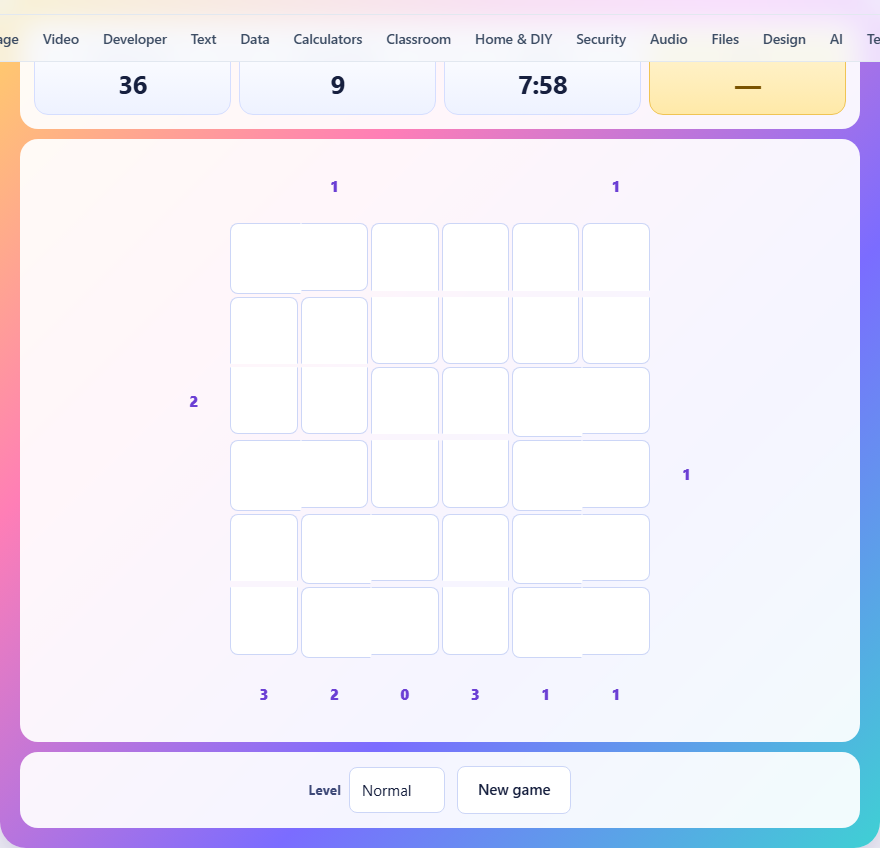
The board and its pieces
The board is a rectangle divided into dominoes. Each domino covers two squares, either side by side or stacked on top of each other. You cannot move the dominoes or split them. They stay where they are.
Every domino is one of two things. It is either a magnet or a blank slab. A magnet has a plus sign at one end and a minus sign at the other. A blank slab has neither. Your job is to decide, for every domino on the board, whether it is a magnet and which way round it points, or whether it is blank.
What the numbers around the edge mean
Four sets of numbers sit around the border. The numbers on the left side count how many plus signs belong in each row. The numbers on the top count how many plus signs belong in each column. The numbers on the right side count the minus signs per row. The numbers on the bottom count the minus signs per column.
Some of those numbers may be missing. A missing number means the puzzle can be solved without it. The answer is still unique because the remaining clues are enough to pin down every domino. Missing clues are not a mistake. They are part of the design.
The rule that keeps poles apart
Two plus signs may never sit next to each other, and two minus signs may never sit next to each other. This applies side by side and up and down. Diagonal neighbours do not count. Only squares that share an edge are checked.
This constraint is what makes the puzzle work. Without it, you could scatter poles freely and just match the counts. With it, every plus you place forces every touching square to be either a minus or blank, and that chain of forced decisions is where the real solving happens.
How the controls work
Tap any square of a domino and both halves change together. The first tap turns the domino into a magnet with plus on the tapped side and minus on the other. Tap again and the poles swap over. Tap a third time and the domino goes back to blank.
Both squares always change as a pair. You never set one half of a domino independently. That matches the physical object. A real magnet has two poles. Half a magnet does not exist.
The stat panel above the board tracks three things. Squares left shows how many cells still have no assignment. Clues wrong shows how many of the edge numbers are currently not satisfied. Time left is a countdown.
Difficulty levels and board sizes
Easy gives you a 4x4 board with five minutes. Normal is a 6x6 board with eight minutes. Hard is a 6x8 board with eleven minutes. Larger boards have more dominoes and more missing edge numbers, which means longer deduction chains.
On the easy board, most dominoes can be settled directly from the edge counts. On the hard board, you often need three or four steps of reasoning before a domino can be placed with certainty. The hard board also tends to have more missing edge numbers, so you rely more heavily on the adjacency rule and less on the raw counts. If you are new to the puzzle, start on easy and build up. The patterns you learn on a small board transfer directly to the larger ones.
Starting with the zeros
A row that needs zero pluses cannot have any plus signs at all. Every magnet in that row must point its minus end inward. But a minus in that row touches whatever sits above and below it, and those neighbours cannot also be minus. So a zero on one row forces decisions in the rows beside it.
The same applies to columns. A column that needs zero minuses means no minus sign can appear in any square of that column. Every magnet in it must have its plus end in that column, and every square touching those pluses from the side is then forced to be minus or blank.
When both a row's plus count and a column's minus count are zero, the square where they cross cannot be a pole of either kind. Any domino covering that square is either blank or has its other end in a different row and column. That narrows its options dramatically.
Counting the dominoes in a full line
Sometimes a row needs as many pluses as there are dominoes entirely inside it. When that happens, every one of those dominoes is a magnet and every one has its plus end in that row. There is no room for blanks.
The same logic works in reverse. If a row needs zero pluses and every domino in it lies entirely within the row, every domino must be blank. No magnet can sit there without putting a plus somewhere.
Dominoes that span two rows complicate this, because only one half sits in the row you are counting. Those halves can be plus, minus, or blank. But the dominoes that fit entirely in one row have both halves in that row, and their state is settled by the count alone.
How one pole forces its neighbours
Place a plus sign in a square. Every square that shares an edge with it must be either minus or blank. It cannot be plus, because two pluses touching would break the rule. If one of those neighbours is part of a domino that already has its other half decided, the neighbour may be forced.
This cascade is the engine of the puzzle. Place one pole, rule out the same pole in four directions, and see what falls out. On many boards a single well-chosen domino near the edge of the grid sends a wave of forced moves across three or four rows.
When you are stuck, look for a square where every option but one leads to a contradiction. If making a square plus forces its neighbour to be minus, and that minus breaks a column count, then the original square cannot be plus. That kind of elimination is slower but it always makes progress.
Remembering that blank is a real answer
The most common mistake is trying to fill the entire board with magnets. Not every domino is a magnet. Some are blank, and figuring out which ones is half the puzzle. If you place magnets everywhere and then try to fix the counts, you will hit contradictions quickly.
A helpful habit is to count how many pluses a row needs and compare that to how many dominoes it contains. If the row has five domino halves but only needs two pluses, at least some of those dominoes must be blank. Knowing the blank count narrows down which specific dominoes can carry poles.
Another sign that a domino should be blank is when both of its possible orientations cause a conflict. If placing plus on the left half means two pluses touch, and placing plus on the right half breaks a column count, the domino cannot be a magnet at all. Marking it blank often unlocks its neighbours.
Common errors and how to avoid them
- Placing a pole without checking all four neighbours. A plus that touches another plus will look fine until you fill in the squares around it and find no legal way to continue.
- Ignoring the minus counts on the right and bottom. They constrain the board just as much as the plus counts on the left and top. Cross-check both sides of every row you settle.
- Trying to solve left to right like a crossword. Jump to wherever the counts are most restrictive. A row with a zero or a row where every domino must be a magnet is a better starting point than a row with a middling count.
- Forgetting that missing edge numbers still constrain the board. A missing number means the count was not needed, not that the row is free to hold anything. The adjacency rule and the other clues still apply.
All the solving happens on your device
The board is built and checked inside your browser. The generator creates a random layout, fills it with an answer, extracts the edge counts, and then strips away every clue that is not needed to keep the answer unique. All of that work happens on your machine in a fraction of a second. No data is sent to a server, there is no account, and your scores are kept in local storage on this device. You can go offline after loading the page and everything keeps working.