
Drawing a single closed loop from numbered clues
How the numbers guide the loop, what each tap does, the inside-outside trick that solves boards faster than guessing, and the patterns that let you fill in lines before you even start thinking.
What the puzzle asks you to do
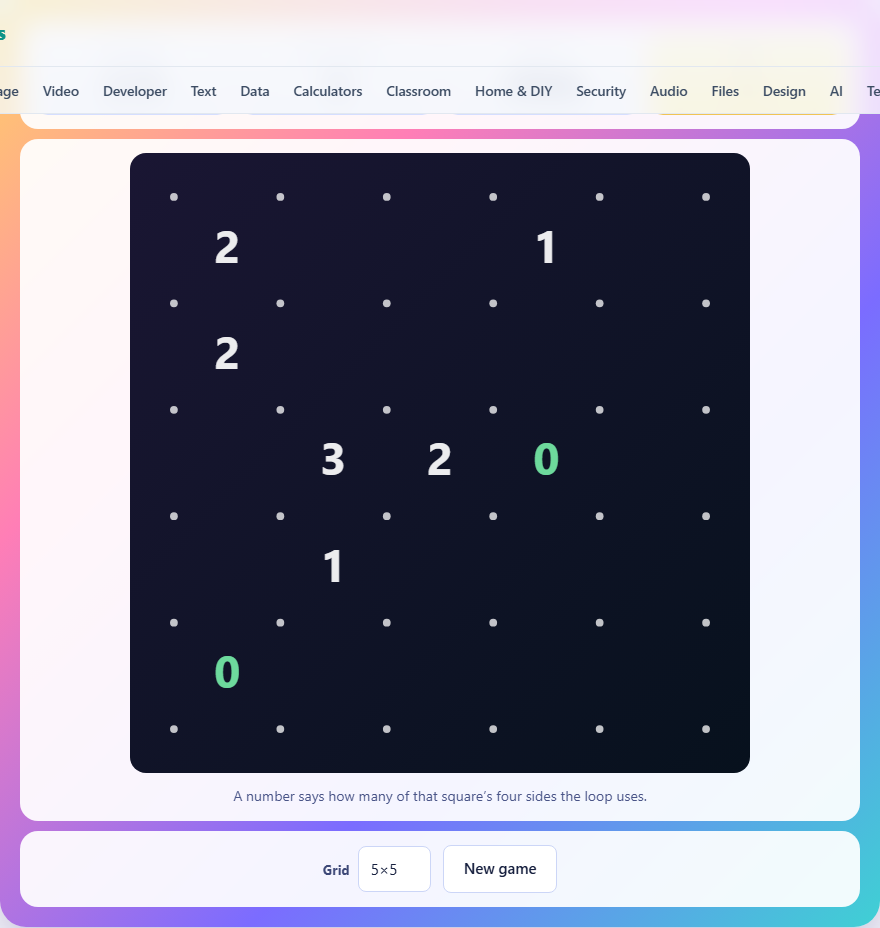
A grid of dots sits on the screen. Between those dots you draw lines, and the lines must form one closed loop. The loop cannot cross itself, cannot branch into two paths, and cannot leave a loose end hanging. When you are done, following the loop with your finger should bring you back to where you started without lifting off.
Some of the squares inside the grid carry a number. That number says exactly how many of that square's four sides the loop uses. A square marked 3 has three of its four sides drawn in. A square marked 0 has none. Squares with no number are free to use any count at all.
Three grid sizes are available. The 4x4 grid gives you four minutes. The 5x5 grid, the default, gives you five minutes and twenty seconds. The 6x6 grid gives you seven minutes. Bigger grids have more clues and more room for chains of logic, but they also have more edges to settle.
Controls on desktop and phone
Tap or click between two dots to draw a line there. Tap the same spot again and the line disappears. On a phone the grid scales to fit the screen, and tapping works the same way.
Shift-tap, or right-click on desktop, puts a small cross on an edge instead of a line. The cross is a note to yourself that you have ruled that side out. It does nothing to the puzzle and does not count toward your answer. You can remove a cross the same way you placed it.
The stat panel above the board tracks two numbers. Clues met shows how many numbered squares currently have the right count of sides drawn. Sides drawn is the total number of lines on the board. A countdown timer runs alongside them.
How scoring and finishing work
When every numbered clue is satisfied and the lines form a single closed loop, the game ends and your remaining time is your score. A faster solve means a higher score. If the timer reaches zero before you close the loop, the game is over.
Your best score for each grid size is saved in your browser. It stays on that device and is never sent anywhere.
The inside-outside way of thinking
Forget about lines for a moment and think about regions. Every square on the board is either inside the loop or outside it. A line is drawn on an edge when the two squares on either side of that edge disagree about whether they are inside or outside.
A 0 means the square and all four of its neighbours are on the same side. None of its edges separate inside from outside, so no lines are drawn. A 4 means the square is an island surrounded entirely by the opposite region, so all four sides are drawn.
This way of thinking matters because it turns a question about lines into a question about shading. You can shade squares mentally and see which edges must carry a line. Two neighbouring squares that are both inside share their boundary with no line. Two neighbours where one is inside and the other outside force a line between them.
Patterns that give you free lines
A 0 settles four edges at once. None of its sides carry a line, and you can mark crosses on all of them immediately. That is the best opening move on any board.
A 3 is nearly as strong. Three of its four sides are drawn, so only one is missing. If you can work out which one is missing, the other three are yours.
Two 3s placed side by side always share the edge between them. Both squares need three sides drawn, and the shared edge is always one of them. The two outer edges beyond them are also always drawn. That pattern is a gift because it fills in three edges with no deduction at all.
A 1 in a corner has only two edges to choose from, since the other two sides face off the board. Exactly one of those two is drawn. A 3 in a corner uses both of its non-border edges plus one border edge, which means only one of the two border edges is missing.
The two-line rule at every dot
On a single closed loop, every dot the loop passes through has exactly two lines meeting at it. No more, no less. If a dot already has two lines drawn into it, every other line that could reach that dot is ruled out. That one rule cascades further than you might expect.
Suppose you draw two lines into a dot and there is a third edge waiting nearby. Mark a cross on it. Now look at the square next to that crossed edge. It might have lost enough possible sides that its number forces the remaining edges. Each settled edge brings another dot closer to its limit of two.
Dots that the loop does not pass through have zero lines. If you can prove a dot must have zero lines, mark crosses on every edge touching it. A common situation is a dot in the corner of a 0. The 0 already removes the two sides that meet at that corner, and the two remaining edges leading outward from that dot often cannot carry lines either because a neighbouring clue would break.
Working from the edges of the board inward
Squares on the border of the grid have at least one neighbour that is off the board entirely. Off-board squares count as outside the loop. That means a border square marked 0 tells you that its on-board neighbours on that side are also outside. You can then reason about their clues with one neighbour already decided.
Corner squares are even more revealing. They have two sides that face off the board, so a number in a corner works with only two edges rather than four. A 2 in a corner uses both of its internal edges. A 0 in a corner means neither internal edge is used, and any neighbour that also borders the edge of the board is pushed outside the loop as well.
Common mistakes and how to fix them
- Starting in the middle of the board. Begin with the 0s and 3s instead, especially those on the edges. They settle the most lines with the least effort.
- Forgetting the single-loop rule. You can satisfy every numbered clue and still have two separate loops on the board. The puzzle requires one closed circuit, so check that your lines connect into one path.
- Ignoring the cross marks. They cost nothing to place and save you from checking the same edge twice. Use them freely on any edge you have ruled out.
- Drawing lines that force a dot to have three edges. If a dot already has two lines, stop. Any more would branch the loop, and branches are not allowed.
- Guessing when the clues still have something to say. Every board has exactly one answer, so anything you can prove is correct. If you are stuck, look for a dot with two lines or a number whose remaining edges have only one possible arrangement.
Moving up from 4x4 to larger grids
On the 4x4 grid there are only sixteen squares and the clues tend to settle quickly. It is a good place to practise the basic patterns. The 5x5 grid adds nine more squares and usually has longer chains of deduction. The 6x6 grid demands patience because a single overlooked cross can stall you for a minute.
Larger grids reward the inside-outside approach more than the line-counting one. Shading an entire region as inside or outside settles every edge along its boundary in one mental step, while counting lines one at a time gets slower as the board grows.
One trick that helps on bigger boards is to work from several anchor points at once rather than building one long chain. Find a cluster of 0s in one corner and a pair of 3s elsewhere. Settle both areas, then look for the clues that bridge them. The loop has to connect everything, so at some point your two solved regions will force the edges in between.
Everything stays on your machine
The puzzle is built and checked entirely in your browser. No board is sent to a server, no account is needed, and your scores stay in local storage on the device you are using. Once the page has loaded you can disconnect from the internet and keep playing. You can test this yourself by loading the page, switching to airplane mode, and starting a new game. The board appears, the timer runs, and the loop checks itself, all without reaching out to any server.