
Three rules, one grid, no guessing
How Lonely Cells works, why each of the three rules matters, the tap cycle that tracks your reasoning, timed solving across three grid sizes, and the deduction chains that let you solve by logic instead of luck.
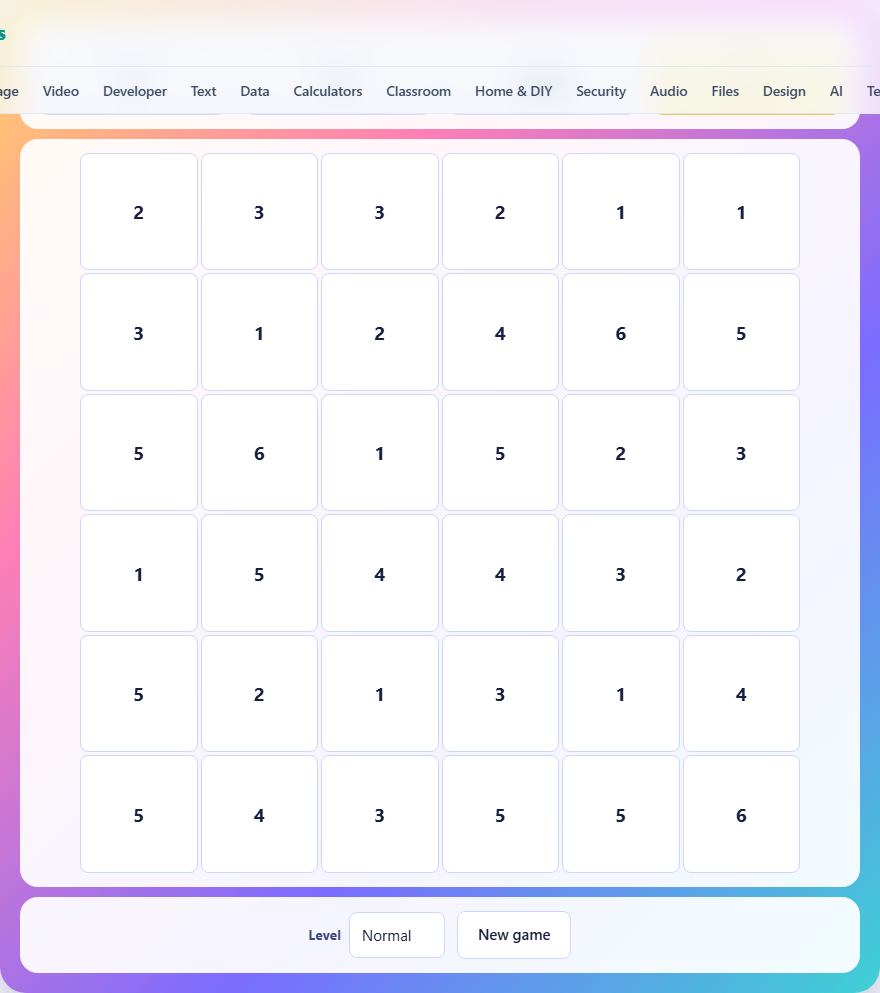
The setup
Lonely Cells gives you a grid filled with numbers. Every row and every column contains some repeated values. Your job is to black out squares until no number appears twice in any row or column among the squares that remain white.
That alone would be simple. What makes it a puzzle is two extra rules that must hold at the same time. First, no two blacked-out squares may touch along an edge. They can touch at a corner, but not side by side. Second, all the white squares must stay connected in one piece. You must be able to walk from any white square to any other by stepping up, down, left or right through white squares only.
Three rules, all enforced together: no repeated numbers, no touching black squares, and one connected white region. A move that fixes one rule but breaks another does not count.
The three-tap cycle
Tap a square once and it turns black. Tap it again and it gets a green ring, marking it as definitely white. Tap a third time and it returns to its undecided state.
The green ring is not just a visual aid. Marking a square as safe is half of how the puzzle is solved on paper. When you know a square must stay white, locking it in prevents you from accidentally blacking it out later and losing track of your logic.
The scoreboard shows three readings. Blacked out counts the squares you have darkened. Repeats left counts how many duplicate pairs still exist in the remaining white squares. Time left is a countdown clock that runs from the moment you start.
Board sizes and time limits
Easy uses a five-by-five grid and gives you five minutes. Normal moves to six-by-six with seven minutes. Hard is seven-by-seven with ten minutes.
The time limit is generous by design. Most five-by-five puzzles take under two minutes once you know the techniques. The clock is there to keep each attempt moving forward rather than stalling in one spot. If you run out of time, the loss message reminds you of a useful deduction pattern to try next round.
Each grid is generated fresh and verified to have exactly one solution before it reaches you. That single-answer guarantee is what makes the three rules enough to solve the puzzle without trial and error.
The triple-in-a-line deduction
The strongest opening move comes from spotting three identical numbers in a single row or column. When the same number appears three times in a line, the middle one must stay white.
Here is why. No two black squares may touch. If you blacked out the middle square and one of its neighbours, you would have two black squares touching. And you cannot black out all three, because that would also create touching pairs. So the middle cell is safe, and you can give it a green ring right away.
This leaves two copies of the number still in the line, one on either side of the safe middle one. Exactly one of them must be blacked out to remove the duplicate. Which one depends on the other rules, but locking the middle and knowing that one of the outer two must go is a strong start.
Pairs side by side
Two identical numbers sitting next to each other in a row tell you something useful about any third copy of that number in the same row. That third copy must be blacked out.
The reason is that neither of the adjacent pair can be blacked out without problems. If you black out one of the pair, the other stays white and shows the same number. But the one you removed was the only copy that could pair with the third one somewhere else in the row. You are left with two copies still visible. The only clean answer is to keep both members of the adjacent pair white and remove the third.
This technique works along columns as well. Any time you see two identical numbers next to each other, look along the rest of that row and column for more copies of the same number. Those distant copies are usually forced to be black.
The connection rule in practice
After you have worked through the number constraints, the connection rule acts as a final check. All white squares must form one connected region. If blacking out a certain square would cut the white area into two separate islands, that square cannot be blacked out.
This comes up most often near the edges and corners. A square sitting along the border with only two white neighbours is a potential chokepoint. Removing it might strand a section of the grid. Before you black out any border square, check whether the white squares on both sides can still reach each other through a different path.
On larger grids, the connection rule can also force moves. If a particular square is the only bridge between two regions of white squares, it must stay white. Ring it green and move on. These forced-white moves then feed back into the number rules and often crack open a section you were stuck on.
A solving walkthrough
Start by scanning every row and column for triples and adjacent pairs. Mark the forced cells green and black out the forced removals. After that first pass, the repeats counter will often drop by half.
Next, look at every black square you just placed. Its four neighbours are now safe because no two black squares may touch. Ring them green. Those newly safe squares might be duplicates of something else in their row or column. If so, the other copy must be blacked out.
Keep chaining. Every black square forces its neighbours white. Every white square forces its duplicates black. Every new black square forces its neighbours white again. On a well-built puzzle, this chain runs from the first deduction all the way to the last square.
When the chain stalls, look for the connection rule. Is there a square whose removal would cut the grid? That square must be white. Feed that back into the number rules and the chain should restart.
Traps that catch beginners
- Blacking out a square without ringing its neighbours. The no-touching rule means every neighbour of a black square is automatically safe. Missing this skips the easiest deductions in the puzzle.
- Focusing only on the number rule. The puzzle has three rules. Solving by numbers alone will eventually produce a grid where two black squares touch or the white region is split. Check all three as you go.
- Not using the green ring. Leaving squares undecided when you know they must stay white costs you information. The green ring is your memory. Use it freely.
- Guessing when stuck. The puzzle has one answer and is built to be solvable by logic. If you need to guess, there is a deduction you missed. Back up and look for triples, adjacent pairs, or forced connections.
- Ignoring the clock until it is almost gone. Glancing at the timer after each major chain keeps you aware of your pace without adding pressure.
Harder grids, bigger chains
The five-by-five grid is a tutorial. Most rows have only one duplicate, and the deduction chains are short. The six-by-six grid adds enough squares that some rows carry two or even three pairs of duplicates, and the chains interlock across rows and columns.
On the seven-by-seven grid, almost every deduction touches two or three lines at once. A single blacked-out square in the middle of the board might ring four neighbours green, each of which forces a duplicate in a different row or column. Those four forced moves then trigger their own cascades. The puzzles are not harder in concept, but the chains are longer and it is easier to lose your place.
If you find the jump from five-by-five to seven-by-seven too steep, spend a few rounds on six-by-six until the chaining habit is automatic. The same techniques work at every size. Only the length of the chains changes.
Nothing leaves your device
The grid is built and checked by code running in your browser. No data goes to a server, no account is needed, and your scores stay in your browser's storage on this machine. Once the page has loaded you can disconnect from the internet and keep solving without any change.