
Placing bulbs without a single clash
How the lighting and blocking rules work, what the numbers on the black squares demand, why crosses matter as much as bulbs, and a step-by-step approach to solving any grid by logic alone.
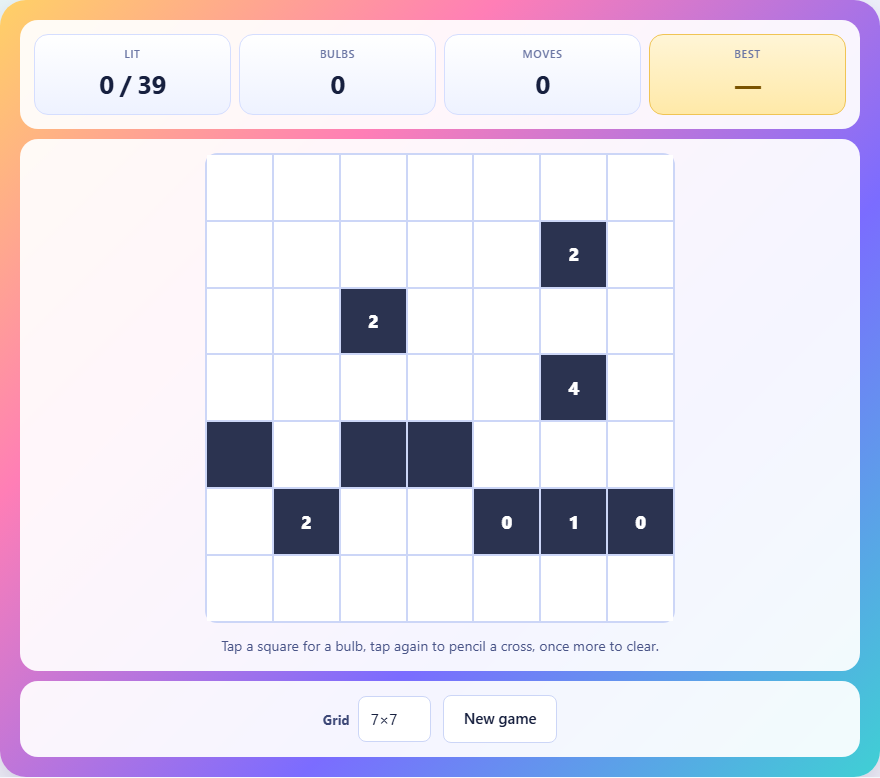
The goal in one sentence
Light Up hands you a grid of white and black squares. You place light bulbs on the white squares. A bulb shines along its entire row and column until a black square blocks the beam. Every white square must end up lit, no two bulbs may see each other, and every numbered black square must have exactly as many bulbs next to it as the number says. Satisfy all three rules and the puzzle is done.
The grids here come in three sizes. The six-by-six is a good warm-up. The seven-by-seven is the standard challenge, and the nine-by-nine takes real patience. All three are generated fresh each time, and each one is checked to have exactly one answer before it reaches you.
How light travels
A bulb sends light in four directions: up, down, left and right. The light runs along the row and column until it hits a black square or the edge of the grid. Every white square the beam passes through is lit.
Light does not bend around corners and it does not jump over black squares. A bulb in the top-left corner of a clear row lights the entire row, but if a black square sits three squares in, everything beyond it stays dark.
Two bulbs that can see each other along a row or column are clashing. The game marks them in red to tell you something is wrong. A solved grid never has a clash, so if you see red you need to move one of the two bulbs.
What the numbers mean
Some black squares carry a number between zero and four. That number says exactly how many bulbs must sit on the four squares that touch it along its edges. Not more, not fewer. A zero means none of its neighbours may hold a bulb. A four means all four must.
Not every black square has a number. A blank black square has no constraint at all. It blocks light the same way, but it makes no promise about what sits next to it.
The numbers are the strongest clues in the puzzle. A zero immediately rules out four squares. A four immediately fills four squares. Most solves begin with these extreme clues and work outward from there.
Controls and the three-tap cycle
Tap a white square once and a bulb appears. Tap again and the bulb is replaced by a small pencil cross, a mark that says you have decided no bulb goes here. Tap a third time and the square is cleared back to empty.
The cross is not decoration. Marking where a bulb cannot go is how you track your reasoning. When a number is fully satisfied, crossing off its remaining neighbours prevents you from accidentally placing a bulb there later. When a square is already lit, crossing it reminds you that a second bulb in that line would cause a clash.
The scoreboard above the grid shows three things. Lit counts how many white squares are currently lit out of the total. Bulbs shows how many you have placed. Moves counts every tap, including the ones that place crosses and the ones that clear squares.
Start with the easy numbers
Zeros and fours are free moves. A zero has no bulbs next to it, so cross off all four of its neighbours right away. A four means every neighbour is a bulb, so place all four immediately. Those bulbs then light large sections of the grid, and the lit squares tell you where more bulbs cannot go.
After the extremes, look for numbers whose free neighbours match their remaining need. A one in a corner has only two neighbours at most. If one of them is already crossed, the other must be a bulb. A two with exactly two free neighbours fills both.
This pattern keeps repeating. Each bulb you place lights squares, which rules out positions, which forces other numbers. A good puzzle unravels in a chain of forced moves once you find the right starting point.
The lonely square rule
Sometimes a white square can only be lit from one direction. Every other line of sight is blocked by black squares or by positions where a bulb would cause a clash. When a square has only one possible source of light, a bulb must go in that source.
Spotting these lonely squares is the second most useful technique after working with numbers. Scan the dark squares on the board and trace their lines of sight. If a dark square can only be reached by one open position, that position needs a bulb.
This works even when no numbers are nearby. On larger grids where many black squares are blank, the lonely square rule is often the only way forward. It is the difference between staring at the grid and actually making progress.
Eliminating positions with crosses
Every bulb you place has a ripple effect. It lights a line of squares, and none of those lit squares can hold a second bulb. Cross them all. Then check every numbered black square near the new bulb. If a number is now fully satisfied, cross its remaining neighbours.
Build the habit of crossing aggressively after every bulb. On a nine-by-nine grid, a single bulb in the right spot can rule out a dozen positions. Those crosses then force other squares through the lonely square rule or through numbers that have only one way left to be filled.
If you find yourself stuck, the most likely problem is that you placed a bulb without crossing the positions it rules out. Go back through each bulb and trace its light in all four directions. Every lit square that is not crossed is a missed deduction.
No guessing is ever needed
Every grid on this page has been verified by a solver to have exactly one answer. That means you can always reach the solution through logic. If you feel the urge to guess, there is a deduction you have not seen yet.
The generator starts with a full set of numbers on every black square, then strips clues one at a time for as long as the answer stays unique. This means harder grids have fewer numbered squares, but the ones that remain carry more information because they have to keep the answer unique on their own.
When you are stuck, step back and look for chains. A bulb placed here would light that square, which means no bulb can go there, which means this number can only be satisfied one way. These chains of logic are what the puzzle is about. Think of it as following a thread. One forced move leads to the next, and the next leads to a third. Most grids have at least one long chain that resolves half the board once you find its first link.
Mistakes that slow you down
- Placing bulbs without crossing the positions they rule out. This is the single biggest source of errors. A bulb without its crosses is half the work done.
- Ignoring blank black squares. They carry no number, but they still block light. A blank black square between two white regions means each region needs its own bulb.
- Treating a number as a minimum. The number is exact. If a two already has two bulbs next to it, no more may be added, even if the remaining neighbours are unlit. Cross them.
- Forgetting that clashing bulbs are always wrong. Two bulbs in the same line of sight cannot both stay. If placing a bulb turns another one red, one of them must move.
- Solving from the middle outward. Edges and corners are more constrained, so they tend to give more information. Start where the numbers are and work toward the open areas.
The puzzle stays in your browser
The entire game runs on your own device. The grid is generated by code running in your browser, your moves happen locally, and nothing is sent to any server. There is no account, no login, and no tracking of your solves beyond the best-score number stored in your browser's local storage on this device alone. Load the page once and you can play offline for as long as you like. You can prove it by disconnecting from the network after the page loads and starting a new puzzle. Everything still works, because there was never anything on the other end.