
Flipping squares to darkness
How the toggle mechanic works, why only one board in four is actually solvable, the chase technique that cracks any size grid, and how to read the bottom row when the rest of the board is already dark.
A puzzle about neighbours
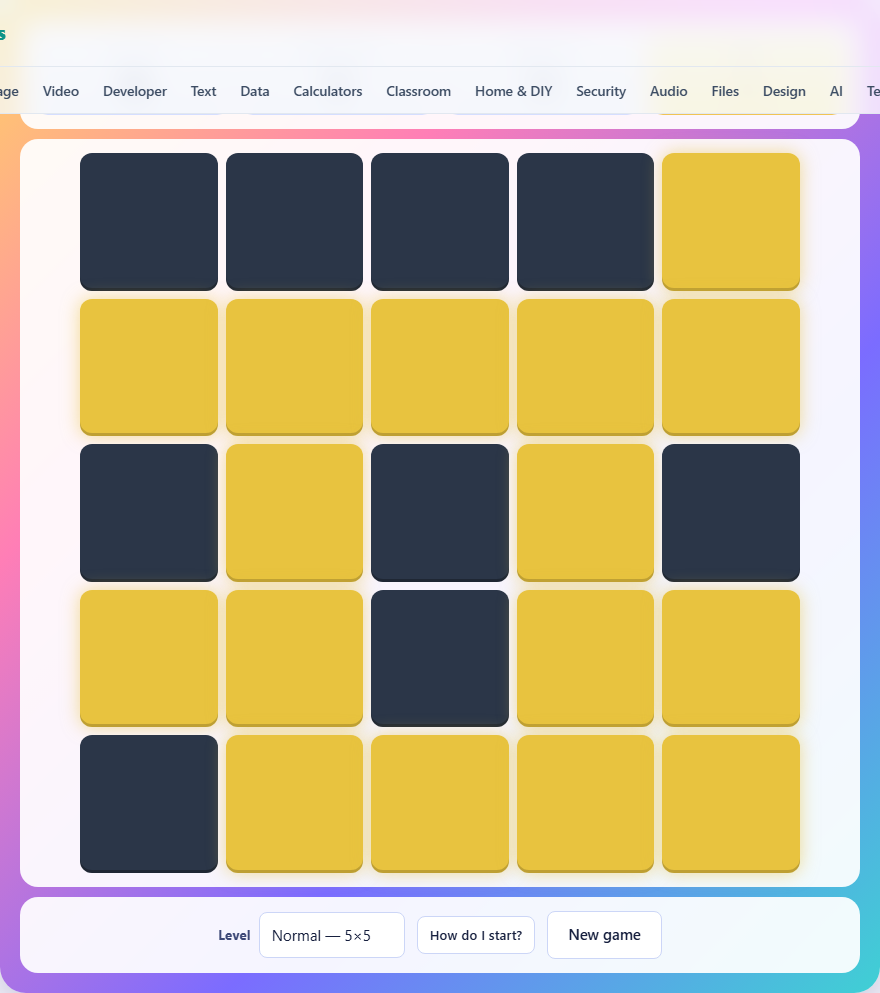
Lights Out gives you a grid of squares, some lit and some dark. Press any square and it flips, but so do the squares directly above, below, left and right of it. If a square was on it turns off. If it was off it turns on. Your goal is to make every square dark before you run out of moves.
The catch is that every press changes five squares at once, or fewer along the edges where some neighbours are missing. A corner press flips three squares. An edge press flips four. A centre press flips five. You cannot touch one square without disturbing the ones around it, and that is what makes the puzzle interesting.
The board sizes and controls
Three levels are on offer. Easy uses a four-by-four grid with sixteen squares. Normal is five-by-five, the classic size for this puzzle, with twenty-five squares. Hard stretches to six-by-six and thirty-six squares.
Controls are simple. Click or tap a square to press it. That is the only action in the game. There are no dragging gestures and no keyboard shortcuts to learn. The board scales to fit your screen, so it works the same way on a phone as on a wide monitor.
A button labelled How do I start shows a short hint about the chase technique. Picking a different level from the dropdown and pressing New game starts a fresh puzzle at that size. Your best score at each level is tracked and shown when you beat it.
What the scoreboard tracks
Three numbers sit above the board. Still on counts how many lights remain. Moves used counts your presses so far. Moves left is your budget.
The move limit is not a guess. Each puzzle is built from a known number of presses, so the shortest possible solution is known before you start. The limit adds a margin on top of that, usually around eighty percent extra, so a clean solve always fits without trouble. When you clear the board, the win message tells you both your count and the shortest path, so you can see how close you came to perfect.
Why every puzzle here can be solved
Not all Lights Out boards have an answer. On a five-by-five grid, roughly three boards out of four are impossible no matter what you press. Scattering lights at random would hand out unsolvable puzzles most of the time.
The generator avoids that trap by building backwards. It starts from a board where every square is dark, then presses a random set of squares. Because every press can be undone by pressing the same square again, whatever the generator did can always be reversed. The board you receive is guaranteed to have at least one solution.
This also means the puzzle knows its own par. The generator counts how many distinct squares it pressed. If it pressed the same square twice those cancel out, so the real count of squares you need to press is never more than what the generator used.
The chase technique
The most reliable strategy for any board size is called the chase. It works top to bottom, one row at a time, and turns a confusing grid into a set of small problems.
Start with the top row. For every lit square in that row, press the square directly below it. That press flips the lit square off, which is what you want, and it also flips the square you pressed and its own neighbours, which you will deal with later. Move to the second row and do the same thing: wherever a light is still on, press the square below it.
Keep going row by row until you reach the bottom. By this point, every row except the bottom one is guaranteed to be dark. The bottom row may still have some lights on, and those form a pattern you can handle separately.
The beauty of this method is that it does not ask you to see the whole board at once. Each row is its own small task. You look at one row, press below each of its lights, then forget about it and move on.
Finishing the bottom row
After chasing the grid from top to bottom, the bottom row is the only place with lights left. The patterns that can appear there are limited, and each one has a fix.
The fix is not to press squares in the bottom row itself. Instead, you go back to the top row and press certain squares there, then chase the whole board again. Which squares you press at the top depends on which pattern the bottom row ended up with.
On the four-by-four board, the bottom row patterns are short and there are only a few of them, so trial and error works fast. On the five-by-five board the standard patterns are well documented. The important thing is that the answer always exists. If you chased correctly, one of the known top-row adjustments will clear the bottom.
For a first attempt, do not worry about the bottom-row fix. Just chase top to bottom and see what you get. You will start to notice the same bottom-row patterns coming up again, and eventually you will remember which top-row presses fix each one.
Order does not matter
One fact simplifies everything about this puzzle. Pressing a square twice puts it back exactly where it started. That means pressing the same square three times is the same as pressing it once, and pressing it four times is the same as not pressing it at all.
Because of this, the solution is a set of squares, not a sequence. It does not matter which order you press them in. Press them left to right, right to left, or in any other order, and the final board will be the same. If you press square A and then square B, the result is identical to pressing B first and then A.
This has a practical consequence. If you made a press that you know was wrong, you can undo it by pressing the same square again. You lose two moves from your budget, but the board returns to where it was.
Mistakes new players make
The most common mistake is pressing randomly and hoping for the best. Each press affects up to five squares, so random tapping creates chaos faster than it fixes anything. The chase technique works because it is systematic, not because it is clever.
- Trying to fix one corner without a plan. A corner is three presses away from dark, and each of those presses disturbs other squares. Fixing one corner often lights up two others.
- Forgetting that edge and corner presses flip fewer squares. A press in the centre flips five squares, but a press in the corner only flips three. The edges behave differently from the middle, and the corners differently from the edges.
- Giving up when the bottom row is not dark after one chase. That is normal. The bottom row tells you what to change at the top, and a second pass finishes the job.
- Pressing the same square over and over thinking it will cycle. It only toggles. Two presses undo each other completely, so you are wasting moves in pairs.
- Ignoring the par number after a win. The win message shows the shortest possible solution. Comparing your count to par is the best way to judge whether your technique is tight or loose.
Thinking a few presses ahead
Once the chase technique is comfortable, you can start thinking about efficiency. The par for most five-by-five puzzles is between five and eight presses. If the chase takes you fifteen, you probably pressed squares that cancelled each other out along the way.
One habit that helps is to scan the board before you start. Count the lights. If only three or four are on, the solution might be just two or three presses. Try to find a single press that turns off two or three lights at once. On a sparse board, one good press near a cluster can clear most of it.
On denser boards, the chase is still the safest route, but look for clusters of four lights in an L shape or a line. Those patterns often collapse with two well-placed presses instead of the four the chase would use.
Everything stays on your machine
The puzzle runs entirely in your browser. No board is fetched from a server, no moves are sent anywhere, and no account is needed. Your best scores sit in your browser's own storage on this device and are never uploaded. If you close the tab, every trace of the game is gone. You can load the page, disconnect from the internet, and keep playing without a difference.