
Outbidding a probability-driven opponent at dice
How the wild ones change the arithmetic, what counts as a legal raise, when to call a bluff, and the strategies that work against an opponent doing exact probability behind every decision.
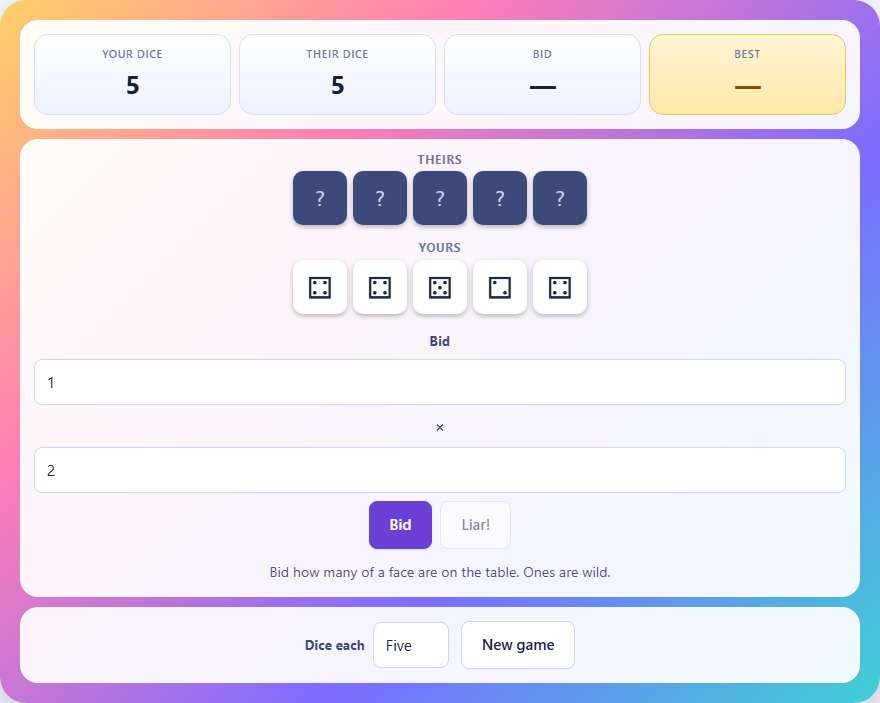
The setup and the secret
Both sides start with the same number of dice. Each side rolls in secret. You can see your own dice but not theirs. They can see theirs but not yours. The game is about guessing what the whole table holds, using only your own dice and the bids that go back and forth.
Ones are wild. A die showing one counts as any face. If you hold two fives and a one, you effectively have three fives. This is the standard rule in traditional versions of the game, and it is what makes the arithmetic interesting. Without wild ones, each unknown die would match a given face one time in six. With them, it matches about one time in three.
Making a bid
A bid has two parts: a quantity and a face. Saying three fours means you claim there are at least three dice showing four on the entire table, counting both sides and including wild ones.
Pick the quantity from the left dropdown and the face from the right dropdown. Faces run from two to six. You cannot bid on ones, because ones are wild and bidding on them would need a special halving rule that complicates the game for new players. Press Bid to submit.
Each bid must raise the previous one. You can raise by naming more dice at any face. Five twos is higher than four sixes, because five is more than four. You can also raise by naming the same number of dice at a higher face. Three fives is higher than three fours, because five is higher than four. You cannot lower either number.
Calling a bluff
Instead of raising, you can press the Liar button. This challenges the standing bid. All dice are revealed and counted.
If the bid turns out to be true, meaning the table really does hold at least that many of that face counting wilds, then the challenger loses a die. You called a good bid a lie, so you pay the price. If the bid was false, the bidder loses a die. They claimed something the table could not back up.
After the count, both sides re-roll with their remaining dice and a new round begins. The loser of the challenge starts the next round. Lose all your dice and the game is over.
The one-third rule
Because ones are wild, any unknown die has a one in three chance of matching a given face. It shows that face on one of its six sides and shows a one on another. That is two chances out of six, which is one third.
This is the number that should drive every bid you make. If the standing bid is four fives and you hold two fives yourself, you need two more from the unknown dice. With five unknown dice, the chance that two or more of them show a five or a one is about sixty per cent. That is a comfortable raise.
Bidding as though each die had only a one in six chance of matching gives away too much. You would challenge bids that are actually likely to be true, and you would lose challenges more often than you should.
Bid on what you hold
The safest bids are built on your own dice. If you hold three fours, bidding three fours is very likely to be true even if none of the hidden dice cooperate. The opponent has to assume you might be holding exactly that.
A bid built on thin air is the opposite. Claiming four sixes when you hold none means all four must come from the hidden dice. With ones wild and five unknowns, the chance of four matching sixes is low. You are handing the opponent a cheap challenge.
When you have a strong cluster of one face, lean into it. Bid that face early and let the opponent wonder whether you really have it or not. They cannot see your hand, and a truthful bid is the hardest kind to call.
How the opponent makes decisions
The computer does not guess. Before every decision it calculates the exact probability that the standing bid is true, given the dice it holds and the number of dice it cannot see. It uses the binomial formula with a one-third chance per unknown die.
When the probability drops below roughly twenty to thirty per cent, it challenges. When the probability is high enough, it raises with a bid that is comfortably likely from its own point of view, adding a little randomness so its play is not perfectly predictable.
This means bluffing the computer is harder than bluffing a nervous human. It does not react to body language or tone. It reacts to numbers. The way to beat it is to make bids that are true for you and unlikely for it. A bid of three fives when you hold three fives is safe. A bid of three fives when you hold none is a gamble the computer may catch.
The endgame is a different contest
When only a few dice remain on the table, the game changes sharply. With ten dice in play, a bid of three fours is modest. With four dice in play, the same bid is ambitious. Every lost die tightens the ceiling on what the table can actually hold.
In the last rounds, challenge earlier than feels comfortable. A bid of two fours with only three dice on the table needs two out of three to cooperate. That is far from certain. The opponent knows this too, so late-game bids are often lies waiting to be called.
A useful rule of thumb: when the total dice on the table drops below six, treat any bid above two with suspicion. The fewer dice there are, the more each one matters, and the less room there is for a bluff to be accidentally true.
Dice counts and starting options
A dropdown labelled Dice each offers three settings. Four gives each side four dice. Five, the default, gives five. Six gives six. More dice means more unknowns, which makes bids harder to judge and gives the game a longer arc.
With four dice each, the total starts at eight and rounds are quick. The table thins fast and the endgame arrives early. With six dice each, the total starts at twelve and the opening bids can go much higher before a challenge makes sense.
The stats bar tracks your dice count, their dice count, and the current standing bid. The game is won by taking the opponent's last die.
Reading the opponent's pattern
The computer adds a small amount of noise to its decisions, so it is not perfectly predictable. But patterns still show through. When it raises with a high face, it usually holds at least one of that face plus a wild. When it challenges quickly, the standing bid was almost certainly below its threshold.
Pay attention to what it bids on. If it keeps raising fours, it probably holds fours. That tells you something about what is not in its hand. If it avoids sixes entirely and raises with threes, its sixes are likely sparse. Use that information when deciding whether to challenge or raise.
The computer never peeks at your dice. Its calculations use only its own hand and the count of dice it cannot see. That is the same information you have in reverse. The game is symmetrical in its ignorance, which is what makes it fair.
Mistakes that cost dice
- Calling a bluff too early. In the first round with ten dice on the table, even a big-sounding bid is often true. Let the numbers climb until the probability turns against the bidder.
- Bidding on a face you do not hold. Every unknown die only matches one third of the time. Without your own dice backing the bid, the numbers work against you fast.
- Ignoring wild ones in your count. Your own ones are as good as any face. A hand with two ones and a three effectively has three threes. Count them.
- Raising by one when a bigger raise is safer. Going from three fours to four fours when you hold four fours is a stronger bid than creeping to three fives. Larger jumps built on your own hand are harder to call.
- Playing the same way in the endgame as at the start. With two dice each, almost any bid above two is a stretch. Challenge sooner than your instincts say.
Nothing is sent to a server
The dice rolls, the bids, the opponent's calculations, and the outcome are all handled inside your browser. The computer opponent does not phone home. There is no account, no matchmaking, and no record kept anywhere beyond your own tab. Close it and the game is gone.