
Landing a spacecraft without running out of fuel
How the physics work, why you need to start slowing down long before it feels right, how to kill sideways drift without wasting altitude, and what the three conditions for a safe landing actually are.
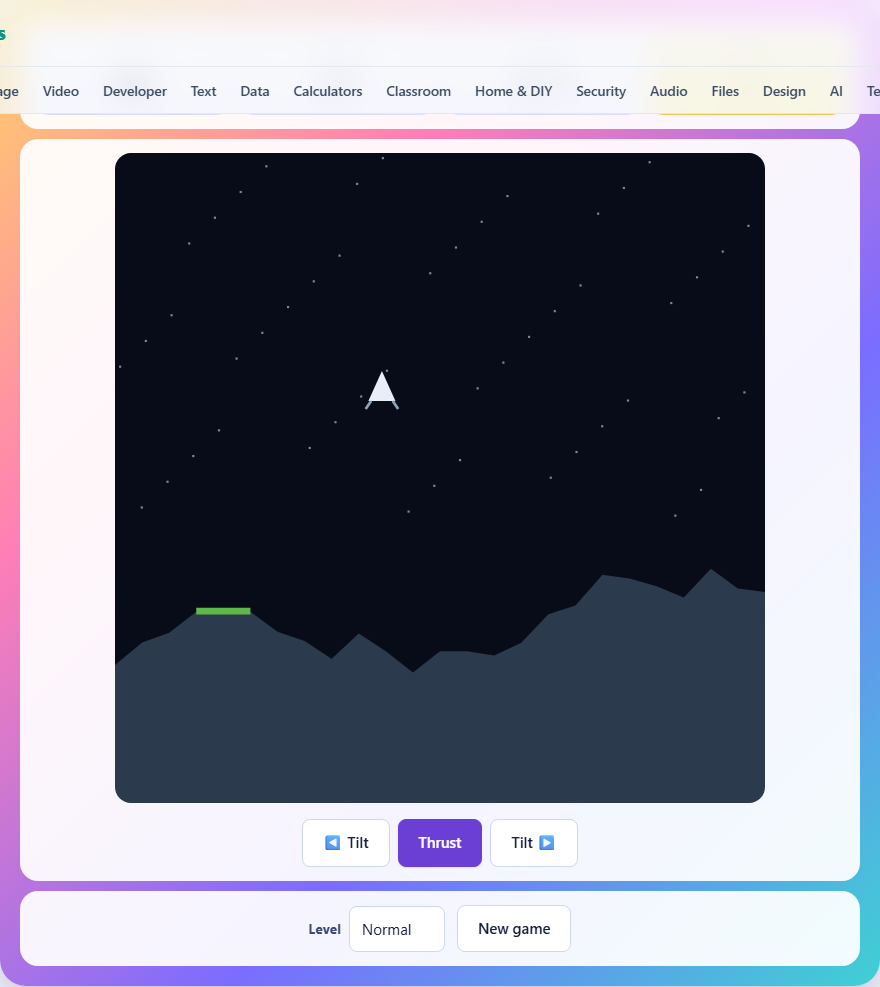
What you are trying to do
A small spacecraft falls toward a rocky surface. Somewhere on that surface is a flat green pad. Your job is to land on the pad, upright, slowly, and before the fuel runs out. Do it three times and you win.
Each successful landing generates a new surface with a new pad in a different position. The terrain changes, your fuel refills to the level's starting amount, and the craft reappears at the top with a fresh sideways drift. Three clean touchdowns in a row is a full game.
The physics in plain terms
Gravity pulls the craft down at a constant rate. Every moment, your downward speed increases by the same small amount. If you do nothing, the craft falls faster and faster until it hits the ground.
Thrust pushes the craft in whatever direction the nose is pointing. Point the nose straight up and thrust slows you down. Tilt left and thrust pushes you left and slightly up. Tilt right and thrust pushes you right and slightly up. Thrust always costs fuel, and fuel does not come back.
There is no air. Nothing slows you down except your own engine. Any sideways speed you pick up stays until you thrust against it. Any spin you add stays until you thrust the other way. In the vacuum of this game, every nudge has consequences that last until you actively undo them.
Controls on keyboard and touchscreen
On a keyboard, the left and right arrow keys rotate the craft. The up arrow or the space bar fires the engine. You can also use the A and D keys to tilt and the W key to thrust.
On a phone or tablet, three buttons appear below the game area. The left button tilts the craft left, the right button tilts right, and the center button fires thrust. Hold them down rather than tapping. A quick tap gives you almost nothing. A steady press is how you control the descent.
The stat bar above the game shows three numbers. Fuel is how much you have left. Descent shows your current downward speed. Landings shows how many of the three touchdowns you have completed.
The three landing conditions
A landing is safe only if all three conditions are met at the moment the craft touches the pad. Miss any one of them and the craft crashes.
First, you must be on the green pad. The pad is the only flat stretch on the surface. Landing on the jagged terrain to either side is a crash, no matter how gently you touch down. The message will tell you that you missed the pad.
Second, you must be upright. Even a small tilt at the moment of contact tips the craft over. A perfect slow descent at a slight angle still counts as a crash. Straighten up in the final seconds.
Third, you must be going slowly enough. Both your downward speed and your sideways speed have to be below the limits for the current difficulty level. On Normal, the vertical limit is about one point one and the sideways limit is about zero point six. Harder levels tighten those numbers. The Descent figure in the stat bar tracks your vertical speed in real time.
Start slowing far earlier than feels natural
The most common way to crash is waiting too long to brake. Gravity is constant and thrust is weak in comparison. If you fall freely for most of the descent and then try to slow down near the ground, you will not have enough thrust to stop in time. The math is simple: gravity adds speed every moment, and your engine can only subtract a little bit of that speed each moment. Once you are falling fast, you need a long burn to slow down, and a long burn needs fuel and altitude that you may not have.
The rule of thumb is to start a gentle braking burn when the craft is still high up. Keep the nose pointed roughly upward and tap thrust every few moments to keep the Descent number from climbing. If the Descent figure stays under one, you are in good shape. If it passes two, you are probably already in trouble.
On Easy, the engine is strong enough that you can recover from a fast descent if you catch it early. On Hard, gravity is nearly twice as strong and the engine is barely enough. Start braking almost immediately on Hard.
Killing sideways drift without losing altitude
The craft starts each flight with a small sideways push to the right. That drift will carry it across the screen at a steady speed unless you correct it. Correcting costs altitude because you have to tilt the craft, which points the thrust partly sideways and partly up. While the engine is pushing you sideways to cancel the drift, it is not fully fighting gravity.
Fix the drift while you are still high up. Tilt into the direction of the drift, burn for a moment, then straighten out and check. If the craft is still sliding, repeat. Each correction costs a few points of altitude and a few units of fuel. Doing this early, when altitude is plentiful, is cheap. Doing it near the ground is dangerous because you no longer have room to lose height.
Once the sideways speed is near zero, keep the craft upright and focus on vertical control only. Any tilt after this point reintroduces sideways drift, so make your final approach as straight up and down as you can.
Fuel is the only clock
There is no timer. You can hover in one spot for as long as your fuel lasts. But hovering burns fuel fast, because you need constant thrust just to hold altitude against gravity. Every second you spend hanging in the air is fuel you will not have for the final approach.
The right approach is to descend steadily, not to hover. Let the craft fall, tap the thrust to keep the descent gentle, and aim for the pad. A smooth diagonal glide path burns far less fuel than stopping at a high altitude and then restarting the descent.
On Normal, you start with six hundred and twenty units of fuel. A full hover at that level drains the tank in about twelve seconds of continuous burn. A controlled descent that uses thrust in short bursts can stretch the same fuel across the entire drop.
The three difficulty levels
Easy gives you nine hundred units of fuel, gentle gravity, and generous speed limits for landing. You can afford mistakes. A long hover to line up the pad is possible without draining the tank, and the craft forgives a moderately fast touchdown.
Normal cuts the fuel to six hundred and twenty, increases gravity, and tightens the speed limits. Hovering is expensive. You need to plan your descent and aim for the pad during the fall rather than stopping above it.
Hard drops the fuel to four hundred and sixty, makes gravity even stronger, and demands a very slow, very straight landing. There is almost no room for error. A single wrong correction at low altitude can leave you without enough fuel to slow down. Every action has to count.
Common crashes and what they teach
Each crash message tells you what went wrong. Missed the pad means you touched down on the jagged terrain instead of the flat green stretch. Landed on its side means you were tilted at contact. Came in too fast means your speed was over the limit.
- Waiting too long to brake and then holding thrust at full power near the ground. The fuel runs out and gravity wins.
- Correcting sideways drift near the surface. At low altitude there is no room to absorb the height lost during a tilt-and-burn correction.
- Oversteering. A quick tap of left or right adds rotation that has to be removed with another tap in the other direction. Two taps where one would do wastes fuel.
- Ignoring the Descent number. Watching the craft visually feels natural, but the stat bar is the only accurate measure of how fast you are falling.
- Hovering above the pad to line up perfectly. That hover burns through fuel at the worst possible moment.
What a clean landing looks like
Start on Normal. The craft appears near the top left with a rightward drift. Tilt left and burn briefly to cancel the drift. Straighten up. Now you are falling straight down with no sideways motion.
Let the craft drop while tapping thrust occasionally to keep the Descent figure under one. Look for the green pad on the surface below. If the pad is off to one side, add a tiny tilt in that direction, burn for a moment, then straighten up again. Aim to be roughly above the pad by the time you are halfway down.
In the final approach, keep the nose perfectly upright. Tap thrust to slow the descent to well under the limit. Touch down gently on the pad. The message says Touchdown and the landing counter ticks up. Two more to go.
Your game stays on your own machine
The entire game runs in your browser. The physics, the terrain, and the scoring all happen on your device. Nothing is uploaded, there is no account, and no data is sent to any server. Your best results stay in your browser's storage. Once the page has loaded, it works offline.
Closing the tab when you are done is all the cleanup needed.