
Winning at Hawaiian checkers by counting moves, not stones
How Konane works, why capturing more stones can lose you the game, what the computer is actually thinking, and how to build a position along the edges that outlasts anything in the middle.
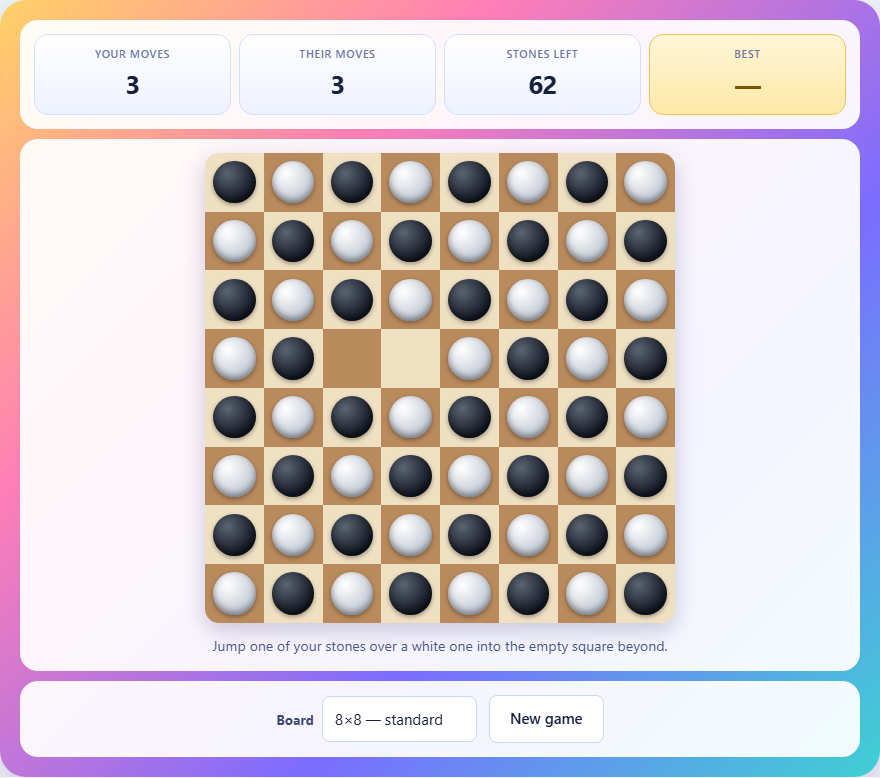
A game older than the boards it was carved on
Konane was played across Hawaii long before European ships arrived. The boards were carved into lava rock, and the pieces were pebbles of black basalt and white coral. Members of Captain Cook's crew saw it being played in 1778 and wrote about it.
It is one of the very few traditional board games where capturing is not just allowed but required. You cannot pass. You cannot advance a stone without jumping. The only thing you can do on your turn is jump one of your stones over an enemy stone into the empty square beyond, removing the stone you jumped. If you have no jump available, you lose. That single rule is the whole game.
How the board starts
The board begins completely packed. Every square holds a stone, alternating black and white in a checkerboard pattern. Two stones near the center are removed automatically to create the first gaps. This is the traditional opening and it happens before you make your first move.
You play the black stones. The computer plays white. After the two opening removals, you take the first turn. From this point on, the only legal action is a jump.
The jump rule in detail
A jump works like this. One of your stones hops over a single enemy stone that is directly next to it - up, down, left, or right - and lands in the empty square on the other side. The enemy stone you jumped is removed from the board. You must jump over exactly one enemy stone into exactly one empty square. Diagonal jumps do not exist in this game.
After landing, you may keep jumping in the same direction if the pattern repeats. If there is another enemy stone right next to where you landed, and another empty square beyond that, you can take it in the same turn. These chain jumps can be two, three, or more captures long. But every jump in the chain must go the same way. You cannot turn a corner.
You do not have to take the longest jump available. A single jump is legal even when a double or triple is possible. Sometimes a shorter jump is the better move.
Controls and what the board shows you
Tap one of your black stones. The squares it can jump to light up, and each one shows a number. That number is how many enemy stones this jump would capture. A one means a single jump. A two means a double jump that takes two stones in a row.
Tap the destination square to make the jump. The captured stones vanish and the board updates. The stat bar shows three numbers. Your moves is how many jumps you have available right now. Their moves is how many jumps the computer has. Stones left is the total count of both colors still on the board.
The computer thinks for a moment after your move and then plays its reply. A message below the board tells you when it is your turn and how many jumps you have.
Why stones do not matter
New players usually try to capture as many stones as possible. A triple jump feels like a huge win. But Konane does not care how many stones each side has. The only thing that determines the winner is who runs out of moves first.
A player with twenty stones and no available jump has lost to a player with three stones and one jump left. This is not an edge case. It is the normal way games end. Stone count is meaningless. What matters is mobility - how many jumps you will have after this move, and how many your opponent will have.
This is also how the computer plays. Its evaluation function counts its own available jumps and subtracts yours. It searches several moves ahead using that same measure. It does not care about capturing your stones. It cares about running you out of moves.
Why a big capture can hurt you
A triple jump removes three enemy stones and opens three squares. Those three new empty squares are potential landing sites for the opponent. More open space means more room for the other side to keep jumping, which means more mobility for them.
A single jump removes one stone and opens one square. The disruption is smaller. Sometimes the position after a single jump leaves your opponent with fewer options than the position after a flashy triple. The question to ask before every move is not how many stones can I take but how many jumps will I have afterward.
This is the central lesson of the game. Restraint wins more often than greed. Take the jump that preserves your mobility, not the one that captures the most.
Building a position along the edges
A stone on the edge of the board can only be jumped from two directions, compared with four directions for a stone in the center. This means edge stones are harder for the opponent to attack. A cluster of your stones along a side or in a corner tends to survive longer than a cluster in the middle.
Late in the game, when the board is mostly empty, the edge advantage becomes even stronger. An edge stone with a wall behind it cannot be jumped from that direction at all. If you can build a small fortress of two or three stones along a rim, the opponent needs very specific positions to break in.
Try to steer the action toward the center in the early game. Let the opponent capture your central stones while you keep your edge stones intact. By the mid game, you want most of your remaining stones near the sides while the opponent is scattered in the open.
Three difficulty settings
The Board dropdown offers three choices. The six-by-six gentle board has fewer stones and the computer searches only two moves ahead. Games are shorter and the computer makes visible mistakes, which makes it a good place to learn the jump rule and practice counting moves.
The eight-by-eight standard board is the traditional size. The computer searches four moves deep, which is far enough to avoid most traps. Winning here requires real attention to mobility.
The eight-by-eight sharp board uses the same size but the computer searches five moves deep. That extra level of lookahead makes it noticeably harder to trick. It will rarely walk into a position that runs itself out of jumps, so you need to create those dead ends gradually over many turns.
Mistakes that cost games
The most common mistake is chasing captures. Taking a big jump feels good, but the open space it creates often gives the opponent exactly the room they need to keep moving. Before every jump, glance at the Their moves number in the stat bar. If your planned move would increase it, think twice.
- Taking a triple jump when a single jump in a different direction would leave the opponent with fewer options.
- Ignoring the move counts in the stat bar. Those two numbers are the real score. Watch them.
- Playing everything in the center where stones can be attacked from four sides. Move the action to the edges when you can.
- Thinking the game is about material. A stone you never use is worth nothing. A stone that creates one more jump for you is worth everything.
- Not looking at what the opponent can do after your move. The computer always considers your reply. You should too.
A sample opening on six-by-six
The board starts with thirty-six stones and two gaps near the center. You have black. Tap one of your stones next to a gap. The available jumps light up. Take a single jump toward the edge rather than toward the middle.
After the computer replies, count both sides' available moves using the stat bar. If yours is higher, you are ahead. If it is lower, look for a move that cuts the opponent's options rather than one that adds to your own captures.
The game ends when one side has zero jumps. On a six-by-six board, that usually happens within twenty turns. On eight-by-eight, games can last much longer, and the edge strategy matters more because there are more rim squares to work with.
The game stays on your device
Everything runs in your browser. The computer opponent thinks on your machine, not on a server. There is no account, no upload, and no data sent anywhere. Your best results are saved in your browser's local storage on this device only.
Once the page has loaded, you can disconnect from the internet and keep playing. Closing the tab is all the cleanup needed.