
Solving sudoku when the clues are sums
A walkthrough of Killer Sudoku from the first forced pair to the last empty cell, covering how cages and sums replace given digits, the forty-five rule, the four forced pairs worth memorising, and the habits that separate clean solves from messy guesses.
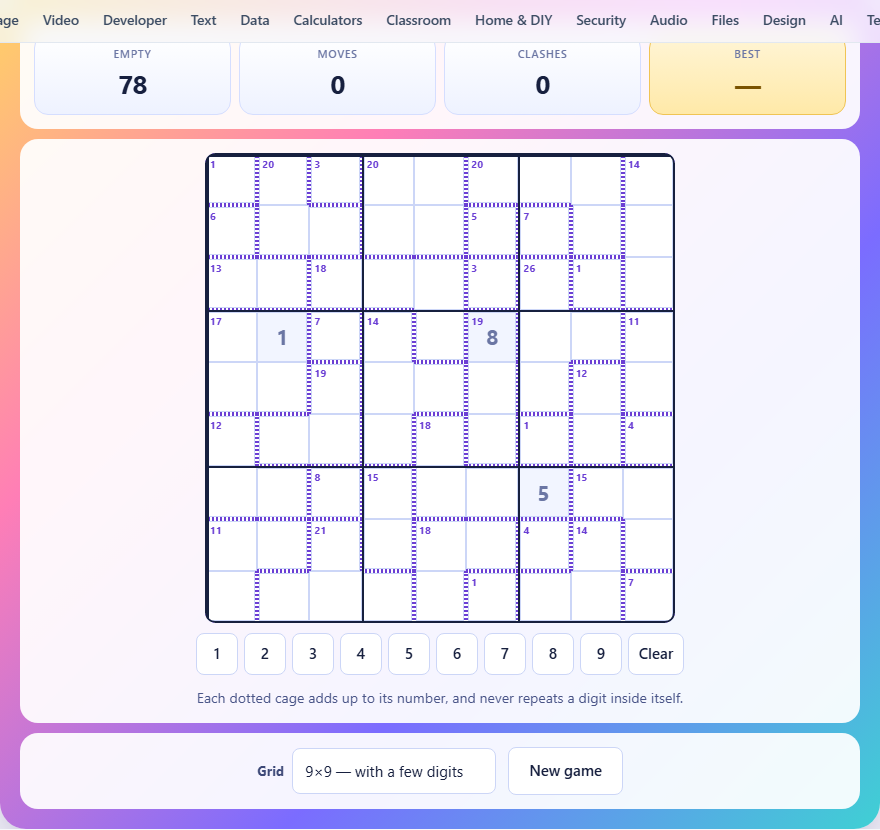
Standard sudoku, then one more rule
Every row holds each digit once. Every column holds each digit once. Every box holds each digit once. Those are the ordinary sudoku rules, and they apply here without change.
On top of them, the grid is divided into dotted cages. Each cage has a small number printed in its top-left corner. The digits inside that cage add up to that number, and no digit repeats within a cage. A cage of three squares labelled 15 could hold 2, 6, and 7, but never 5, 5, and 5.
Most puzzles here start with no given digits at all. The sums are the clues. Everything you need to fill the grid is inside the cage totals and the sudoku rules working together.
Grid sizes and difficulty settings
The gentle setting uses a six-by-six grid with boxes of three columns and two rows. Digits run from 1 to 6. Two digits are given to get you started, and the cages hold at most three squares each. This is a good place to learn the mechanics without the arithmetic becoming heavy.
The middle setting moves to a full nine-by-nine grid. Digits run from 1 to 9, boxes are three by three, and cages can hold up to four squares. A few digits are given to open the puzzle.
The hard setting is the same nine-by-nine grid, but with no given digits at all. Every cell starts blank. The cage sums are your only entry point, and the puzzle demands more deduction before the first digit goes in.
Controls for entering digits
Tap or click a cell to select it. It highlights with a border. Then tap a number on the pad below the grid, or press a number key on the keyboard. The digit appears in that cell. To erase it, tap the Clear button on the pad, or press Backspace or Delete.
You can move the selection with the arrow keys. Left, right, up, and down shift it by one cell. Cells that were given at the start cannot be changed. The game does not prevent you from entering a wrong digit. Instead, it highlights clashes in red as you go.
What the red highlights mean
Whenever a digit breaks a rule, the cell turns red. The rules being checked are rows, columns, boxes, cages, and cage totals.
A duplicate 4 in the same row will turn both 4s red. A cage whose running total has already passed its target will light up every filled cell in that cage. A cage that is completely filled but does not add up to its number will do the same.
Red is a warning, not a punishment. You can keep playing with clashes on the board. Fixing the mistake removes the highlight. The puzzle is solved when every cell is filled and nothing is red.
The four forced pairs
A cage of two cells can only hold one combination in certain cases. These are worth memorising because they appear on nearly every grid.
A two-cell cage with a sum of 3 must hold 1 and 2. No other pair of distinct digits adds to 3. A sum of 4 in two cells must be 1 and 3. At the other end, a sum of 16 in two cells must be 7 and 9, and a sum of 17 must be 8 and 9.
You do not know which cell holds which digit yet, but you know both values. That narrows the possibilities in the row, column, and box each cell sits in. Two forced pairs in the same row can sometimes fix both cells outright.
On a six-by-six grid the forced pairs change. Two cells summing to 3 is still 1 and 2. Two cells summing to 11 is 5 and 6. Learning the extremes for each grid size is the fastest way to open a new puzzle.
The forty-five rule
On a nine-by-nine grid, every row adds up to 45. So does every column and every box. The digits 1 through 9 sum to 45, and each unit holds all of them once.
This is the most powerful deduction tool in the game. Find a row, column, or box where all the cages except one sit entirely inside it. Add up the sums of the cages that fit. The difference from 45 is the total of whatever cells are left.
If exactly one cell is left, you know its value. Suppose a box has four cages inside it, summing to 38. The remaining cell must hold 7, because 45 minus 38 is 7. You have a digit without any trial and error.
The same trick works with two or three cells left. Knowing their combined total is not as good as knowing a single digit, but it is still a strong constraint. On the six-by-six grid, the magic number is 21 instead of 45, since 1 through 6 add up to 21.
Working from small cages outward
A single-cell cage tells you the value of that cell outright. A two-cell cage near the extremes gives you the forced pair. A three-cell cage with a low sum has very few possible fillings.
Start with the smallest cages and the most constrained ones. Fill in what you can, then look at how those digits interact with the rows and columns they touch. Each placed digit removes a possibility from its row, column, and box, which often forces another cage.
Large cages of four cells with a middling sum have many possible combinations. Leave those for later. By the time you reach them, enough digits will be fixed around them that the combination becomes obvious.
No repeats inside a cage, even across boxes
This rule trips people up more than any other. A cage can span two boxes. In ordinary sudoku, two cells in different boxes are allowed to hold the same digit. But in a cage, they are not. The no-repeat rule inside a cage is separate from the box rule, and it is stricter.
A cage of two cells adding to 10 could be 1 and 9, 2 and 8, 3 and 7, or 4 and 6. It cannot be 5 and 5, even if the cells are in different boxes and different rows. Forgetting this leads to clashes that are hard to trace because the duplicate looks legal from a normal sudoku standpoint.
Mistakes that slow you down
Guessing is the biggest one. Every puzzle here is verified to have exactly one solution. That means it can always be reasoned out. If you feel stuck, the answer is to look harder at the constraints, not to try a digit and hope.
Forgetting the cage total while focusing on the sudoku rules is common. You place a valid digit in a row and column but forget to check whether the cage can still reach its sum with the remaining empty cells. The red warning catches this eventually, but checking before you write saves time.
Ignoring the hard setting because it looks empty is a missed opportunity. A grid with no given digits feels impossible, but the same small cages give you the same forced pairs. The opening is identical. The middle game takes longer, but the puzzle is no less solvable.
- Do not guess. Every grid has one answer and can be deduced.
- Check cage totals before writing a digit, not after the clash appears.
- Use the forty-five rule every time a row or box is nearly covered by cages.
- Watch for no-repeat violations in cages that cross box boundaries.
- Start with forced pairs at the extremes, then work outward.
Every grid is proved unique
The puzzle generator builds a complete grid, cuts it into cages, writes down the sums, and then runs a solver to confirm that only one solution exists. If the solver finds two, the grid is thrown away and a new one is built.
The solver works like a human would: it fills the most constrained cell first and prunes branches where a cage can no longer reach its sum. It also has a budget on how long it can search. If it runs out of time, the grid is treated as ambiguous and discarded. This means every puzzle you see has been checked, and you will never hit a dead end caused by the puzzle itself.
Your grid stays in your browser
The generator, the solver, and the clash checker all run inside your browser. No puzzle data is sent to a server. There is no account, and your progress is not synced anywhere. Your best score is kept in your browser's storage on this device.
You can load the page, turn off your connection, and play as many puzzles as you like. Everything still works, because the generation and the solving happen locally.