
Clearing every dial on a wrapping plate
How the stamp-and-dial puzzle works, why the order of your presses never matters, how to read the plate backwards from its target, and the counting tricks that save presses.
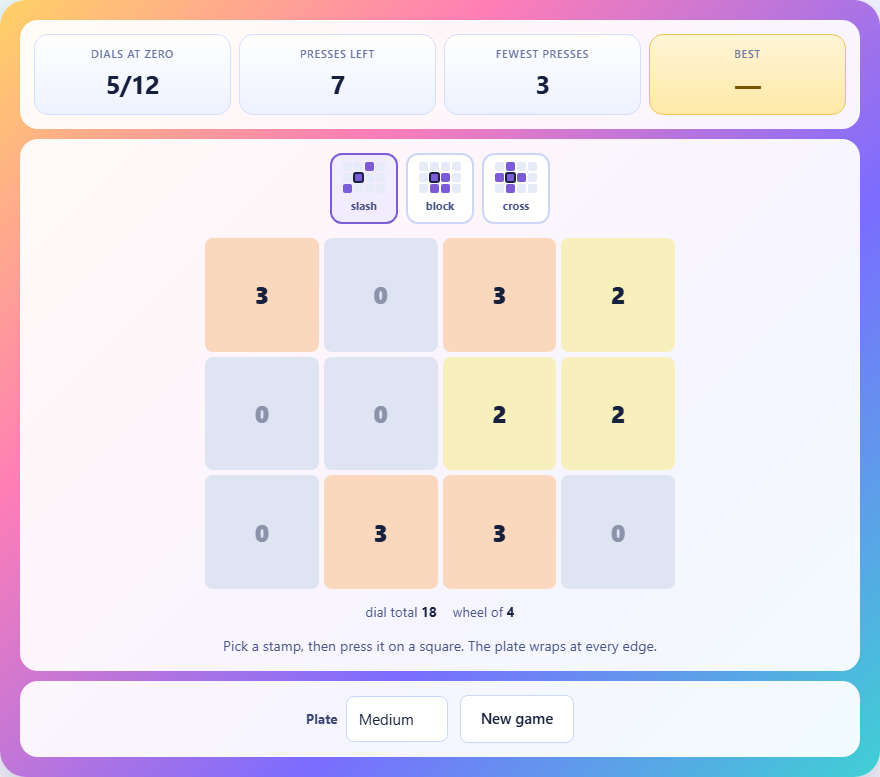
The plate, the dials, and the goal
The board is a grid of twelve squares arranged in three rows and four columns. Each square holds a dial. The dials are not ordinary clocks. Each one cycles through a fixed number of positions, starting at zero, stepping to one, then two, then three, and wrapping back to zero at the top. The number of positions on the dial is called the wheel size.
On a Small plate the wheel has three positions, so every dial reads 0, 1, or 2. On Medium the wheel has four, and on Large it has five. The goal is always the same: bring every dial to zero. You do that by pressing stamps.
How stamps work
Above the plate sits a row of stamp thumbnails. Each stamp has a fixed shape - a cross, a block, an elbow, a T, and so on. The shape tells you which squares it covers when you press it onto the board.
One square in each thumbnail is outlined. That is the anchor, the square you actually tap. When you tap a square on the plate, the selected stamp lands with its anchor on that spot, and every dial the stamp covers advances by one step. If a dial was at two on a wheel of four, it becomes three. If it was at three, it wraps to zero.
The plate wraps too. If a stamp runs off the right edge, the part that went past the edge reappears on the left. If it runs off the bottom, it comes back at the top. There are no walls and no corners. Every square on the plate is equally reachable from every other.
Why the order does not matter
Each stamp press adds one to a fixed set of dials. Adding one and then adding one again gives the same result as adding one in the other order. So pressing stamp A and then stamp B leaves the plate in the same state as pressing B first and then A.
This is a deep property. It means the puzzle is not about finding a sequence. It is about finding a count - how many times each stamp goes in each place. Once you know the counts, you can press them in whatever order you like and the result will be the same.
It also means that pressing a stamp the full wheel number of times in the same place does nothing. On a wheel of four, four presses of the same stamp in the same spot cycle every dial it touches through all four positions and back to where it started. Those are four wasted presses.
Reading the plate backwards
When you look at a dial showing 3 on a wheel of 4, the natural reading is that it needs three more presses to reach zero. That is true, but it is the wrong way to think about it. Three presses is the long way round. One more press takes 3 to zero in a single step.
Read every dial as the number of presses it still needs to reach zero by the short route. A dial at 1 needs the full wheel minus one presses by the long route, but just one press by the natural direction. A dial at 3 on a wheel of 4 needs one press. A dial at 2 on a wheel of 5 needs three.
Once you rewrite the plate this way, the numbers look smaller and the puzzle feels friendlier. A plate full of 3s on a wheel of 4 is really a plate full of 1s.
Using the grand total
Underneath the plate you will see the grand total of all the dials and the wheel size. This is a powerful check on any plan.
Each stamp press adds its size - the number of squares it covers - to the grand total of the plate, modulo the wheel. If a stamp covers five squares, one press adds five to the total. To bring the total to zero, the total of all your stamp sizes must cancel out the starting total modulo the wheel.
Suppose the total is 9 and the wheel is 4. Then 9 mod 4 is 1. You need stamp presses whose sizes add to a multiple of 4 minus 1, modulo 4. That is 3 mod 4. If one stamp covers 3 squares, a single press in the right place accounts for the total. If both stamps cover 4, you know the total is already going to be handled automatically, because 4 mod 4 is zero.
This kind of arithmetic does not solve the puzzle outright, but it rules out a lot of wrong guesses early.
The budget and the par
You are given a budget of presses. It is a few more than the fewest the puzzle can be solved in, shown as the par. Going over the budget ends the game. Reaching zero under par is a perfect run.
The par is found by a search. The game builds each plate by pressing stamps onto a blank board and then reversing the result, so the answer always exists and the par is the true minimum. On Small plates the par is often three or four. On Large plates it can be five.
Because the budget gives you a handful of spare presses, you do not need to find the best answer. Any answer that fits inside the budget counts. But the closer you get to par, the better your score.
Overlaps and the smallest stamp
Two stamps that share a square are the key to fine control. Pressing both of them on the same spot advances the shared dials by two but the unshared dials by only one each. That difference is the only way to adjust a single dial without disturbing everything around it.
Look for overlaps early. If two stamps can both cover a particular dial, pressing them both there will advance that dial by two while the others go up by one. On a wheel of 3, advancing by two is the same as subtracting one. That is exactly the tool you need when one dial is one step ahead of its neighbours.
The stamp that covers the fewest squares is usually the one you save for the end. It touches the least of the plate, so it does the least collateral damage. Use the bigger stamps first to bring the plate close to zero, then apply the small one to mop up.
Common traps
The biggest trap is the free press. On a wheel of 4, pressing a stamp four times in the same spot does nothing. It advances every covered dial through all four positions and back to zero, spending four of your budget for no change. If you find yourself pressing the same stamp in the same place more than once or twice, stop and think about whether a single press somewhere else would do the same work.
The second trap is ignoring the wrapping. A stamp on the far right column reaches dials on the far left. Players who forget this will plan their presses as if the plate has edges and miss half the moves available to them.
The third is spending too long on one area. Because every press affects several dials at once, fixing one corner often breaks another. Step back, count the remaining non-zero dials, and plan two or three presses together rather than one at a time.
- Do not press the same stamp in the same place a full wheel of times. The result is zero change and a drained budget.
- Remember the plate wraps. A stamp on the right edge lands partly on the left.
- Plan two or three presses as a batch rather than fixing one dial and watching the rest move.
A worked example on a small plate
Suppose the wheel is 3 and the plate reads 0, 2, 1, 0 along the top row, 1, 0, 2, 1 in the middle, and 2, 1, 0, 0 at the bottom. The grand total is 10, and 10 mod 3 is 1.
You have two stamps: an elbow covering three squares and a cross covering five. One elbow press adds 3 mod 3, which is 0, to the total. One cross press adds 5 mod 3, which is 2. To reduce the total by 1 mod 3, you need presses whose sizes sum to 2 mod 3. One cross press does that.
Now the question is where. The cross centred on the middle of the plate reaches the four neighbours and the centre itself. Checking those five dials against what they need tells you whether that single press is enough. If it is, you have a par-1 answer. If not, try the elbow to handle what is left.
Your plate never leaves the page
Every plate is built and solved inside your browser. The stamps, the dials, and the search for the shortest answer all run on your own machine. Nothing is uploaded, there is no login, and your best score is kept in your browser's local storage. Disconnect from the network after the page loads and the game keeps running, because there was never a server involved in the puzzle itself.