
Adding up positions to solve a shading grid
What the numbers around the edge mean, how the value of a square changes depending on which direction you are adding, where to start, and the reasoning that gets you through a grid without trial and error.
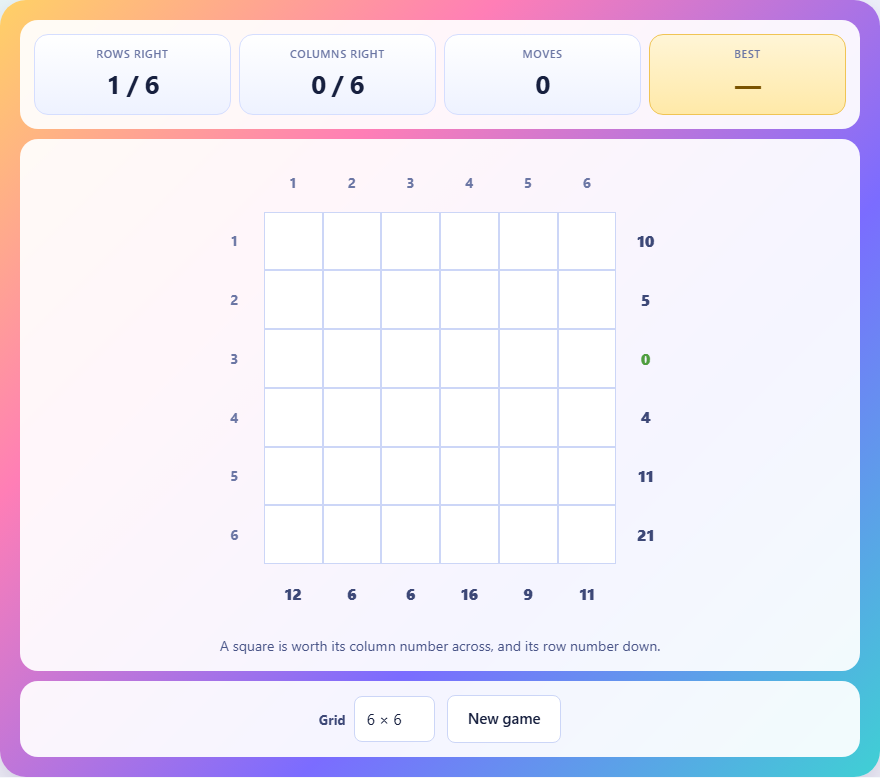
The idea behind the puzzle
You are given a square grid. Each row has a target number on its right side. Each column has a target number underneath it. Your job is to shade some of the squares so that the shaded squares in each row add up to that row's target, and the shaded squares in each column add up to that column's target.
The twist is what a square is worth. Small grey numbers run along the top and down the left side of the grid. The number along the top tells you a column's weight. The first column is worth one, the second is worth two, the third is worth three, and so on. When you add up a row, each shaded square counts for its column number. When you add up a column, each shaded square counts for its row number.
So a single square has two different values depending on which direction you are reading. A square in row three, column five is worth five when you total its row and worth three when you total its column. This double meaning is the whole puzzle.
How to play
Tap a square to shade it. Tap it again to clear it. The total for each row and column updates instantly. When a row's running total matches its target, the target number turns green. When the running total exceeds the target, the number turns red. The puzzle is solved when every row and every column shows green at the same time.
The stat bar above the grid tells you how many rows are right, how many columns are right, and how many moves you have made. Moves count every tap, whether you are shading or clearing. A lower move count is a better score.
Grid sizes
The selector offers three sizes. The 5 by 5 grid uses column weights one through five and row weights one through five. The 6 by 6 grid stretches to six. The 7 by 7 grid goes to seven. Each puzzle is checked by a solver before it appears, so there is always exactly one answer.
Larger grids have more combinations to consider, but the same techniques apply at every size. The 5 by 5 is a good learning ground because you can hold the whole grid in your head. The 7 by 7 grid is a real test of patience and method, with weights running up to seven and row totals that can reach 28.
Start with the extremes
The fastest squares to settle are the ones at the edges of possibility. If a row's target is zero, nothing in that row is shaded. Mark the entire row as clear and move on. If a row's target equals the sum of all column weights, every square in the row is shaded. On a 6 by 6 grid, the maximum row total is 1 plus 2 plus 3 plus 4 plus 5 plus 6, which is 21. A row wanting 21 is completely full.
The same logic applies to columns. A column with a target of zero is empty. A column whose target equals the sum of all row weights is completely shaded. Handle these rows and columns first, because each one you settle removes uncertainty from every line it crosses.
Reasoning about which squares must be shaded
After the extremes, look for rows where only one combination of column weights adds up to the target. On a 6 by 6 grid, a row wanting 11 could be 5 plus 6, or 2 plus 3 plus 6, or 1 plus 4 plus 6, or 1 plus 2 plus 3 plus 5, and several others. But a row wanting 20 can only be 2 plus 3 plus 4 plus 5 plus 6. Every square in that row except the first column must be shaded.
High totals tend to have fewer valid combinations, because the big weights are required and there is little room for substitution. Low totals also tend to have few combinations, since only the small weights can fit. The middle totals are the hardest to pin down from one direction alone.
When a row has several possible combinations, check the columns. If one of those combinations would push a column past its target, that combination is ruled out. The interplay between rows and columns is where the puzzle narrows down to a single answer.
Odd and even as a shortcut
A useful shortcut is parity. An odd total needs an odd number of odd-valued squares. On a 5 by 5 grid the odd column weights are 1, 3, and 5. If a row's target is even, it needs zero or two of those columns shaded. If the target is odd, it needs one or all three.
This narrows the possibilities before you even start listing combinations. Suppose a row on a 5 by 5 grid wants 7. That is odd, so it needs an odd count of the odd columns. If the column constraints have already forced column 1 and column 3 to be clear in this row, then column 5 must be shaded, because it is the only odd column left. And the remaining weight of 2 must come from column 2, because column 4 would overshoot.
Parity checks are fast and catch things that straight addition misses. Run them on every row and column as a second pass after the extremes.
Reading both directions together
No row can be solved on its own unless it is an extreme case. Almost every row total has multiple combinations of column weights that reach it. The answer comes from the columns. When you shade a square, it adds to both a row total and a column total. A shading that makes one row happy might push a column over its limit.
The practical approach is to alternate between rows and columns. Pick a row with a small number of valid combinations. Shade one of them tentatively. Then check every column that the shaded squares touch. If any column has already gone past its target or can no longer reach it, undo the shading and try the next combination.
On the 5 by 5 grid, this back-and-forth usually settles the puzzle in two or three passes. On the 7 by 7 grid, it can take more, but the logic is the same: shade, check the cross direction, and revise.
A worked example on a 5 by 5 grid
Row 1 wants 5. The combinations are column 5 alone, or columns 1 plus 4, or columns 2 plus 3. Row 2 wants 0, so nothing in row 2 is shaded. Row 3 wants 14, which is 1 plus 2 plus 3 plus 4 plus 5 minus 1. That means four of the five columns are shaded and one is not. The missing weight is 1, so column 1 in row 3 is clear and columns 2 through 5 are shaded.
Now look at the columns. Column 5 has a target, and row 3 has already added 3 to it (the row weight of row 3 is 3). If the column target is exactly 3, then column 5 must be clear in every other row, including row 1. That rules out the combination where row 1 uses column 5 alone. Row 1 must use either 1 plus 4 or 2 plus 3. Check the remaining columns to see which one fits.
Each step is small. The puzzle is really a chain of small steps, not one big calculation. Once you are comfortable with this back-and-forth between rows and columns, a 5 by 5 board takes two or three minutes and a 6 by 6 not much longer.
Common mistakes
- Forgetting that a square has a different value in each direction. The weight for row totals comes from the column number, not the row number.
- Shading too many squares and driving a column past its target without noticing. Watch for the red indicator and clear the square that caused it.
- Trying to solve each row in isolation. Rows share columns, and the answer always depends on both directions.
- Overlooking a zero-total row or column. These are free information. Clearing an entire line can unlock several other lines at once.
- Not using parity. The odd-even check is fast and eliminates half the combinations before you start listing them.
- Giving up and guessing when stuck. If you are stalled, check the columns you have not looked at yet. The answer is always logical, and a fresh direction usually breaks the deadlock.
All of it runs locally
The grid, the answer, and every move you make are handled inside your browser. Nothing is sent anywhere. There is no account, no login, and no server storing your game state. Your best move count is saved in your browser's local storage on this device and will not follow you to a different machine or a different browser on the same machine. Once the page has loaded, you can turn off the internet and keep playing. Closing the tab is the only cleanup you need.