
Rigging a crane without running out of rope
How the Hoist puzzle works, what the numbers on the board mean, why gearing has an upper limit as well as a lower one, and how to find the cheapest set of blocks that lifts the load in time.
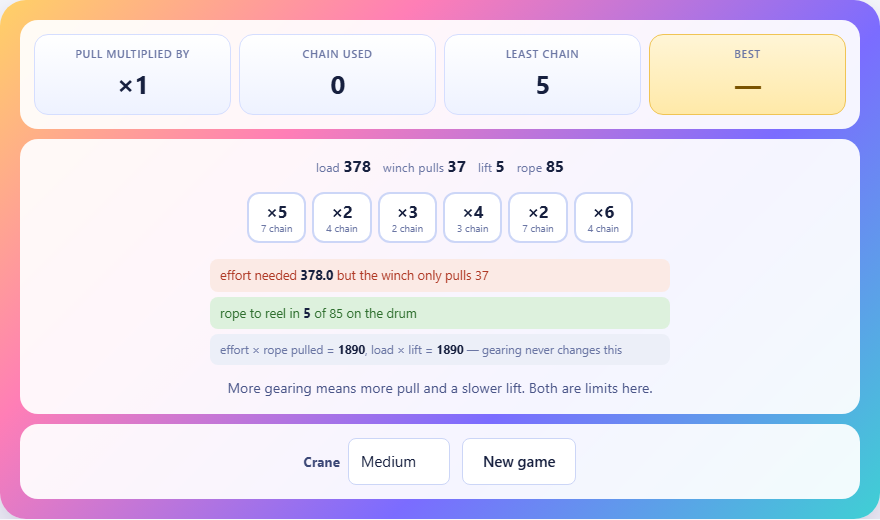
The job in front of you
A crane has a load to lift, a winch to pull the rope, a height to clear, and a fixed amount of rope on the drum. The winch is not strong enough to lift the load directly. You need to fit pulley blocks between them to multiply the pull.
Each block has a ratio, like two or three or five, and a chain cost. Fitting a block multiplies the winch's pulling force by that ratio. Fitting several blocks multiplies all their ratios together. A block with ratio two and a block with ratio three, fitted together, give a total multiplication of six.
But there is a catch. Multiplying the force also multiplies the length of rope you need to reel in. A load lifted one metre with a ratio of six needs six metres of rope pulled through the blocks. The drum only holds so much rope. Too little gearing and the winch stalls. Too much and the rope runs out before the load reaches the top.
The two readings and the window
Two lines on the board tell you whether your current setup works. The first is about force. It shows the effort needed to move the load with your current gearing and compares it to what the winch can pull. This line turns green when the effort is low enough for the winch to handle.
The second is about rope. It shows how much rope must come in to raise the load to the required height and compares it to the total rope on the drum. This line turns green when there is enough rope.
Both lines must be green at the same time. That defines a window of acceptable gearing. The minimum gearing is the load divided by the winch pull, rounded up. The maximum is the rope on the drum divided by the height, rounded down. Your job is to fit blocks whose combined ratio lands inside that window.
Why the bottom line never changes
A third line sits at the bottom of the readings. It shows two products side by side: the effort times the rope pulled, and the load times the height. These two numbers are always equal, no matter what gearing you fit.
This is the law of conservation of energy applied to a simple machine. A pulley, a lever, a gear train, and a screw all obey the same rule. You can trade force for distance or distance for force, but the product stays the same. No machine has ever beaten this bargain. It is why gearing a crane up makes it slow and why low gear on a bicycle spins the pedals fast for little speed.
The bottom line is there to show you this in real time. Fit different blocks, change the gearing, and watch the two products stay locked together. It is the oldest fact in engineering, and this puzzle is built on top of it.
Controls and how blocks work
The available blocks are shown as buttons. Each one shows its ratio and its chain cost. Tap a block to fit it. Tap it again to take it off. A fitted block is highlighted.
Fitting a block adds its chain cost to your total chain used, shown in the counters above the board. The goal is to get both readings green while using as little chain as possible. The least chain counter shows the best possible answer, which the game has worked out by trying every combination.
Below the board, you can choose between Small, Medium, and Large cranes. Small gives you five blocks to choose from. Medium gives six. Large gives seven. More blocks means more possible combinations and more room for wrong answers.
Working out the window by hand
Suppose the load is two hundred, the winch pulls thirty, the height is five, and the rope is fifty. The minimum gearing is two hundred divided by thirty, which is about 6.67, rounded up to seven. The maximum is fifty divided by five, which is ten. Any total ratio from seven to ten will work.
Now look at the blocks. Say you have a two, a three, a four, a two, and a five. Two times four is eight, which is inside the window. Three times three would be nine, but there is only one three. Two times five is ten, which is right at the upper limit and still good. Two times two times two is eight, but there is only two copies of the two block.
Once you find the combinations that land in the window, compare their chain costs. The cheapest one is the answer.
Blocks multiply, they do not add
This is the most common source of confusion. Two blocks with ratio two do not give ratio four in the additive sense. They give ratio four in the multiplicative sense, which happens to be the same number in this case. But a two and a three give six, not five. A two, a three, and a two give twelve, not seven.
The distinction matters because multiplication grows much faster than addition. Adding a single block can double or triple your total gearing. That is useful when you need more force, but it also means one extra block can push you past the maximum and run the drum dry.
Before fitting a block, multiply its ratio by your current total and check whether the result is still inside the window. If it would overshoot, that block is not the right one, no matter how cheap its chain cost is.
Overshooting is as bad as undershooting
New players often think that more gearing is safer. After all, more force means the winch has an easier time. But each extra ratio of gearing also multiplies the rope needed. If the drum runs out of rope before the load reaches the top, the lift fails just as surely as if the winch could not pull hard enough.
The game marks overshooting clearly. The rope line turns red and tells you how much more rope you would need. This is the upper wall of the window, and it is just as firm as the lower one.
Some puzzles have a narrow window where only a few products fit. Others have a wide one where many combinations work. In a wide window the challenge is finding the cheapest. In a narrow one the challenge is finding any that work at all.
Minimising chain cost
Once you find a set of blocks that works, check whether a cheaper set also works. The game tells you the least possible chain cost and will not count a solution as a win until you match it.
Cheaper blocks are not always better. A block with a low chain cost but a high ratio might push you over the maximum. A block with a high chain cost but the exact right ratio might be the only way to land in the window. The cheapest working combination is not always obvious.
Sometimes removing a block and replacing it with a different one costs less chain and still lands inside the window. Sometimes using two small blocks costs less than one large one. Try every combination that fits. The game has already done this and knows the true minimum.
Common mistakes and how to avoid them
- Adding ratios instead of multiplying them. A two and a three give six, not five. Check your arithmetic.
- Fitting every block to maximise force. More force means more rope consumed. The drum will run out.
- Ignoring the chain cost and stopping at the first working combination. The game requires the cheapest answer, not just any answer.
- Forgetting that the order of blocks does not matter. Multiplication does not depend on order, and neither does the chain total. Rearranging blocks changes nothing.
- Fitting a block, seeing both lines go green, and not checking whether a cheaper option exists. The least chain counter tells you whether you have hit the minimum. If your chain total is higher, keep looking.
The whole puzzle runs on your own machine
Every calculation, from the random crane setup to the exhaustive search for the cheapest answer, happens in your browser. Nothing is uploaded. There is no server running behind the page. Your best score is saved in local storage on this device, and the game works offline once the page has loaded.