
Playing Hearts well against three computer opponents
The full rules of Hearts as played here, what the three difficulty levels actually change, how tricks work, how to read the table, and the strategy that keeps your score low.
What Hearts is about
Hearts is a trick-taking card game for four players. You sit across from three computer opponents and try to take as few points as possible. Every heart in a trick is worth one point. The queen of spades is worth thirteen. Everything else scores nothing.
A standard pack of fifty-two cards is dealt into four hands of thirteen. One hand of thirteen tricks decides the winner. Whoever finishes with the lowest score wins.
How tricks work
The game starts with whoever holds the two of clubs. That player must lead it. After that, each player in turn plays one card. If you hold a card of the suit that was led, you must play one. This is called following suit. Only when you have none of that suit may you throw something else.
The highest card of the led suit takes the trick. Cards of other suits do not count towards winning the trick, no matter how high they are. A king of diamonds thrown on a club trick wins nothing. The trick winner leads the next one.
Hearts cannot be led until a heart has been thrown on another suit. This is called breaking hearts. Until that happens, you cannot start a trick with a heart, even if hearts are all you hold. The exception is when your entire hand is hearts and nothing else remains.
The first trick and its restrictions
The opening trick has a special rule. Nothing that scores may be thrown on it. You cannot discard a heart or the queen of spades on the first trick, even if you are void in clubs. This protects everyone from an unlucky deal dumping thirteen points on the very first play.
After the first trick, all restrictions are lifted. If you are void in the led suit, you may throw any card you like, including the queen.
Controls and what you see on the table
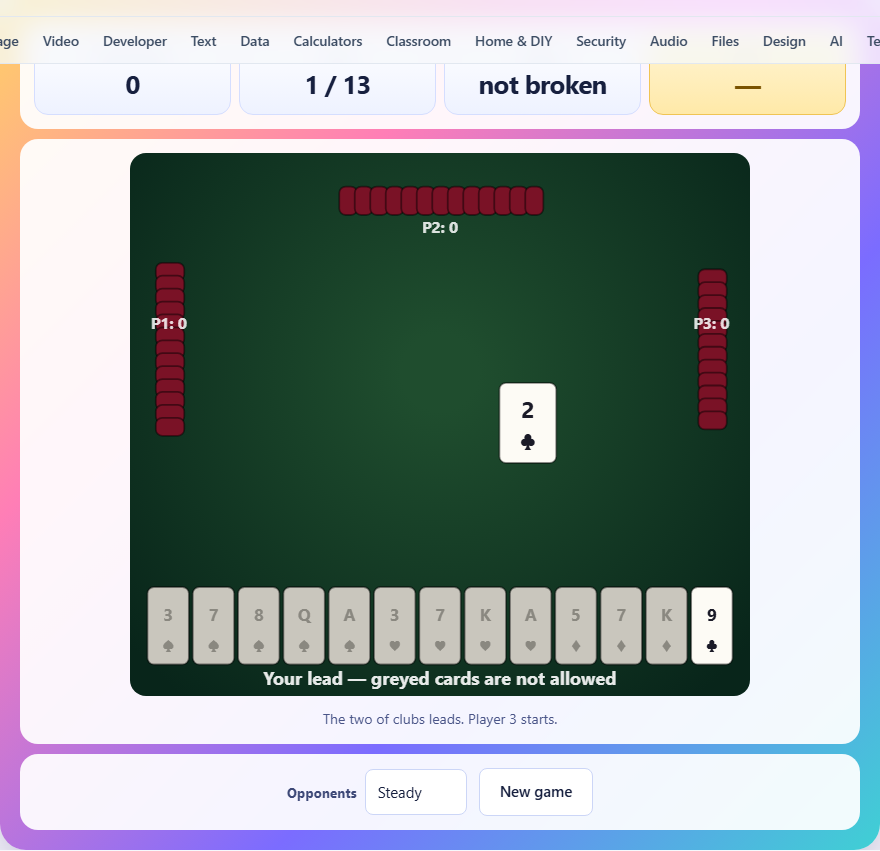
Your hand is shown face up along the bottom of the table. Tap a card to play it. Cards you are allowed to play stay bright. Cards that break the rules are greyed out, and tapping them does nothing except show a message explaining why.
The three opponents sit around the table with their cards face down. Their current scores are shown beside their hands. When cards are played into a trick, they appear in the middle of the table near whoever played them. A short note below the table tells you whose turn it is or what just happened.
Above the board, three counters track your points, the current trick number out of thirteen, and whether hearts have been broken yet.
The three difficulty levels
The Opponents selector offers Careless, Steady, and Ruthless. The difference is in how the computer opponents play, not in the cards dealt.
Careless opponents make no effort to dump the queen. They throw cards without thinking about what scores and what does not. They follow suit honestly but never aim for damage.
Steady opponents will throw the queen when they are void in the led suit, and they prefer to dump hearts when they can. They duck under high cards when following suit, which is the basic skill of the game.
Ruthless opponents do everything the steady ones do, but more carefully. They avoid leading high spades while the queen is still out, and they aim their worst cards at tricks they expect you to win. Playing against them forces you to think ahead.
Getting rid of high spades
The ace and king of spades are dangerous cards. If someone leads spades and you hold the ace or king, you will almost certainly take the trick. If the queen is in that trick, you just collected thirteen points.
The fix is to play your high spades early, while other people are still leading them. If someone else leads the five of spades and you hold the ace, play it. You win a cheap trick with no points in it, and the ace is gone. If you wait, someone will throw the queen under it later.
This is often the single biggest difference between a bad score and a good one. Holding the ace of spades for the last few tricks is asking for trouble.
Using voids to your advantage
A void is when you hold no cards of a particular suit. Voids are powerful because they let you throw anything when that suit is led. If you are void in diamonds and someone leads a diamond, you can throw the queen of spades or your highest heart.
You cannot create voids on purpose in this version, because there is no card-passing phase before the hand. But you can notice which suits you are short in and plan around them. Two cards in a suit means you will be void in it after two tricks of that suit are played.
When the queen is in your hand, being void in a suit other than spades is your best hope. Wait for that suit to be led, then throw her on someone else's trick.
Shooting the moon
If one player takes every single point in the hand, all thirteen hearts and the queen, the scoring flips. That player gets zero and all three opponents get twenty-six points each.
This is rare. It requires taking all thirteen tricks that contain a scoring card. If even one heart lands in someone else's trick, the attempt fails and you are stuck with everything you collected.
A moon attempt usually happens by accident. You win the queen early and pick up several hearts along the way. At some point you realise you already have most of the points and the only way to avoid a huge score is to take the rest. It is a gamble, but when it works it turns a disaster into a victory.
Watch the other players' scores during the hand. If one opponent has taken nothing while you have taken twenty, the moon is still possible. If two opponents have split a few hearts between them, it is not.
Common mistakes and how to fix them
- Holding the ace of spades until late in the hand. By trick ten, someone will dump the queen on it. Play it early when spades are cheap.
- Leading a high card in a suit you have plenty of. You win the trick and take whatever points come with it. Lead low so someone else picks it up.
- Forgetting that hearts are not broken yet. You try to lead a heart, it is refused, and you waste a turn figuring out what else to play. Check the counter above the board.
- Throwing your best cards on the first trick. Nothing that scores can be thrown on the opening trick, so the first trick is always safe. Use it to get rid of a middle card, not a weapon.
- Ignoring what suits the opponents are void in. If an opponent has been throwing hearts on club tricks, they are void in clubs. Leading clubs now is inviting them to dump more points.
- Trying to take zero every hand. A few points in a hand with no queen is fine. The queen is worth thirteen and the hearts are worth one each. A three-point hand where you dodged the queen is a win.
No card passes in this version
Many versions of Hearts include a phase where each player passes three cards to a neighbour before play begins. This version does not. The hand you are dealt is the hand you play.
That means the game is decided entirely by how you play your cards, not by what you choose to pass. It also means you cannot set up a void deliberately by passing away your last card in a suit. Every void has to arise naturally as tricks are played.
Your cards stay on your own device
The deal, the play, and the scoring all happen inside your browser. The opponents are simple rules running in the same page, not a server. Nothing is sent anywhere, and once the page is loaded the game works offline. Your best score is saved in local storage on this device only.