
Guessing hidden words without wasting a single letter
Why the category matters more than the vowels, which letters to try first, how to read a half-filled word, and the habits that keep you alive with letters to spare.
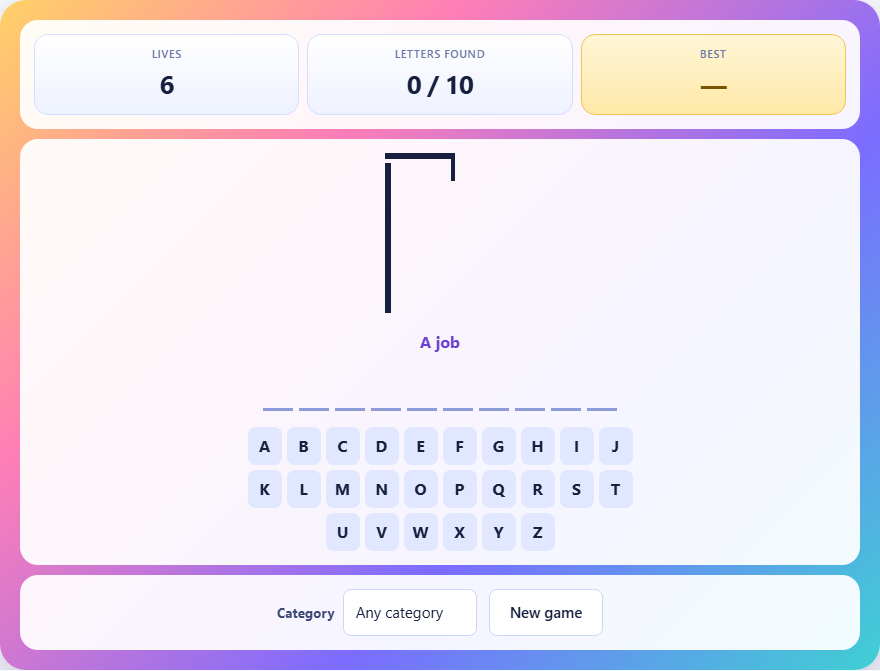
The rules in full
A word is hidden behind a row of blanks. Each blank stands for one letter. You guess one letter at a time. If the letter appears in the word, every blank where it belongs is filled in at once. If the letter does not appear, you lose one life and a part of the figure is drawn.
You start with six lives. Six wrong guesses and the game is over. When you lose, the word is revealed so you always learn what it was. When you guess every letter before running out of lives, you win, and your score is the number of wrong letters you used. Fewer wrong letters is a better score.
Controls on screen and keyboard
An on-screen keyboard shows all twenty-six letters. Tap a letter to guess it. The key changes colour after you use it. Green means the letter was in the word. Red or grey means it was not. A used key cannot be tapped again.
You can also type on your own keyboard. Pressing a letter key does exactly the same thing as tapping it on screen. This is faster when you are playing on a computer and already have your fingers on the keys.
There is no way to guess the entire word at once. You go letter by letter. This is by design. The puzzle is about narrowing the possibilities, not about racing to type a word you already know.
The five categories and what they tell you
Before each round a category is shown above the blanks. The five options are Animals, Food, Places, Objects, and Jobs. You can pick a category from the dropdown or leave it on any category to get a random one each time.
The category is the most valuable clue you get. A six-letter word in the Animals category is a very different list of possibilities than a six-letter word in the Jobs category. Using the category to narrow your mental list before guessing your first letter is the single biggest improvement most players can make.
For example, if the category is Food and the word has nine blanks, there are not that many nine-letter foods in common English. Pineapple, spaghetti, croissant, and marmalade all have nine letters. That kind of narrowing before a single letter is revealed makes your guesses much sharper.
Which letters to guess first
E is the most common letter in English. A and R come next. Starting with those three will reveal something in most words. After that, the right choice depends on what you have learned so far.
Vowels are popular openers because every word has at least one, and many words have several. But consonants can be more informative. Knowing that a word contains no R, S, or T tells you a lot about what it could be. A miss on a common consonant is not wasted. It shrinks the list of possible words just as much as a hit does.
A reasonable opening sequence is E, then A, then R, then S, then T. By the time you have tried those five letters, you will have hits, misses, or both, and the pattern of revealed letters will usually point you towards the answer.
Reading the pattern of revealed letters
After three or four guesses, some blanks are filled and others are not. The shape of the word becomes visible. A double letter in the middle, a common ending, or an unusual starting pair all narrow the possibilities down to a handful.
Suppose the category is Animals and the word reads blank-L-blank-P-H-A-N-T. That is elephant. The shape and the revealed letters make it obvious even without guessing every letter. The game fills in the rest when you guess them, but you knew the answer several letters ago.
Pay attention to word length. A four-letter word in the Objects category has a limited number of answers. A twelve-letter word in any category is rare and the length alone is a strong hint. Short words are harder because there are more possibilities. Long words give themselves away faster because fewer common words share that length.
Common endings and letter clusters
Many English words end with the same few letters. ING, TION, ER, and LY are everywhere. If you see blanks at the end of a word and the pattern looks like it could be one of these endings, guess those letters early. Confirming a common ending reveals three or four letters at once and often makes the rest of the word obvious.
Double letters are another useful pattern. If you guess a letter and it fills two blanks next to each other, you know the word has a double. That rules out a large number of candidates. Words with double L, double T, or double S are common in the word lists here.
Starting clusters matter too. Many words begin with CH, SH, TH, or PH. If the first blank stays empty after guessing common letters, try these consonant pairs. A hit on the second letter of a cluster often reveals the first one by logic alone.
Mistakes that cost lives
The biggest mistake is guessing without thinking about the category. A player who guesses X in the Animals category is almost certainly wasting a life. There are very few animals with an X in their name. The category tells you which letters are likely and which are rare.
- Guessing uncommon letters too early. Q, Z, X, and J appear in very few words. Save them for when you are stuck and have ruled out the common ones.
- Forgetting what you already know. If E, A, and R are all misses, the word has no common vowels. It probably uses I or O. Do not guess U next on a hunch when I is far more likely.
- Panicking at four wrong letters. You still have two lives. Two careful guesses are worth more than two rushed ones. Slow down and look at the pattern again.
- Ignoring the word length. A five-letter animal starting with blank-blank-blank-blank-blank is one problem. A twelve-letter animal is a completely different one. Adjust your guesses to fit the length.
A worked example from start to finish
The category is Jobs. The word has nine blanks. You guess E first. Two blanks fill in, at positions five and eight, so the word reads blank-blank-blank-blank-E-blank-blank-E-blank. You guess A next and position two fills in: blank-A-blank-blank-E-blank-blank-E-blank. You guess R and two more appear, at positions three and nine. The word now reads blank-A-R-blank-E-blank-blank-E-R.
Three guesses in, five of the nine letters are showing and the shape is doing the work for you. A nine-letter job that starts blank-A-R and finishes E-R is a very short list. Carpenter fits it exactly: C-A-R-P-E-N-T-E-R puts A on two, R on three and nine, and E on five and eight, which is precisely the pattern in front of you. Check a candidate against every revealed position before you commit, because a word that matches four of five is still the wrong word. Guessing C, P, N and T now finishes it without risking another life.
This is where the game shifts from luck to logic. The first two or three guesses are almost always the same high-frequency letters. Everything after that should come from looking at the pattern and thinking about what fits.
Adjusting the difficulty for yourself
Picking a specific category instead of leaving it on random makes the game easier. When you know the category is Animals, you are working from a much shorter mental list than when it could be anything. Random category is the harder option because you do not know which list to pull from until letters start appearing.
Word length also affects how hard a round feels. Shorter words are trickier because more words share the same length and the pattern takes longer to become unique. Longer words reveal themselves faster because there are fewer long words in each category. If you keep losing on short words, try switching to a category that tends to produce longer ones, like Animals or Places.
All done inside your browser
The word list, the drawing, and your best score all live on your own machine. Nothing is sent to a server. There is no account, no login, and no tracking of your games beyond the best score stored in your browser. Disconnect from the internet after the page loads and the game runs exactly the same. The word was picked the moment you pressed new game, and it never left your device.