
How to master the five-card hand ranking drill
Which Hand Wins is a timed drill that puts two five-card hands side by side and asks you to pick the stronger one. It sounds easy until both hands land in the same category and the round comes down to tie-breakers. Everyone knows a flush beats a straight, but far fewer people are quick when two pair faces two pair and the fifth card decides it. This guide covers the full ranking, the tie-break rules most people forget, and the habits that help you answer fast and answer right.
The standard hand ranking from high to low
The ranking used here is the standard order for five-card hands. From highest to lowest, the nine categories are straight flush, four of a kind, full house, flush, straight, three of a kind, two pair, one pair, and high card. A hand in a higher category always beats a hand in a lower one, whatever the individual cards are. A pair of twos beats the best high-card hand there is, and a small flush beats the biggest straight. The category check is always the first step, and when the two categories differ the round is settled there and then.
The order follows from how hard each hand is to make. A straight flush requires five cards in sequence all of the same suit, which is extremely rare. Four of a kind needs all four cards of one rank. A full house is three of one rank and two of another. A flush is any five cards of one suit. A straight is five in sequence regardless of suit. Understanding why the list goes the way it does helps you remember it, because you can reason about it instead of memorising it by rote.
How ties are broken
When both hands fall in the same category, the ranks of the cards decide it, and the order in which ranks are compared depends on the category. For four of a kind, the rank of the four matching cards is compared first, and the fifth card only matters when both hands hold four of the same rank. For a full house, the three of a kind is compared before the pair.
Two pair is the category that trips people up the most. The higher pair is compared first, then the lower pair, and only if both pairs match does the fifth card matter. This means a hand with aces and twos beats a hand with kings and queens, because aces outrank kings at the first step. For one pair, the pair is compared, and then the three remaining cards are checked from highest to lowest. For high card, all five are compared from the top down. Suits are never used to break a tie. Two hands with identical ranks are a genuine tie.
The ace exception and the wheel
The ace is normally the highest card, ranked above the king. There is exactly one exception. In the straight that runs ace through five, the ace counts as one, making it the lowest straight possible. This is sometimes called the wheel. It is a five-high straight, not an ace-high one. Every other straight that includes an ace treats it as high, so queen, king, ace is fine but king, ace, two is not a straight at all.
This single exception catches many people during the drill. When you see an ace in a straight, check whether the other cards are two through five. If they are, the straight is five-high and loses to any straight from six-high upward. If the ace sits at the top with a king, it is the highest straight. Getting this wrong costs a round, and on the harder levels where both hands are often straights, it comes up regularly.
Controls, scoring, and difficulty levels
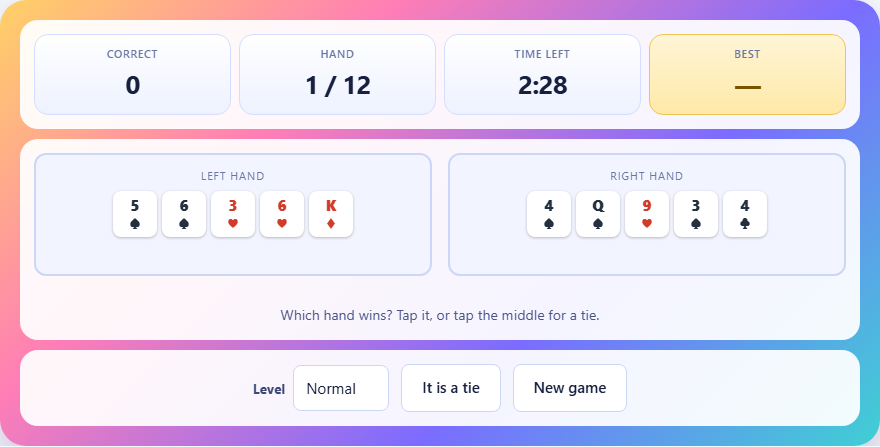
Two hands appear side by side. Tap or click the one you think is stronger. If neither hand is ahead, press the tie button under the board. Each round brings a new pair, and the clock runs from the moment the first hand is dealt. You need seven correct answers out of ten to win on Easy, nine out of twelve on Normal, and ten out of fourteen on Hard.
On Easy, the two hands are often from different categories, so you can usually tell the winner at a glance. You get ten rounds and a hundred and fifty seconds, which is plenty of time to think each one through. On Normal and Hard, the game deliberately deals both hands from the same category. That forces you to work through the tie-breakers rather than spotting the difference instantly. Normal gives you twelve rounds in a hundred and fifty seconds, while Hard raises it to fourteen rounds in a hundred and thirty seconds. Choosing a different level starts a fresh game straight away, and the New game button restarts you at the level already selected.
Speed strategies for reading hands fast
Start by identifying the category, not the individual cards. A quick scan for pairs, sequences, or matching suits tells you the category in a second. If both hands share the same category, then and only then should you look at specific ranks. Checking ranks before you know the category wastes time, because the ranks only matter within the same category.
For two pair, train yourself to look at the higher pair first. Your eye naturally goes to the biggest number, so let it. Compare the bigger pairs, and only if they match, look at the smaller ones. For flushes with no pair, line up the five ranks mentally from highest to lowest and compare from the top. Often the first card that differs decides the hand, so you rarely need to check all five.
Mistakes that cost rounds
The mistake that costs the most rounds is forgetting the two-pair order. Anyone who compares the lower pair first, or who looks at the fifth card before comparing both pairs, will get the answer wrong more often than not. Practise the sequence: higher pair, then lower pair, then the fifth card. Do it in that order every time and it soon becomes automatic.
Another frequent error is assuming that a tie is impossible. Genuine ties happen more often than most people expect, especially on the harder levels where both hands are built from the same category. If you go through the whole comparison and nothing differs, press the tie button with confidence. Hesitating and then guessing one side costs you a round when the honest answer was a tie.
Finally, watch for the ace-low straight. Seeing an ace next to a two, three, four, and five is a five-high straight, not a high hand. Many players see the ace and assume the hand is strong. That mistake is easy to avoid once you are aware of it, but it catches everyone at least once.
A quick way to fix the rank order in your head
Ranks run from the ace at the top down to the two at the bottom: ace, king, queen, jack, ten, nine, eight, seven, six, five, four, three, two. Learning that string by heart takes about a minute, and it pays off on every single round, because each tie-break comes down to which hand holds the higher rank at the first place the two hands differ. Say the list out loud a few times and it sticks.
The comparisons that cause the most trouble are the neighbours: aces against kings, queens against jacks, tens against nines. Those are the moments where your eye has to stop and check rather than glance. On the harder levels both hands come from the same category, so almost every round is settled by one rank against another. Slow down for half a second when two close ranks face each other and you will drop far fewer rounds than the person who simply guesses.
Suits play no part at all. Spades do not beat hearts here, and the order the cards sit in on screen means nothing either, because both hands are sorted before they are compared. Only the category and the ranks count, so a hand that looks scruffy can still be the one that is ahead.
Privacy and how the game runs
The entire game runs inside your browser. The deck is shuffled and both hands are evaluated on your device, and no hands are sent to a server. There is no account, and nothing is uploaded at any point. Your best score is stored in your browser's local storage on this device only, so it will not follow you to a different computer. Once the page has finished loading, you can go offline and the game will keep working without any change.