
Bending a comet through a field of planets
How inverse-square gravity turns a single button press into a curving flight, why aiming at the ring almost never works, and how to read the trail your last shot left behind so the next one arrives.
One input, all physics after that
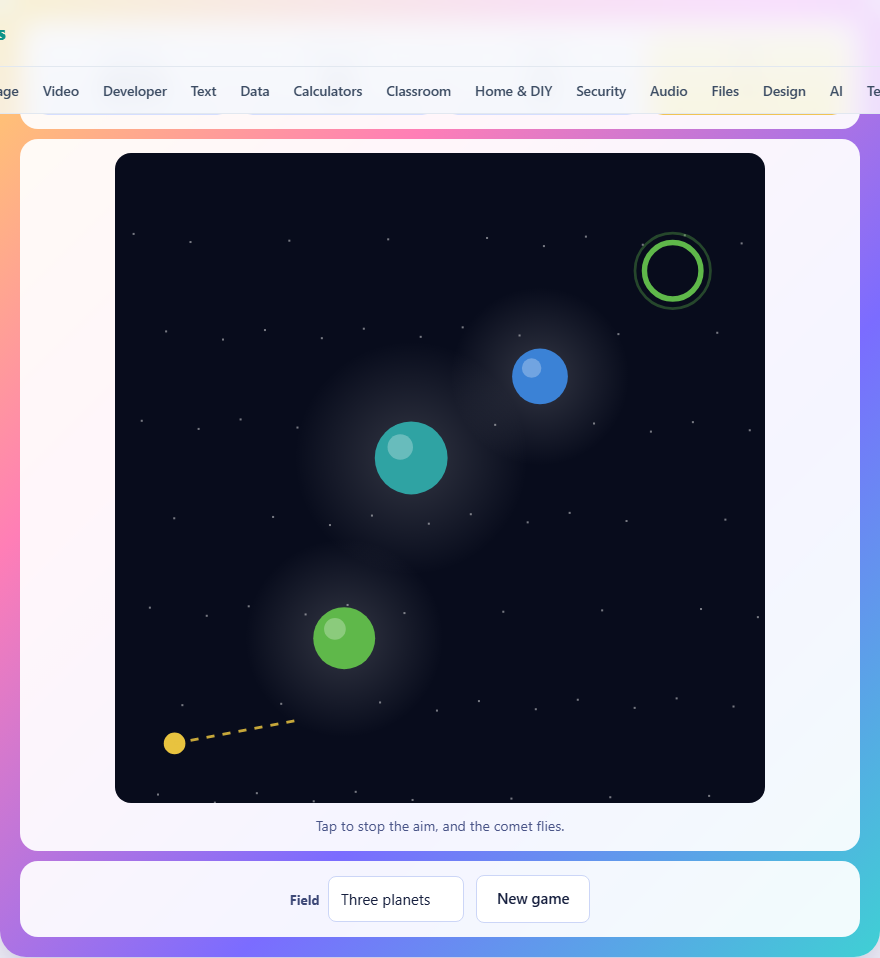
A comet sits in the bottom left corner of the screen. A green ring pulses on the far side. Between them float two, three, or four planets. Your job is to get the comet through the ring.
Here is the catch. You do not steer. A dashed line sweeps up and down from the comet on its own, and you tap the screen or press space to fire at the angle it is pointing when you press. After that the comet flies, and nothing you do can change its path. The planets pull it. Their gravity bends the arc. The shot that reaches the ring is almost never the one aimed straight at it.
The controls and what counts as a hit
On a phone or tablet, tap anywhere on the playing field to fire. On a computer, click the field or press the space bar. That is the only control. There is no second button, no power slider, and no way to adjust the speed. Every shot leaves at the same speed. Only the angle changes.
A hit means the comet touches the green ring. It does not need to pass through the centre. Clipping the edge counts. When you hit, the field rearranges itself with new planet positions and a new ring, and the game continues. Each hit scores one ring. The scoreboard at the top shows how many rings you have hit out of how many you need, and how many shots you have left.
What ends a shot
Four things can end a flight. Hitting the ring is the good one. The other three are failures. If the comet flies off the edge of the field, it is lost in space. If it touches a planet, it burns up. And if it spends too long circling without going anywhere, the game declares it stuck in orbit and moves on.
After a miss you get another shot from the same position, aimed at the same ring. The planets do not move between shots on the same field. That matters, because it means your trail from the last shot is still useful information.
Shots, rings, and the three field sizes
The dropdown next to the field label controls the difficulty. Two planets gives you eight shots to hit three rings. Three planets gives eight shots for four rings. Four planets gives only seven shots for five rings.
The shot count is shared across all rings in a game. If you spend four shots reaching the first ring on the hardest setting, you have only three left for the remaining four. Early accuracy matters more than late accuracy because a wasted shot early costs you everywhere.
When you run out of shots without hitting enough rings, the game ends. It tells you how many rings you reached and suggests aiming wide of a planet rather than at the ring itself. That advice is worth remembering, because it is the core of every successful strategy in this game.
How gravity works in this game
Every planet pulls the comet towards itself at every moment of the flight. The strength of the pull follows the inverse-square law. That means halving the distance between the comet and a planet makes the pull four times as strong. A pass that skims close to a planet bends the path enormously. A pass that stays far away barely curves it at all.
When more than one planet is on the field, the comet feels all of them at the same time. Their pulls add together. A comet passing between two planets gets tugged both ways, and the side it drifts closer to wins. On the four-planet field the interactions become complicated enough that predicting the exact path from the angle alone is nearly impossible. That is what the trail is for.
Reading the trail
Every shot leaves a ribbon on the screen showing the arc the comet actually flew. This trail stays visible until you fire again. It is the most important piece of information the game gives you.
Look at where the trail bends. If it curves hard to the right near a planet and then sails past the ring on the right side, your next shot should aim a little further left. The curve will still pull it right, but not as far. Two or three corrections like this are usually enough to thread the ring.
Pay special attention to where the trail changes direction. That is the point where one planet's pull overcame another's. Moving your aim just a fraction can shift that turning point enough to send the comet along a completely different path. Small changes in the angle produce large changes in the result.
Aim beside a planet, not at the target
The biggest mistake new players make is pointing the aim line straight at the ring. That only works when there is nothing in the way, and there is always something in the way.
Instead, aim so the comet passes close to a planet that sits between you and the ring. The planet's gravity will bend the comet's path towards the ring for you. Think of the planet as a curve in the road. You do not drive at your destination, you drive along the road and the curve takes you there.
On easier fields with two planets, look for the planet that is closest to a line between the comet and the ring. Aim to pass that planet on the side that faces the ring. On harder fields, you may need to use two planets in sequence, letting the first one curve you towards the second and the second one curve you towards the ring.
How close is too close
Each planet has a visible disc surrounded by a faint glow. If the comet touches the disc, it burns up and the shot ends. The glow is a warning zone. Flying inside the glow means the pull is very strong and the comet will turn sharply.
The ideal pass skims just outside the glow. Close enough that gravity does real work, but far enough that the comet does not crash. Finding that line takes practice, and the trail from a crash shows you exactly where the boundary was. A crash that almost worked is actually good news. It means the curve was right and you just need to widen the pass by a tiny amount.
Larger planets pull harder than smaller ones. If two planets are near each other, the bigger one dominates. Plan your route around the large planet first and treat the smaller one as a fine adjustment. On the four-planet field, picking the one or two planets that matter most and ignoring the rest simplifies the problem enormously.
Mistakes that waste shots
- Firing before watching the aim sweep through at least one full cycle. The line swings from steep to shallow and back. If you fire at the first angle you see, you miss the better one that was half a second away.
- Ignoring the trail. Guessing fresh each time burns through shots. Every miss narrows the range of angles that could work, but only if you look at what the last shot did.
- Trying to thread a straight line between planets. The gaps look wide, but gravity does not take breaks. Even a comet that starts on a clean path between two planets gets pulled off course by whichever one it drifts closer to.
- Panic firing when shots are low. Each shot still follows the same physics. Rushing will not make the ring easier to hit. Pause, read the trail, adjust, and fire.
No server, no upload, no account
The physics simulation, the rendering, and your best score all run inside this page on your own machine. Nothing about your game is sent anywhere. There is no login and no data leaves your browser. Your best score sits in local storage so it is still there next time you open the page, but it never travels to a server.
You can test this. Load the page, turn off your network connection, and fire a shot. The comet flies, the planets pull, the trail draws, and the ring registers a hit exactly as before. The server was never part of the game to begin with.